Yearly Archives: 2014

-3unnamed6-1024x379

Do you enjoy Banter?

The celebrated Dublin debate and discussion nights?

Your Xmas has arrived early.

(1) TONIGHT: Banter Review of 2014

An all-star cast of newsmakers and commentators – Panti, Mick Wallace, Louise McSharry and Ann Marie Hourihane – run the rule over the stories and shenanigans, winners and loser, heroes and villians of the last 12 month. Everything from Gaza to Irish Water, Pantigate to Alan Shatter, Ukraine to Malaysian plans, the World Cup to Garth Brooks, Kanye
to Kim will probably feature.

Twisted Pepper (Middle Abbey St., Dublin 1), 6.30pm

Free tickets here

(2) Wednesday: Banter In The Name Of Love

In the Name of Love (see earlier post] is a new oral history which traces the history of the movement for marriage equality in Ireland. Written by Una Mullally and published by The History Press, narrated by those who took a stand, including politicians, activists, artists, drag queens, lobbyists, feminists and those who rocked the boat.
One of the big Irish stories of 2015 is set to be the marriage equality referendum and this book tells the story of how we got from the decriminalising of homosexuality  22 years ago to today’s new brave world. Some of those who contributed to the book will join us at Banter to talk at length about the story so far, what’s to be learned from the various victories and setbacks so far in the path to marriage equality and what lies ahead in the referendum campaign in 2015.

The panel: John Lyons TD, Ailbhe Smyth, Tonie Walsh and Una Mullally

Twisted Pepper (Middle Abbey St., Dublin 1), Wednesday December 10th, 6.30pm

Tickets here

Banter

Fiver

Grab it!

Dave McGeady writes:

That’s a dry five euro note I spotted sitting in a urinal on Friday evening in the rather busy Porterhouse [Parliament Street, Dublin]. Twenty minutes later it was still there. Which leads me to conclude that the recession in Ireland is now over…

terminator_-genisys_official-poster

http://www.youtube.com/watch?v=62E4FJTwSuc

What you may need to know:

1. John Connors’ trusted lieutenant/father Kyle Reese is sent back in time to protect his mother. However, things are not really as they are meant to be as both Skynet and Connors have sent all kinds of Terminators back in time already.

2. Before you start, this is how Genisys is spelt for the sake of the film.

3. The Terminator franchise is in trouble. The Halcyon Company filed for bankruptcy protection and tried to sell the rights for $60-$70 million. The only bid was from Joss Whedon for $10,000. Eventually Pacificor, the hedge fund that pushed Halcyon into bankruptcy in the first place, made a deal for $29.5 million and set about selling off the various bits of the franchise.

4. Arnold Schwarzenegger is showing all of his 67 years. The T-800 is clearly an human-like aging model. He totally redeems himself by landing a Harley on top of a moving train and turning himself in to a stinger missile in the trailer though.

5. They got Nike to remake the ‘Vandal’ trainers that Kyle Reese wore in the 1984 original. Very important?

6. James Cameron was approached to make this film but is too busy spending his Titanic (1997) wealth on Blue Star Wars (2009). He did however have a number of meetings with producers to discuss Arnold’s role and the film’s story lines. His two Terminators were very good.

7. Terminator: Genisys is the first part of another new trilogy. Terminator Salvation (2009) was also meant to kick off it’s own trilogy but Skynet went back in time and made it rubbish.

8. Broadsheet Prognosis: Please don’t come back

Release Date: July 3 2015

Una-MullallySmaller-269x300

Una Mullally

I’ve written a history book. It’s called In the Name of Love, and it launches tomorrow evening. It’s an oral history about a social movement, the movement for marriage equality in Ireland. In this book are over 70 interviews – ministers, journalists, activists, academics – pieced together to document the legislative and social change that has occurred in Ireland in relation to rights for gay people.

I’ve spent two years working on it and I’m very proud of it. Now comes the time to talk about it. In light of these two BAI rulings, that’s the tricky bit. I have been told by national radio stations that in order to discuss this history book, there must be someone present who opposes rights for gay people. These are not editorial decisions. They are instructions from above. The utterly normal issue of civil marriage is being treated hysterically, and stations can’t risk getting another black mark from the BAI.

BAI ruling on marriage equality comments stifles ongoing debate (Una Mullally, Irish Times)

Pic: Imeall

Update:

Via the Broadcasting Authority of Ireland:

The BAI has, at no time in its engagements with broadcasters, issued any direction requiring that broadcasters must automatically “balance” a discussion with an opposing view. Neither has the BAI, at any stage, made a “ruling on marriage equality”.
News and current affairs content on Irish broadcast media is required to comply with the Broadcasting Act 2009 and with the BAl’s Code of Fairness, Objectivity and Impartiality in News and Current Affairs. In setting out its guidance on the principle of fairness, the BAI has indicated to broadcasters that it will be necessary for them to consider the range of ways in which fairness is achieved, including through the selection of contributors, the time allocated to a news and current affairs issue, the scope of the debate, the structure of the programme or the role of the presenter.
Furthermore, the approach to covering issues, including those of public controversy or current public debate, should be guided by ensuring equitable, proportionate coverage. While there may be some instances where balance may be required, an automatic requirement for balance is considered unnecessary and inappropriate by the BAI. Indeed the BAI has consistently expressed the view that the application of such an artificial balance can, in and of itself, amount to a lack of fairness in certain circumstances.
Against this backdrop, it would be a matter of grave concern to the BAI if “national radio stations” or any other broadcasters, incorrectly used the outcomes of recent complaint decisions as a basis for their editorial decision-making.

BAI Comment in Respect of Issues Raised by Una Mullally (BAI)

s_k01_52987839 s_k09_52987561s_k13_52987733 s_k20_52987969 s_k17_05015695s_k10_52988739
Scenes from last year’s Krampusnacht at Neustift im Stubaital in Austria.

On the eve of St Nicholas’ Day (the 6th of December) drink-fuelled revellers dress up as the fearsome horned demon Krampus, shaking their cow-bell belts and running around scaring children to remind them what happens when they’re naughty at Christmas.

You’ve been warned.

MORE: Krampus: St Nicholas’ Dark Companion (The Atlantic)

Screen Shot 2014-12-08 at 12.36.54
Denis O’Brien, who has a 29.9% stake in Independent News and Media and who owns the Communicorp radio group

Draft Government guidelines on media ownership are to be released by Communications Minister Alex White later today.

It follows the Broadcasting Authority of Ireland determining, in  July 2012, that Denis O’Brien does not own Independent News and Media but, rather, that he has a ‘substantial interest’ in the company.

Ahead of this, Fiach Kelly, in the Irish Times, reports:

New Government guidelines on media mergers say it is “undesirable” for one person or business to hold excessive influence and introduce a “public value” test for future consolidation in the industry.

The draft guidelines, which will apply across print, broadcast and online, also set out thresholds that specify how many shares or holdings are needed to be able to influence the “direction or policy … with regard to news, current affairs or cultural content”.

They say that “a holding or voting strength of more than 20 per cent … will generally constitute a significant interest”, while a 10 per cent share could also constitute a “significant interest”.

There you go, now.

‘Public value’ test to be introduced for media ownership (Fiach Kelly, Irish Times)

Related: Shadow of Denis O’Brien looms over new media merger guidelines (Fiach Kelly, Irish Times)

Previously: Denis O’Brien’s Editorial Interference: The Smoking Gun

Well, That’s A Relief

Screen Shot 2014-12-08 at 12.03.35

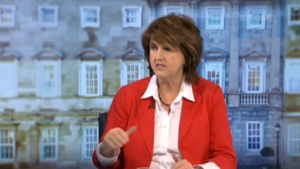
Last night, on RTÉ’s The Week In Politics,  Tánaiste Joan Burton, above, was asked about the possibility of junior bondholders in the former Anglo Irish Bank being repaid from the liquidation of IBRC.

She said:

“It is completely unlikely to happen because in the queue before the junior bondholders are the Irish people.”

Her comments came after Finance Minister Michael Noonan made comments about repaying junior bondholders in the Dáil last week.

Following Ms Burton’s comments last night, Brian Lucey, professor of finance at Trinity College Dublin, spoke on Morning Ireland this morning about the situation.

Gavin Jennings: “Brian Lucey, good morning, who are junior bondholders? Why would they be paid? And how much could they expect to be paid?”

Brian Lucey: “They can expect to be paid around €280 million. These are people who would have put capital into Anglo Irish Bank in return for a high yield. And because of that high yield, the accepting risk and that risk would be that the bank might fail. And, guess what, the bank failed. The reason they might think they might get paid now is because the economy is picking up and particularly property prices are picking up and they do have a claim under liquidation law, under the companies and bankruptcy laws, as they stand at the moment, they have a claim if, after everybody else is paid off, there’s money left in the pot, then they will get it. Joan Burton is a little bit loose with her language there. The implication people here is, ‘oh, once again, €35billion back, we’ll get it, they might get something’. The reality is the State can only recoup a maximum of €1.1billion which is fees outstanding as part of the guarantee system, that Anglo Irish Bank didn’t pay. So there’s an issue here. The reality is most of the people involved here are not the credit unions, the pension funds, etc, that had money with Anglo Irish Bank in this junior debt, they’re people, they were sold because they couldn’t hold on to it, they were junk bonds. They were bought up by vulture capitalists who are now expecting, having paid 2c, 3c, 5c, 10c on the Euro to get 100c back.”

Jennings: “So these are people who wouldn’t initially have been bondholders in Anglo?”

Lucey: “No.”

Jennings: “They would only have become so in the last couple of years, yes?”

Lucey: “Yes.”

Jennings: “Now when Joan Burton says that the people of Ireland come ahead of junior bondholders, is that true in terms of..”

Speak over each other

Lucey: “…except of €1billion that Anglo owes us. The €35billion is not going to be recouped. In fact we’re continuing to burn €25billion for Anglo over the next 20 years and that’s a greater immorality  than this €280million. €280million is two thirds of the total stand planned for next year for capital in the health system – in other words building hospitals. [Finance Minister] Michael Noonan should have stood up, in my opinion, and said, ‘Under absolutely no circumstances, whatsoever,  will a penny ever be paid out to these people’.

Jennings: “But what he did explain in the Dáil last week was, and you might be able to parse this for us, that the sale of loans assets so far has gone – I’m paraphrasing here – better than expected. So that all the people who were owed money would be written to, there would be ads put out, a deadline put and anybody, essentially, who was entitled to their money back, who wanted their money back would get their money back.”

Lucey: “That is what he said but I think that it’s economically unwise, politically foolish and morally reprehensible for these people.”

Jennings: “But there’s no precedent of us having done otherwise, so far?”

Lucey: “Well of course there isn’t – this government has been buckling all along under the mildest pressure from Anglo or people related to Anglo and, you know, it flabbergasts me and I think others that they would even contemplate this as opposed to saying, ‘get up the yard’.”

Jennings: “But without a precedent so far, why would they change their minds now?”

Lucey: “Well they won’t, so they’ll do this if they have to, if they think they have to. They could walk into the Dáil tomorrow and they could change the bankruptcy and liquidation laws. It might be that people would then, in the fullness of time, take a legal case against the State. The State should defend that to the hilt. They should run this clock out as long as is necessary. The State’s resources are ultimately, infinitely greater than anybody who bought these bonds at 7c on the Euro and who are now trying to get 100c back. And they should not ever pay these people. It is, fundamentally, it’s not an economic issue for me, it’s a moral issue.”

Jennings: “There’s also a legal issue though isn’t there…”

Talk over each other

Jennings: “But Michael Noonan pointed out in the Dáil last week, a high court case taken in Britain over two years ago which I think involved a similar case of essentially bondholders looking for their money back when they were entitled to..he pointed this out in the Dáil last week, right?”

Lucey: “He’s technically correct, which is the best kind of correct when you want to do something unpopular. Look, we are a sovereign nation and we can make a decision to do pretty much anything we like. People can then take legal action, if they wish, and in the fullness of time, the Irish and the  European courts say you must pay this, if that’s 20, 30, 40, 50 years down the line then that’s fine. But it would be incomprehensible that in the time, when last night, when people were sleeping in sub-zero temperatures on the cities and towns of this country, that we would think of doing anything like this. It’s not an economic issue, it’s not a legal issue for me, as a citizen of this state, it’s a moral issue and we should, as citizens, take a moral perspective. Economics and finance got us into trouble and got the rest of the world into trouble because we lost sight of the fact that it’s a moral issue. Adam Smith, the founder of modern economics, was not just an economist, he was a moral philosopher.”

Listen back in full here

The Week In Politics (RTE)