



Yearly Archives: 2016


CEO OF Irish Mortgage Holders David Hall, Independents 4 Change TD Joan Collins, and Social Democrats TD Catherine Murphy outside the Four Courts in Dublin this morning
Further to Independents 4 Change TD Joan Collins’ Supreme Court appeal against the constitutionality of the €31 billion promissory note [to pay Anglo, Irish Nationwide Building Society and Educational Building Society over 15 years from 2010]….
Supreme Court has reserved judgment on TD Joan Collins’ challenge to issuing of 31 billion promissory notes.
— Mary Carolan (@MaryCarolanIT) April 5, 2016
A reserved judgement means the court will review the details of the case and provide a written verdict at an unspecified future date.
Pic: Fiona Fitzpatrick

Contemporary tykes watch vintage Irish TV Shows for the first time, specifically Glenroe, Bosco and The Den, with bewildering consequences

From top: Historian Niamh Puirseil; director of the Iona Institute David Quinn; senior reporter with Today FM Juliette Gash; John Devitt, of Transparency International Ireland; and Irish Independent columnist Colette Browne
Last night, on Tonight with Vincent Browne, the panel spoke about the so-called Panama Papers – a leak of 11.5 million documents, involving nearly 215,000 companies and 14,153 clients, from the database of the world’s fourth biggest offshore law firm, Mossack Fonseca in Panama.
The papers show how some world leaders, politicians and high-profile figures have been able to hide large stashes of money.
Yesterday, Colm Keena in the Irish Times, reported that former Fine Gael director of elections and strategist Frank Flannery featured in the papers, in relation to the purchase of a house in London, in the 1990s.
Mr Flannery has said no offshore company was involved in the sale.
Grab a tay.
John Devitt: “It should be pointed that out: Panama isn’t the only secrecy jurisdiction or financial centre that can be used to facilitate these corrupt and criminal transactions. Dublin has also been at the centre of some controversy in the past and the use of complex financial instruments such as hedge funds have come under some scrutiny recently. So the IFSC has served and is believed to have served as a vehicle through which dirty money has been laundered.”
Vincent Browne: “What’s the evidence for that?”
Devitt: “Well we know for example, most recently, that the family of Sani Abacha, a former Nigerian dictator, were…”
Vincent Browne: “Say that name again and say it very clearly because…”
Devitt: “Sani Abacha. He’s a former…”
Vincent Browne: “Ok..I thought it might be confused with a name of a senator here who’s certainly isn’t engaged in…”
Devitt: “The point is that he was, or his family, he’s now deceased but his family was subject to proceeds of crime action by the UK authorities and they sought the assistance of the Criminal Assets Bureau here to locate the Abacha or one of the members of the Abacha family so that they could retrieve money that was believed to have been laundered in Irish banks. There are also cases involving the use of Irish insurance companies, going back to 2006, if not earlier, that earned Ireland the tag as the ‘wild west of European finance’. There were re-insurance deals involving a company based in the IFSC that facilitated a $500million fraud. Much of this was going on without any scrutiny.”
Vincent Browne: “We’ve been assisting mega corporations to avoid tax on a massive level for years and years and it’s part of what we are. It’s our selling card.”
Devitt: “Ireland’s reputation as a lightly regulated economy was a calling card for the government for a number of years and still is to a large degree. While regulation might have been tightened up since the banking crisis, Ireland is still not considered to be one of the most stringently regulated financial centres in Europe. There are moves being made to tighten it up somewhat and we’ve made, we know that shelf companies have been outlawed since the introduction of the new Companies Act.”
Vincent Browne: “Colette, you’ve been reading about this.”
Colette Browne: “Yeah, I have and it’s very interesting. There’s 11 million documents – 2.5 terabytes of data, so it’s an absolutely huge file. And it’s been revealed that 58 relatives and friends of kinds, prime ministers and presidents all around the world who are involved in this – so stashing money in these offshore accounts. So, as per usual, it’s people in positions of authority recommending cuts for the little people while they solve their money away in these bank accounts in secrecy and pile up these massive wads of cash. Now Richard Bruton today came out and said that if there was any Irish people that were engaged in any illegality, I think his exact words: ‘you can be absolutely sure that tax evaders will be vigorously pursued’. And I was doing a story recently on white collar crime and what I found out was quite shocking. That the Office of Director of Corporate Enforcement hasn’t had a forensic accountant employed for a year. So between March last year and March this year. In 2004 the Director of the Office of Director of Corporate Enforcement said that the agency wouldn’t be credible unless it had more, it had one forensic accountant at the time. Last year, in its annual report, it was given permission to hire six additional forensic accountants so that it could go after large scale white collar crime in this country. Instead it has zero forensic accountants, so we’re talking about a country which experienced the biggest financial crash in the history of the world and we have our prime regulatory body, which is supposed to investigate white collar crime, which didn’t have a forensic accountant for the last year. Now Remy Farrell is a senior counsel, who prosecutes these types of crimes, and he was speaking about this in 2004, or 2014 rather and he said that Ireland at the time was like a tinpot dictatorship because it had only one forensic accountant in this body. For the last year, we’ve had no forensic accountant.”
Devitt: “It’s not just the ODCE, mind you, that is short of resources. The Criminal Assets Bureau, the GBFI, the Garda Bureau for Fraud Investigation are grossly under resourced and I’m not sure that’s by accident. I think there’s been a policy going back a number of years now to turn a blind eye to this kind of crime.”
Colette Browne: “But to have politicians come out and say that these people will be vigorously pursued and then to have the State’s main regulatory body, which is supposed to pursue these people, without having the technical expertise to go after them I mean, it’s actually a joke.”
Watch back in full here

It seems that our beaches are full,
Of faeces that comes from the gull,
I’m all in a flap,
About taking their crap,
And I reckon it’s time for a cull.
John Moynes
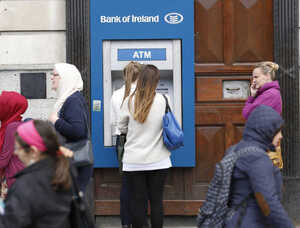
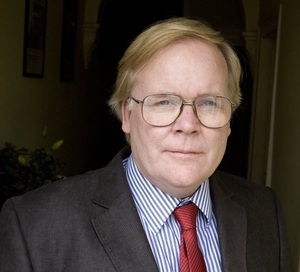
From top: College Green, Dublin 2; Michael Taft
What is the real story with Irish wages?
Michael Taft writes:
With all the talk about industrial action and wage claims and wage offers and summer of discontent, etc. etc. etc. it is worth taking a step back and to look at the big picture.
Are Irish workers paid too much in comparison with other EU-15 countries?
A blog written by the Director of the Nevin Economic Research Institute, Dr. Tom Healy, looks at the adjusted wage share in the economy. That’s one way of measuring wages – and it shows Ireland performing pretty badly in comparison.
Here I am going to approach this issue by quantifying the proportion of the economy that goes on wages. But whenever you go down this route you are faced with a big question.
Do we use GDP which is inflated by multi-national profits which are not generated here but are imported to take advantage of our corporate tax regime?
Do we use GNP even though this is also inadequate as it excludes actual productive activity? Or do we use the Irish Fiscal Advisory Council’s hybrid-GDP which attempts to measure our actual economic or fiscal capacity?
Let’s take a cautious, conservative approach and use GNP. In terms of EU comparisons this means using Gross National Income (GNI) which is essentially GNP including payments from the EU (CAP funding, etc.).
When we do this we find Irish workers, collectively, are paid a small percentage relative to workers in other EU countries.
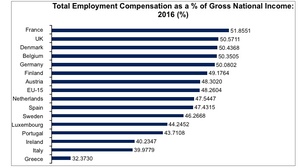
The EU Commission’s AMECO database estimates for 2016 finds that Irish employee compensation is near the bottom of the EU-15 table.
Employee compensation combines both wages and employer social insurance contributions; this is the standard measurement of wages and, as such, can be taken as a very close proxy to ‘labour costs’.
Throughout the EU-15, wages make up 48 percent of GNI. In Ireland compensation makes up only 40 percent – equal to Italy and ahead of lowly Greece (if we used GDP or the Fiscal Council’s hybrid-GDP, the percentage would be even lower).
What would happen if Irish wages rose to the average EU-15 level?
Total wages would rise by €15.4 billion, or 20 percent more than today.
That is the equivalent of €9,400 per Irish employee.
Of course, economies and wages are never so simple; therefore, you can’t run a slide-rule over gross numbers and extrapolate an optimal wage figure.
Much depends on the bargaining power of workers vis-à-vis employers, the position in the business cycle, the sectoral structure of the economy (high-tech? medium-tech?), compositional effect, productivity levels, etc.
However, we can’t get away from the fact that Irish wages take up far less of Gross National Income than in almost all other EU-15 countries.
This is not a recent phenomenon.
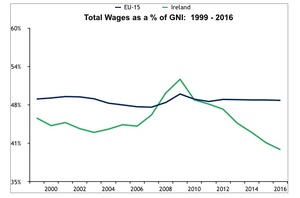
Prior to the crash Irish wages remained well below the EU-15 average. The spike in at the beginning of the crisis doesn’t mean that Irish wages rose. In 2009, they fell by 9 percent and, again in 2010 by 7 percent. The reason wages increase in the graph is because GNI fell even faster – by 13 percent in 2009.
However, by 2011 normal business was restored and since then Irish wages have fallen by 8 percentage points.
One may dispute the legitimacy of a particular wage claim or wage offer. But when you step back and look at the broad landscape – just as Dr. Healy did – one can’t avoid the conclusion that Irish workers are not well paid in comparison with other European workers; at least not in terms of the proportion of the wealth that they generate.
Michael Taft is Research Officer with Unite the Union. His column appears here every Tuesday. He is author of the political economy blog, Unite’s Notes on the Front. Follow Michael on Twitter: @notesonthefront

The birds, the bees, the beer and the bra.
Are Ya Having That writes:
After 900 years of research ‘LeatherJacketGuy’ tells us some of the Craziest Facts About Women!

Cian Nugent – Things Don’t Change That Fast
What you may need to know…
1. Finding his voice on third full-length Night Fiction, Dublin guitarist and composer Cian Nugent taps into his long-running appreciation for ’60s and ’70s singer-songwriters and the blues after stints with instrumental experimentation and psychedelia, both as a soloist and with accompaniment from his band The Cosmos.
2. Streaming above is Things Don’t Change That Fast, a moody, pensive rumination taken from the aforementioned long-player, released this past January.
3. A man of eclectic influences to say to least, from the aforementioned singer-songwriter oeuvre, to surf-rock, to jazz, Nugent has made a playlist for The Thin Air with some of the tracks he’s used as reference points on the new record.
4. Nugent plays Cobh’s Sirius Arts Centre on May 7, while their next Dublin show is Whelan’s on May 12, sharing a bill with Canadians Nap Eyes.
Verdict: Having been one of the most forward-thinking people in Irish music the past few years, Nugent has really come into his own on the new LP. Not all who wander (creatively or thematically) are lost.


The Champagne Gun, available in gold, chrome and rose gold – a mere €403 apiece from King of Sparklers.
Your little friend, when the time comes.