



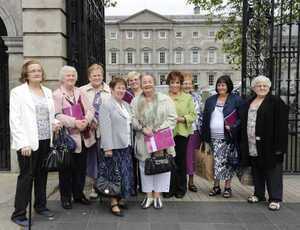

From top: report by Judge Maureen Harding Clark on the ex gratia payment scheme for women who had symphysiotomies; members of the Survivors of Symphysiotomy campaign group in June 2012; and Judge Harding Clark
In 2014, the then Minister for Health Leo Varadkar commissioned Judge Maureen Harding Clark to review the Government’s ex gratia payment scheme for women who have had symphysiotomies.
Judge Harding Clark’s 274-page report was published yesterday.
The scheme involved three levels of compensation for the women who had undergone the procedure:
Category 1A: symphysiotomy only, €50,000
Category 1B: symphysiotomy with significant disability as defined in the scheme (where medically verified physical symptoms or conditions were directly attributable to symphysiotomy and which had lasted for more than three years) €100,000
Category 1C: a particular form of symphysiotomy, with or without significant disability €100,000 – €150,000
Category P1 and P2: pubiotomy, with or without significant disability, €100,000 – €150,000
According to the terms of the scheme, pubiotomy was defined as “[involving] the sawing through of the pubic bones while symphysiotomy involves cutting through soft fibrous cartilage and does not involve bone or the use of a saw”.
Women who wished to apply for compensation could do so between November 10, 2014 and December 5, 2014 – yielding almost 600 applications (with some being made outside this time-frame) while the State expected fewer than 350.
In the end, the following payments and conclusions were made:
185 were declared ineligible for the scheme.
Symphysiotomy was established in 403 cases (60 of which involved symphysiotomy to release the after-coming head in breech deliveries and for shoulder dystocia) and pubiotomy in 1 case – with 399 women receiving awards.
216 women received €50,000
168 received €100,000
15 received €150,000
In addition:
4 women died before any offer was made
1 woman rejected the offer to continue her action through litigation
1 woman died before the offer that was notified to her could be accepted.
From the report:
“A great deal of adverse publicity surrounds the subject of symphysiotomy in Ireland. The Scheme was therefore premised on the widespread assumption that symphysiotomy was a surgical procedure which as a matter of near certainty, created lifelong suffering.
It was generally asserted that Irish obstetricians were motivated by Catholic teaching on
contraception rather than by obstetric need and that they were alone in the English-speaking world in performing symphysiotomy during the 1940s until the late 1960s.The terms of the Surgical Symphysiotomy Payment Scheme reflected those widespread perceptions and provided for payment once a surgical symphysiotomy was proved, no matter why the surgery was performed.
…No general pattern of immediate or developmental injury was seen. The evidence did not confirm that symphysiotomy inevitably leads to lifelong pain or disability or those symphysiotomy patients aged in a manner whichwas different to those of non-symphysiotomy women.
The majority of applicants who underwent symphysiotomy made a good recovery and went on to have normal pregnancies and deliveries and to lead a full life. Most applicants had at least 4 normal deliveries after the symphysiotomy.
A small number of applicants suffered from pelvic pain and a slightly larger group from urinary issues. Whether the conditions were associated with prolonged labour, the use of forceps, parity or the symphysiotomy procedure or a combination of all three was not possible at this remove to determine. It was noted that many symphysiotomy procedures were carried out after a ‘failed forceps’.
…Five applicants had a documented history of incontinence associated with the symphysiotomy birth. They had suffered bladder/urethral damage or fistula at the time of symphysiotomy. The injury was identified within hours of the symphysiotomy and repaired at the first opportunity. All five applicants were thereafter predisposed to urinary tract infections and in one case, continuing incontinence.
Pain and/or discomfort over the pubic joint during intimate relations in the first 12 months post symphysiotomy was a very common complaint. However, the vast majority of applicants became pregnant within a year of the symphysiotomy. Several applicants claimed that the symphysiotomy caused cessation of all sexual relations and the end of their reproduction. A small number claimed that their reluctance to engage in sexual intercourse led to marriage breakdown.
In many cases, applicants had seen the word episiotomy on their records and had equated that with symphysiotomy. 23 other claims involved spontaneous symphysiotomy. The rest of the claims involved incorrect assumptions that
…Many applicants who did not undergo symphysiotomy provided statements of fairly harrowing memories of the operation and how their lives had been ruined, how they were unable to walk or take care of their babies, that they were incontinent, suffered prolapse of pelvic organs and had never recovered to this day.
Much more concerning was that their claims of disability were supported by medical opinion. I believe that prolonged and exhausting labour (common until the concept of managed labour was advocated in the late 1960s by Dr. Kieran O’Driscoll at the NMH) and especially, if the delivery was by forceps was attributed to symphysiotomy.
Such confabulation is understandable in the context of a difficult delivery many decades previously. Fear, pain, narcotic analgesia, exhaustion and dehydration can all contribute to confusion and memory blanks. It is therefore probable that hearing the testimony of others led many applicants who did not undergo symphysiotomy to acquire false memories and to fill in the blanks
On the Catholic Church:
…Very detailed and forensic examination of available contemporaneous medical records failed to find evidence of a religious as opposed to an obstetric reason when a symphysiotomy operation was performed.
“It was introduced to permanently enlarge a narrow pelvis and thus avoid unnecessary repeat caesarean section deliveries in a country where contraception was not countenanced by the Catholic population and was in any event illegal and unavailable.”
“The evidence is that sterilisation was not performed in any of the Dublin Maternity Hospitals at that time even though the procedure was not proscribed by law as with the case of contraception. The medical indication for symphysiotomy was always provided.”
On the media:
It is obvious that the rarity of symphysiotomy means that few GPs know anything of the procedure apart from from media reports. This sometimes emotional and sensational reporting has led many highly competent doctors to believe that once a symphysiotomy is performed, pelvic instability, pain and urinary incontinence follow as a matter of course.
This probably explains why the reporting of a patient’s condition and complaints changed once the possibility of symphysiotomy was raised. So little is known, as opposed to perceived, about the sequelae of symphysiotomy that on a number of occasions, I was reprimanded by an applicant’s doctor for reporting that a radiology report received in his patient’s case indicated a completely a [sic] realigned pubic joint. This it was declared was an impossibility and a reflection of my ignorance.
… Examination of records found that 30% of applicants did not undergo symphysiotomy at all and most applicants did not suffer medically verified injury which accorded either with media reports or with their narratives. This overall finding is reflected in the number of applicants (30%) who underwent symphysiotomy but did not claim any disability. My own expectation at the commencement of the Scheme that most applicants would be able to identify and establish their significant disability was not confirmed.
…After much thought, I concluded that it is very probable that the combination of a traumatic birth experience and exposure to other women’s stories has created a self convincing confabulation of personal history. Another inference is that the possibility of financial payment has influenced suggestible women and their family members into self- serving adoption and embracing of the experiences described by others or in the media and created psychosomatic conditions.
…As previously mentioned, the history of symphysiotomy in Ireland was very fully explored by Professor [Oonagh] Walsh. To a great extent, her scholarly report has been ignored by sections of the media who appear to prefer the more lurid and unfounded accounts projected by some activists and bloggers. I am therefore not sanguine that there will be any change in the manner of reporting of the subject.
On conspiracy theories:
Very considerable efforts were taken to thoroughly and fairly examine all applications. Particular difficulties arose in a number of cases where the applicants were firmly convinced that they had undergone either symphysiotomy or pubiotomy and were unwilling to accept the truth of the content of their medical records. Conspiracy theories were not uncommon. Usually the issue was set to rest following gynaecological and radiology examination; sometimes several such examinations were necessary.
Thud.
Meanwhile…
We just want to thank everyone who continue to support us in the face of dreadful propaganda from State and its creatures #Symphysiotomy
— Symphysiotomy (SoS) (@SoS_Ireland) November 23, 2016
Read the report in full here
Related: Symphysiotomy: the whitewash that never was (Paul Cullen, Irish Times)
Previously: ‘Happy To Shred’
Meanwhile….
‘I want to reiterate that this was a maternity unit that was to some extent caught in a time warp. There was no badness or cover up.”
Judge Maureen Harding Clark at the end of her 2006 inquiry into events at the maternity unit in Our Lady of Lourdes Hospital, Drogheda, where Dr Michael Neary removed the wombs of 129 women over 25 years, a rate that was 20 times the national average.
Good times.


