
Yearly Archives: 2016

‘sup?

How would your pet vote given the opportunity?

Your pet and its voting intentions to broadsheet@broadsheet.ie marked ‘My Pet Votes____________’

000a0c9b-642 Mazars-logo

From top: RTÉ Investigations Unit; auditors Mazars

On December 17, 2014, journalist Ken Foxe sought from the Houses of the Oireachtas, under FOI, copies of invoices and receipts submitted by 22 TDs and Senators.

Every year the expense claims of 10% of national politicians are randomly audited by Mazars.

It was these politicians Mr Foxe was focusing on for an RTÉ Investigations Unit project, called No Expenses Spared.

On January 16, 2015, this request was refused with the Oireachtas claiming it never physically held the records. It claimed the records passed from the politicians to Mazars.

On February 9, 2015, Mr Foxe sought an internal review of this refusal.

But, on February 25, 2015, the Oireachtas again refused claiming, under section 42(l) of the FOI Act, that the records Mr Foxe was seeking were considered to be the politicians’ ‘private papers’.

Further to this, Mr Foxe, who lectures at the Dublin Institute of Technology, writes:

That seemed to me to open the door to their release. It seemed clear to me that the Oireachtas were no longer relying as strongly on the idea that they did not hold the records – when the invoices and receipts were so clearly in possession of a contractor that they had employed.

Equally, the idea that the “private papers” argument could really apply to invoices and receipts that had been issued from local newspapers, or other such businesses, seemed a stretch.

Similar material has, as we know, been routinely released under FOI in the past in Ireland, and of course in the United Kingdom.

Solicitor Fred Logue – who worked closely with Gavin Sheridan on a number of high-profile cases over NAMA and the ECB – helped me in putting together a new appeal, this time made to the Information Commissioner.

The case, at least to me, seemed open and shut.

However.

One of the very first big decisions made by the Information Commissioner [in 1999] in a case involving Richard Oakley, now of the Times Ireland, had covered some very similar terrain.

In that case, then Commissioner Kevin Murphy said that he could not accept that expenses of members could come within the term “private papers of its [Oireachtas] members”.

I will let the new Information Commissioner Peter Tyndall come in here with his decision:

“Against this background, it would seem reasonable to conclude that receipts and invoices for expenses incurred by [Oireachtas] members in the course of the performance of their functions would not ordinarily be considered to be private papers of the members. However ….”

That turned into a big however.

Mr Tyndall said that under the Houses of the Oireachtas (Inquiries, Privileges, and Procedures) Act 2013 – these invoices and receipts were clearly “private papers”.

He explained the inconsistency with the decision that had been made by his predecessor Mr Murphy about political expenses by pointing out that the new FOI Act 2014 – in particular Section 42(l) – contained new provisions.

“It is quite broad in nature,” Mr Tyndall said, “and affords a more significant protection for private papers of members of the Houses than previously existed.”

Quick aside – there is only one group of people who can benefit from this new and “significant protection”.

Mr Tyndall continued to say that it could be argued that this “broad protection” was “inconsistent” with requirements of public bodies to achieve greater openness, strengthen accountability, and so on.

He concluded:

“Nevertheless, while it might be expected that information relating to expenses of members of the Oireachtas should be fully transparent and subject to public scrutiny under FOI, I must have regard to the prevailing legislation at the time of my decision.”

The decision to refuse access for me – and the broader public – to even a selection of the expense claims of our elected TDs and Senators was upheld.

By the way, this is the expenses system, which we are repeatedly told is “fully vouched”.

Two questions:

Who benefits from this arrangement?

Answer: About 166 TDs and 60 Senators.

More importantly though, who introduced this significant extra protection for politicians (already benefitting from an incredibly opaque and non-transparent expenses system) when the FOI Act was being drafted?

Answer:
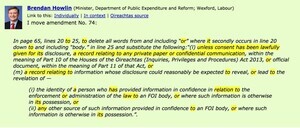
howlin

Read the decision in full here

New FOI Act added “significant protection” from scrutiny for expense claims by TDs and Senators (No Expenses Spared)

Freedom of Information Act 2014

Thanks Kildarestreet.com

fgpostersfgposters2

Oh.

This afternoon

Puca writes:

Rival FG candidates (and colour schemes). Londonbridge Road, Dublin Forrrre.,…

Meanwhile…

CaYau5-W4AAODPx

YIKES!

Harry Byrnes Clontarf writes:

[Labour’s] Aodhan O Riordain is freaking us out looking in at us today!!

CaYIPTiWwAAk9au

This afternoon.

Buswells Hotel on Molesworth Street, Dublin 2.

The launch of the Anti Austerity Alliance/People Before Profit (AAA/PBP) General Election 2016 ‘common principles’. To wit:

A new type of politics, based on people power
Real recovery for 99% means challenging rule of 1% – Apple should pay back taxes, establish minimum effective corporation tax rate of 12.5%, introduce Millionaire’s Tax and establish debt audit commission
Public investment to develop quality services & infrastructure, strategic enterprise and create decent jobs
Scrap austerity taxes and reverse austerity cuts
Fight for equality – repeal the 8th amendment, end discrimination by schools, separate church and state…

Fight, etc.

Top from left: Brid Smith Richard Boyd-Barrett, unidentified  Ruth Coppinger, John Lyons and Paul Murphy.

AAA-PBP Launches ‘Common Principles: Radical Alternatives & Real Equality’ (Anto Austerity Alliance)

Pic: Mark Coughlan

Crickhowelldan

From top: The ‘fair tax town’ of Crickhowell, South Wales; Dan Boyle

Robin Hood,  the Double Irish and level playing fields.

Let’s talk about tax.

Dan Boyle writes:

Last week my itinerary took me to a picturesque small town/large village, Crickhowell, in south eastern part of Wales. Going around this country I get to see many pretty villages. I had come to Crickhowell to learn about its recent brush with notoriety.

Local businesses had come together to examine how collectively they could become a legal entity to avoid paying Corporation Tax, as multi national corporations have succeeded in doing for decades.

It is an idea simple in its inception yet so brilliant in its potential. This self styled Fair Tax Town can, and I believe will, become a beacon for a wider Fair Tax movement.

As someone Irish witnessing this phenomenon I can’t help but to admit some slight feelings of ambivalence.

Over the years, at Green meetings in Europe, I had always argued that Ireland needs to be considered a special case. An island nation at the periphery of Europe, a creative corporate tax policy was our attempt to counter the competitive disadvantage of not being part of the European land mass, in having lower distribution costs by being closer to the largest population centres.

And I believed it. In the way that many of us come to believe in the myth of Irish exceptionalism.

Being a World leader in the practice of tax tourism, Ireland could create a short cut in manufacturing national wealth figures that held as little depth as the paper on which they were written.

Many corporations now have Ireland as their mailing address. Their presence isn’t without some advantages. Access to certain industries have become fast tracked, new skills and technologies have been acquired in larger numbers.

And yet there could have been, and may yet be, a better type of industrial policy for Ireland. One that takes longer to bear fruit in terms of tax receipts but would be more sustainable, more rooted in our infrastructure, more capable of withstanding the whims of the global economy.

Here’s an idea. Let’s use the taxation system to develop a distinction between the types of corporations that exist from those who physically make things to those trade in services. Exempt those who make things. They build up our manufacturing capacity. Tax service industries who by their nature are ephemeral.

This is where a Robin Hood Tax could come into play. Designed as a tax on financial transactions, it could just as easily be applied to trade in intellectual properties. Of course it would need to be international in its application.

The OECD is at present engaged in an exercise seeking to bring about a level playing field in relation to corporation tax. It’s a fruitless exercise. The mobility of capital makes it impossible to secure the tax liability of multi national corporations. Their liability can only be enforced through an international mechanism.

In phasing out out the Double Irish tax loophole, Ireland is starting slowly to move away from its reputation as a tax tourism locale. Our reputation could be better improved if we were to contribute to an honest international debate on fair tax.

Dan Boyle is former Green Party TD. Follow Dan on Twitter: @sendboyle

PaddyCullivanJan2014_large

Paddy Cullivan

Free Sunday?

At 3pm?

Cullivan’s Travels.

In the Project Arts Centre, Temple Bar, Dublin

Paddy Cullivan, writer and performer on RTÉ’s Callan’s Kicks and leader of The Camembert Quartet, The Late Late Show‘s house band, and special guests look back at Irish satire through the years.

‘Cullivan’s Travels’ will journey from Hall’s Pictorial Weekly to Scrap Saturday, Callan’s Kicks to Bull Island, Pictorial Weekly to The Savage Eye, and include both chat and performance.

Paddy is joined by Tara Flynn, John Moynes (‘sheet ricksmith), comedian John Colleary (Pictorial Weekly) and Sean Hardie, ex-BBC producer/director and writer TV comedy and satire (Not The 9 O’Clock News, Spitting Image, Bremner Bird and Fortune).

Tickets: €5

Cullivan’s Travels, (Project Arts Centre)

Screen Shot 2016-02-04 at 13.49.26

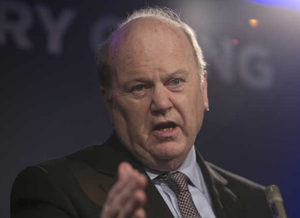
Finance Minister Michael Noonan at Fine Gael’s Long Term Economic Plan launch in Dublin this morning

On Tuesday, in the Dáil, United Left Alliance TD Clare Daly raised the case of ‘Grace’ and the foster care home in Waterford in which she suffered extreme physical and sexual abuse for many years.

She remained in the home for 13 years after other children had been removed because of concerns raised.

Ms Daly told the Dáil:

“In 1996 a decision was made by the social workers on the ground to remove that young woman. That is a fact which is backed up. We know that subsequently the foster father contacted the then Minister for Health, Deputy Noonan, and petitioned to have what he called his “beloved daughter” kept with the family… A documented case conference decision to remove that young woman from the foster home before August was subsequently reversed in October 1996 and the young woman, Grace, remained there up until 2009. People need to know who made that decision and who will pay the price for it.”

Ms Daly added:

“One of the whistleblowers at the centre of this case has made the point that, sadly, it is not the only such case. In his opinion, it represents dozens of others in the same region over a 20 to 30-year time span. It is fair to say there is a systemic problem in the HSE. It is very much the old attitude that when the church or State is threatened, the response is to say nothing, admit nothing, call in the lawyers and see what happens.”

Further to this, Finance Minister Michael Noonan spoke to Richard Crowley on RTÉ’s News At One and Mr Crowley raised the matter of the letter…

Richard Crowley: “As you know, Clare Daly raised an issue in the Dáil this week. This was in relation to the abuse allegations in the South East area and she mentioned that a letter had been written by the foster father in the controversy, directly to you as Minister for Health, this was in 1996, by the foster father. Can you, I know it’s 20 years ago and you received lots of letters, thousands of letters at that time no doubt, have you had a chance to check you files or do you have any recollection of that case? At that particular time? Or at any time you while you were minister for health?”

Michael Noonan: “No, I’ve no clear memory of it but I did check the position of Department of Health and seemingly two letters arrived, one to me, and one to the junior minister for health, Austin Currie. And the letter, to me, I contacted, I got my officials to contact the South Eastern Health Board and my understanding of it was the person would be removed from foster care. But subsequently, information came through that there was some kind of appeal and that that didn’t happen and then, after that, because it was a question of the possible abuse of a child, the data was given to the minister of state who had responsibility for children. And I’m not sure what happened after that.”

Crowley: “So you had no further contact with the issue or the people involved?”

Noonan: “I’d no further contact after that and I didn’t have the power to direct and I didn’t direct. But the initial information I got was that yes, there was an issue and the child was removed. And, subsequently then, I forget the exact details but it was some kind of  appeal process and the decision of whoever took it down in the South East wasn’t implemented at that point and then it went on to Minister Austin Currie.”

Crowley: “Minister Noonan, thank you very much for coming in…”

Listen back in full here

Clare Daly claims foster father lobbied Michael Noonan (Irish Times)

Previously: Still In The System

Clare Daly transcript via Kildarestreet.com

Sam Boal/Rollingnews

At the Green Party general election launch this morning.

Meanwhile…

There is tay.