

Mick Caul writes:
Not Good Enough: Children’s lives are being destroyed in “hubs”. Government are indifferent. Joins us AUG 16th at @ICHHDUBLIN 7.30pm.



Mick Caul writes:
Not Good Enough: Children’s lives are being destroyed in “hubs”. Government are indifferent. Joins us AUG 16th at @ICHHDUBLIN 7.30pm.







MORE to folly
 Derek Mooney
With the Summer break in mind I decided to put together a summer reading list of titles to take away with you on holidays. Some of these I have already read, some I am planning to read. It includes recommendations from friends and suggestions made on Facebook and Twitter.
The list is in no particular order. If you disagree with any of my choices, then feel free to offer your suggestions in the comments section below.
Here goes:

Ruadhán MacCormaic’s The Supreme Court (Penguin Ireland) is a fascinating history and account of our top court. It is, in the words of Vincent Browne, “…not just for people interested in law; it tells you a lot about Ireland.”
It is no mere dry chronology of landmark ruling, but rather it tells the story of the court through its people, both on and before the bench, and the influence it has had on our society. A definite must read for anyone seriously interested in public policy.

At the risk of giving this list too much of a lawyer-y flavour, I am also including Joyce in Court by the late Supreme Court Judge, Adrian Hardiman, and published posthumously by Head of Zeus.
It is a very readable account about James Joyce (and there are not many of them), concentrating on his interest in the law and his fascination with court proceedings. Hardiman charts the many references to real trials in both Ulysses and Finnegans Wake and looks at the legal battles to prevent Ulysses’s publication.

Though published two years ago, Chris Dooley’s partial biography of Redmond: A Life Undone (Gill and MacMillan) looks at the seven critical years of Redmond’s political life from 1910 – 1918. At the start of this period Redmond is at the peak of his powers. He is leader of the Irish Parliamentary Party in Westminster, a major player holding the balance of power.
By 1917 he is a reviled and near irrelevant figure, broken by events – not least the 1916 Rebellion – with one year of life left. Dooley’s book attempts successfully to chart Redmond’s gradual disconnection with his electorate and his resulting declining fortunes. A really good read.

My next suggestion is written by a good friend and former colleague, Dr Brian Murphy. It is: Forgotten Patriot: Douglas Hyde and the Foundation of the Irish Presidency (The Collins Press) This is not just a biography of our often neglected first President who worked to make his presidency as inclusive as he could, it is the expertly researched and well told story of how the office of the President was born and grew. More importantly, Brian dispels the lazy analysis that has portrayed the pre-1990 history of presidency as just “a retirement home” far removed from real life and politics.

While on the topic of Douglas Hyde I can also recommend Cormac Moore’s The GAA v Douglas Hyde: The Removal of Ireland’s First President as GAA Patron, also from The Collins Press. It’s an entertaining account of how the GAA dumped Hyde as its patron following the President’s attendance at a soccer match between Ireland and Poland – a breach of the GAA’s ban on foreign games. The book not only looks at the twists and turns of how Hyde was removed but looks at the ramifications
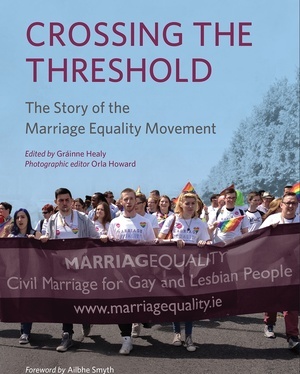
Crossing the Threshold: The Story of the Marriage Equality Movement (Irish Academic Press) is a collection of 23 essays, edited by Dr Grainne Healy, described as “the official history of the role played by the Marriage Equality organisation”. It is just that and does not try to a history of the wider campaign. The essays are thoughtful and highlight the importance of personal stories and individual activism.

It should be read alongside the other book on the topic which was co-authored by Grainne along with Brian Sheehan and Noel Whelan: Ireland Says Yes: The Inside Story of How the Vote for Marriage Equality Was Won. It looked just at the final 100 days of the campaign and highlighted the crucial importance of having allies outside the usual liberal circles and how the campaign strenuously avoided the traps of insularity – a lesson that other campaigns should learn if they wish to succeed.
Looking beyond the solely Irish context Chris Patten’s First Confession: A Sort of Memoir (Penguin Books) is not just an autobiography, but rather a well written and often funny examination of today’s big political themes, most particularly identity, seen through the author’s own history and experiences. Patten is an astute observer and still has a lot to say. Well worth a read.
As a fan of the writing Niccoló Machiavelli, I can heartily recommend Erica Benner’s excellent Be Like the Fox, Machiavelli’s Lifelong Quest for Freedom (Penguin Books). She dismisses the one-dimensional caricature of him as cynical henchman and paints him as a profound political thinker, even a champion of liberty. A non-machiavellian Machiavelli, so to speak.
If you like your histories with plenty of gore and intrigue that I also suggest you grab a copy of Guy de la Bedoyere’s Praetorian: The Rise and Fall of Rome’s Imperial Bodyguard (Yale Books). It is what they used to call a “rollicking good read” and charts the history of the Emperor’s elite guard and their role in the making and breaking of their political masters. A must-buy if you are looking to send a book to the Garda Commissioner?
Moving from the intrigues of the past today’s ones, JD Vance’s Hillbilly Elegy, A Memoir of a Family and Culture in Crisis (Harper Collins) has received a slew of awards.
Not only has it been named as one of “Six books to help understand Trump’s win” it also has the distinction of being praised in the Dáil by Leo Varadkar, Paschal Donohue and Fianna Fail’s James Lawless.
It tells the story of a family in a rust belt town that achieves some upward mobility but finds that this progress is partially illusory and learns how the American Dream is a nightmare for many.

My final suggestion is an almost old fashioned whodunnit, but a dark one with a strong Belfast accent. It is the Guardian Irish Editor Henry McDonald’s debut murder mystery: The Swinging Detective (Gibson Square Books).
Set in Belfast, Berlin and London, the main character is Martin Peters a detective with the Berlin police is investigating two gruesome killings, but he has a past as a British army soldier who served in Belfast that haunts him. It is the first of a trilogy of Martin Peter’s planned by McDonald.
This is a personal selection. Like me it has a heavy political leaning, but enjoy nonetheless.
Derek Mooney is a communications and public affairs consultant. He previously served as a Ministerial Adviser to the Fianna Fáil-led government 2004 – 2010. Follow Derek on Twitter: @dsmooney

Montague Street, Dublin 2
Who is to blame?
Further to the outcry over gentrification by ‘millenials’ of Dublin city neighbourhoods.
Niamh writes:
Alright alright, ironic/artisan bakery schtick is not True Dublin enough, or whatever, blah blah, but there is a point I must make loud and clear, and ask that you, my peers, pay attention: this is NOT millennials.
Millennials are broke, indebted, and over-educated victims of circumstance, both terrified of never being employed, and obliged to live in decrepit, over-packed houses in order to remain within walking distance of work options. Because they can’t fuppking drive.
The generation opening bakeries and making The Happy Pear a thing are GENERATION X, or at least those who survived the cocaine blizzard of the early noughties long enough to produce Sucra and Fiachra and need somewhere hip to take the souped-up bugaboo of a Sunday morning.
So leave my poor, hungry, worthlessly qualified generation alone, ‘k?
Anyway the oul lads and oul ones of Rare Ould Dublin are the ones sitting on ex-council house goldmines, charging millenials five hundred quid a pop for a box room. They’re doing OK….
FIGHT!
Previously: Progress

Kevin Myers (inset) whose article in the Sunday Times led to his sacking yesterday
Further to the sacking of Kevin Myers from the Sunday Times…
…It has been asked, quite reasonably, why on earth none of the editors saw a problem before publishing the piece.
The answer is that they’ve never seen a problem with his work before or, if they did, thought the potential eyeball attention outweighed the risk. Major newspapers have been publishing Myers for years, and he has always said the same kinds of things….
…We live in an age in which there is a great deal of moral panic about online abuse. It isn’t moral panic because there is no such abuse, but because the focus on social media is a type of displacement and scapegoating.National newspapers have been commodifying racist, sexist and homophobic spite and bullying for years. They have created a decrepit caste of ghastly celebrities, whose fame is built entirely on who they victimise for a living.
And as we are learning, the broadsheets are often no better than the tabloids—indeed, by offering a patina of legitimacy to boorish and self-serving sadists, they may be even worse.
Yet the newspapers and news broadcasters, globally, are in decline. Audiences are falling, revenues are falling and, crucially, trust in journalists and outlets— even the broadsheets—has plummeted. The age of the Internet, signalling the decline of six hundred years of print culture, has also ended the ideological monopolies of print empires.
As the British press discovered to its cost at the last election, this process is much more accelerated here than elsewhere. The fact that even the ‘serious’ press makes much of its coin out of such mediocre malice, is one reason why.
Earlier: ‘The Iterations of Sexism/Racism’
Yesterday: Kevin’s Gate



Not an official Ferrari model per se, (or even the 1960s’ swankiest hearse) but rather a unique two-door estate version of the 1965 Ferrari 330GT 2+2.
The 1965 Ferrari 330GT 2+2 Shooting Brake was commissioned by Ferrari importer Luigi Chinetti Jr. and styled by American illustrator Bob Peak, it is thought to be the last Ferrari crafted by Italian coachbuilder Vignale.
Yours for between €600,000 and €770,000.


Meet Your Maker – a podcast about “the people who make the things you love” – launches today!
Host Liam Geraghty writes:
The debut episode (above( asks what happens when you remove the star of the show from the show? Dan Walsh tells the story of how he chopped Garfield out of Garfield, gained millions of fans and attracted the attention of the one person he didn’t want to find out about what he’d done: Garfield creator, Jim Davis. Subscribe now on Apple Podcasts, Stitcher or wherever you get your podcasts.

This morning.
Dublin 1
Dominic Plant writes:
Knight to Bishp….IFSC chess…
JIMMYJAMES (him off the comments), adds:

Ah here.

