






Yearly Archives: 2017
Big Pharma
at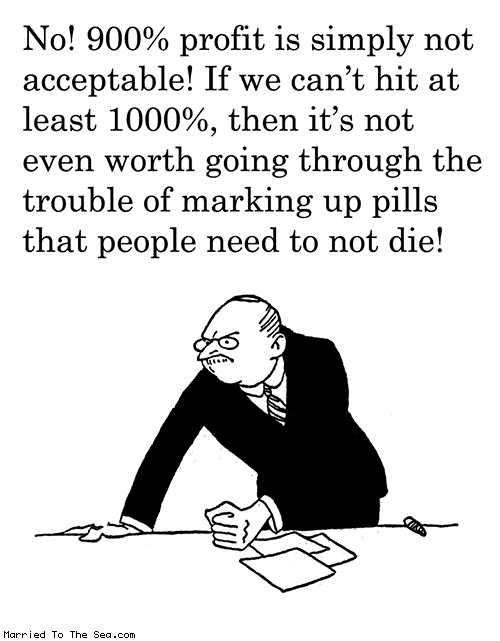


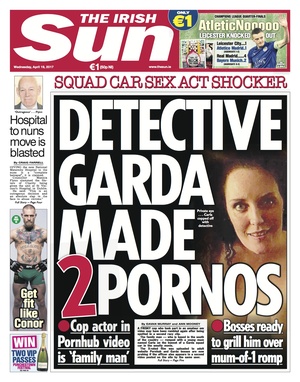






MORE to folly


This evening.
Stirrup Lane, Inns Quay, Dublin 7.
You can see what he’s done there.
Thanks John Gallen

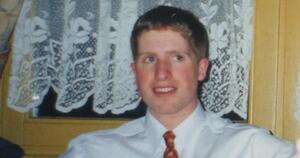
From top: CCTV footage showing three men waiting outside Trevor’s Deely’s workplace. Gardai say the two men on the left are Trevor’s work colleagues; Trevor Deely
On April 7, Crimestoppers launched a renewed appeal for missing Trevor Deely.
“Forensically-enhanced’ CCTV footage was released showing a man standing outside the back entrance of Trevor’s work that Gardai now wished to question.
Some of the footage, however, had been used previously in a 2015 TV3 documentary and, in one screen grab, a second man (not Trevor) can be seen next to the person of interest.
Filmmakers David Lester Mooney and Mark Kilbride, having discovered this anomaly, then spotted a third person in another image (top).
This afternoon, David and Mark were contacted by a Garda officer who stated that these two new figures have “previously been identified” as Trevor’s work colleagues.
If this is correct, it throws into question certain accounts of that evening that we have been given since Trevor vanished and adds to the confusion that surrounds many aspects of this case.
The following is a timeline of relevant events since Trevor’s disappearance on December 8, 2000, detailing some discrepancies and raising a number of questions.

What happened reform of the Senate?
The latest, excellent Here’s How podcast presented by journalist William Campbell tackles former Green Party TD, Senator and strategist Dan Boyle on the empty promises of Seanad reform that defeated the abolition referendum.
William (in a brilliant polemic) also addresses the uselessness of tribunals of inquiry In Ireland.
Fight!
Listen here
Loaded
at
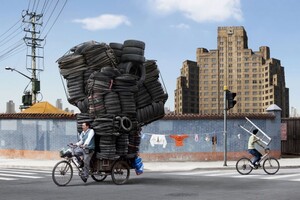


 Totems by French photographer Alain Delorme (you may recall his rather excellent plastic bag murmurations) created during two artistic residencies in Shanghai between 2009 and 2011. Delorme sez:
I took 6000 photos to create the final series of 18 images. Using Photoshop, I increased the amount of goods to give the impression that the carrier is being engulfed … This is to represent how our obsession with consuming the ‘Made in China’ products they carry creates a kind of slavery.


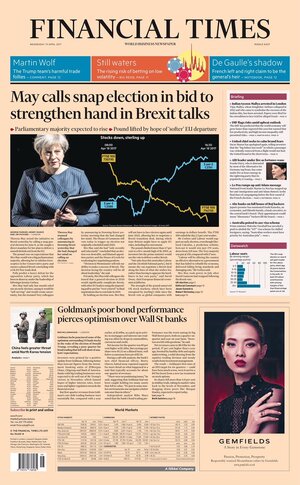
From top: Theresa May; Jeremy Corbyn; Shane Heneghan
Further to the announcement of a UK General Election on June 8…
Shane Heneghan writes:
On paper, Theresa May’s decision to seek a general election makes sense. Her party enjoys an historic lead in the polls ahead of Labour and the given wisdom is that the Conservatives will make very strong gains.
Received wisdom is not doing all that well these days, however and a few potential pitfalls seem to leap off the page.
The most predictable of these is perhaps Scotland. Nicola Sturgeon remains one of the most popular women in the British isles and continues to campaign for a second independence referendum with great gusto.
If the SNP do as well as they did last time (and we have no reason to think they won’t) then their demand for another referendum can hardly be ignored. Theresa May’s increased majority could come at the cost of the very existence of the United Kingdom.
Perhaps even more obvious is the threat of political fatigue.
This will be the fourth national poll in the UK in three years. This will depress turnout. That does not necessarily make it difficult for the Tories, (unless the fact that May promised there would be no early election becomes an issue) but it will make things a little more unpredictable.
And then there’s Corbyn. The man they said was doomed from day one. Both figures and pundits put his chances at getting to Downing Street at slim to none.
In such unpredictable times we can never completely rule him out, of course, but let’s consider a Labour wipe out where they lose up to 100 seats. This leaves the far left of the Labour party discredited for a generation and allows for a more centrist and ultimately more electable leader to emerge.
If, on the other hand, Labour under Corbyn make modest gains, then the left of the party holds on to some credibility and causes some Tory blushes even if the leader has to stand a side.
With such great expectations, the real risk is that the gamble falls flat. Imagine if Theresa May comes form a majority of 12 to just 20.
Tory backbenches would not be best pleased at having just fought a seven week campaign for next to nothing. She’d look weak and any potential opponents within the party she has would be bolstered.
Today, the media is full of a sense of palpable inevitability. Remember what happened the last time there was such a feeling around a female candidate?
Shane Heneghan is a Brussels-based election and poll watcher. Follow Shane on Twitter: @shaneheneghan
Earlier: Snap!
Montage: Daily Telegraph

This afternoon.
Elly writes:
Recuperating in Riverchapel, Co. Wexford, with existential Buffy the dog.
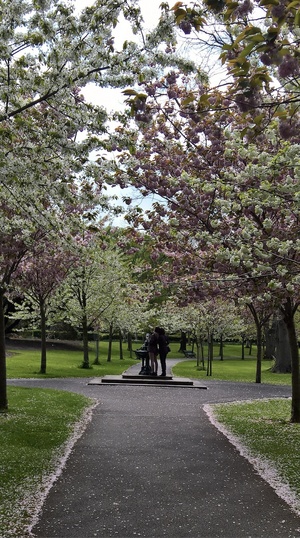
This afternoon.
Herbert Park, Ballsbridge, Dublin 4.
Thanks Luke Brennan
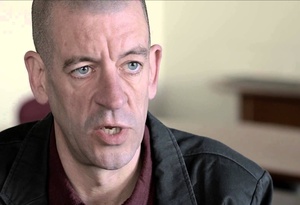
Historian Diarmaid Ferriter
Anthony Sheridan writes:
This article is dedicated to the millions of Irish citizens who have suffered and continue to suffer because of the absolute refusal of Irish journalists and commentators to call a spade a spade.
The spade in this instance is the disease of political corruption and how that disease has infected every aspect of how our country is governed.
The commentator in this instance is historian Diarmaid Ferriter.
Mr Ferriter is a highly regarded academic, a man who is steeped in the study and history of Irish politics, a man who regularly frequents the airwaves and print media delivering his opinion and analysis on current and past events and in particular on current and past political events.
Because individuals like Mr Ferriter are highly respected they have a profound influence on how people think, how they form their opinions, how they understand what’s happening in politics and in the country in general.
When such influential individuals fail to understand the reality of how our country is (mis) governed they do serious damage to any hope of rectifying the situation. They become, in effect, part of the problem.
Political corruption is the most serious problem facing our country today. Political corruption lies at the core of almost all that is rotten in our country. Political corruption should be front and centre in the minds of every single journalist and commentator who writes or speaks about what is happening in our country today.
And yet, the word ‘corruption’ is rarely uttered or written, the term ‘political corruption’ is avoided like the plague by mainstream media and political commentators. Political corruption is never, ever the subject of a major, stand-alone documentary by any media outlet.
Mr Ferriter provides us with the most recent example of this depressing fear of calling a spade a spade. In a 900-word article in the irish Times on the subject of political corruption he manages to avoid using the word even once.
Even the headline avoids the reality. ‘Cute Hoorism Has Cast A Long Shadow’
Cute hoorism is not proper English; it is a meaningless term in the broader world. It is strictly an Irish term with just one function – to avoid calling a spade a spade.
It serves just one psychological function for those in denial – If I don’t write or utter the term ‘political corruption’ then I don’t have to acknowledge its existence and therefore I don’t have to identify those responsible for the disease.
Opinion makers and in particular academic opinion makers should use proper, accurate and powerful words to drill right down to the heart of very serious problems such as political corruption.
Mr Ferriter’s headline should read: ‘Political Corruption Has Cast A Long Shadow’
In common with most other commentators Mr Ferriter knows there is something very seriously wrong with Irish politics but is not prepared to state the brutal truth – our political system is intrinsically corrupt, it is beyond repair, it is the principal reason our country has morphed into the status of failed state.
Instead of identifying and criticising those responsible, the ruling political elite principally made up of Fianna Fail, Fine Gael and Labour, Mr Ferriter, in common with many other deniers, blames the ordinary people of Ireland.
“They (the people) were only too happy to embrace the abolition of rates that finished off all pretence of autonomous local government, enhanced an unhealthy concentration of power at the centre and had serious consequences for the funding of local services.”
He goes on to confirm his total misunderstanding of today’s political realities by completely misreading the reasons for the rise of the water protest movement.
While acknowledging that the rebellion against Irish Water was justified he asserts that the issues that triggered the protest were – charges, pollution, fairness and conservation.
Wrong, wrong, wrong and wrong again.
Political corruption and betrayal was and still is the overwhelming reason for the rebellion against water charges. A significant and growing percentage of the population have lost faith in the political system and by extension, state authority.
Quoting Arthur Griffith, Mr Ferriter writes of individuals, operating in an imaginary Ireland, disparaging those making serious efforts to resolve serious national problems.
“Pious patriots praised an imaginary medieval Ireland and then wondered why Ireland was decaying around them but were determined to preserve their picturesque ignorance.”
Mr Ferriter is writing about himself. He operates in an imaginary Ireland that still believes the old corrupt political regime is fit for purpose, that it works for the good of the people and the country.
That is why he cannot bring himself to utter the dreadful ‘corruption’ word, it would mean acknowledging and therefore having to deal with the brutal reality of a hopelessly corrupt political system.
Here’s my interpretation of the above quote as it applies to Mr Ferriter and other commentators who cannot or will not acknowledge the brutal reality of our corrupt political system.
Delusional commentators praise and defend an imaginary democracy and endlessly wonder why that democracy continues to decay around them. In order to preserve their picturesque ignorance they insist on only writing and speaking in the language of cute hoorism.
Diarmaid Ferriter: Denial and the language of cute hoorism (Anthony Sheridan, Public Enquiry)
Diarmaid Ferriter: cute hoorism has cast a long shadow (irish Times, April 15)