https://www.youtube.com/watch?v=QvDydF7Mhyo

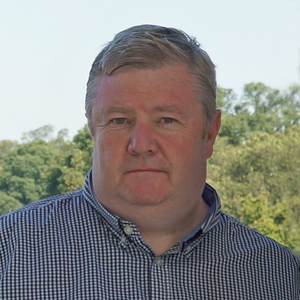
From top: Taoiseach Enda Kenny speaking in Capitol Hill last Thursday; former High Court judge Bryan McMahon
You may recall how Taoiseach Enda Kenny gave a speech in the presence of US President Donald Trump at a Friends of Ireland lunch in Capitol Hill, Washington last Thursday, concerning the estimated 50,000 Irish who are living in the United States illegally.
The speech prompted an article in The New York Times headlined, ‘Irish Premier Uses St Patrick’s Day Ritual to Lecture Trump on Immigration’.
At the beginning of his speech, Mr Kenny mentioned that he would be presenting a miniature replica of Arrival, a bronze sculpture of a famine ship by John Behan, to Mr Trump.
In 2000, the then Fianna Fáil Taoiseach Bertie Ahern unveiled the original 26-foot by 26-foot Arrival at the UN headquarters in New York.
At the time, Mr Ahern said:
“This sculpture celebrates the Irish people who traveled the world in search of a new life and all the nations and countries which welcomed them and offered them a chance for that better life.”
During the speech, Mr Kenny said:
I haven’t had the opportunity to present you with a particular piece of sculpture which is entitled “Arrival,” by John Behan. It’s a miniature — but it’s quite large — of what stands at the United Nations in New York of the tale and the story and the history of Irish immigrants after the famine years.
… I just want to say, I had a very good meeting this morning with the Vice President and with General John Kelly. Sitting at the table, we were hosted by the Vice President in the traditional breakfast in the Naval Observatory. Didn’t get much chance to eat the breakfast, I have to say; it’s one of the difficulties in politics — it’s in front of you but you can’t get near it. We did discuss the question of immigration, which is so important to the fabric of our people. And I know that in this country, this is an issue that the administration and the President are reflecting upon. And that’s something that, again, we will work with you diligently in this regard in the two sectors that we used to have a facility for E3 visas for young people who want to come to America and to work here. We discussed that very constructively this morning.
And secondly, as a part of the overall immigration reform that the Irish have contributed so much, it would be part of that. And we look forward to the works that will take place at the time ahead.
You might say that when Mike Pence’s grandfather landed here in Ellis Island in 1923, that the contribution had been made by so many Irish for so many years. It was in 1771 that the friendly Sons of St. Patrick were put together in Philadelphia, and one of their first honorary members was a young man called George Washington.
And seven years later, he handed the first commission to a naval officer called John Barry, who was co-founder of the American Navy. And he was joined later by John Holland, who designed the first submarine. And he was followed by Louis Brennan, from my hometown, who had a major impact on the navigation systems for torpedoes.
And so many others, from Henry Ford, through music and culture, and so many other areas, that 22 members of the American Presidents who sat in the White House had either Scots or Irish blood in them. And you follow in that line, sir. And I’d just like to say in finality, this is what I said to your predecessor on a number of occasions: We would like this to be sorted. It would remove a burden of so many people that they can stand out in the light and say, now I am free to contribute to America as I know I can. And that’s what people want.
I know you’ll reflect on this, but I’m always struck by the American National Anthem when it’s sung before the great occasions. And I suppose being an emotional Irishman, the hairs tingle at the back of your neck when you hear your own national anthem.
But for us, when Old Glory waves, and you put your hand on your heart and you say, “The land of the free and the home of the brave,” ours is still as brave as ever, but maybe not as free. Because of the 4,000 Congressional Medals of Honor given out to the defense forces, over 2,000 go to the Irish Americans. So they fought in the Revolutionary War. They beat the daylights out of each other in Fredericksburg and Gettysburg and Yorktown, and other places, in Atlanta. They fought every war for America and died for America — and will continue to do so. All they want is the opportunity to be free.
And this administration, working with Democrats and Republicans, I hope, can sort this out once and for all. And for future years, you determine what it is that you want to do. As George Mitchell said last evening, you can’t return to open immigration, but for the people who are here — who should be here, might be here — that’s an issue that I’m sure your administration will reflect on. And we in Ireland will give you every assistance in that regard. There are millions out there who want to play their part for America — if you like, who want to make America great. Heard it before? Heard that before?
Further to this…
Readers may recall there are an estimated 20,000-26,000 undocumented migrants living and working in Ireland.
In addition, readers may recall how Direct Provision is the system by which asylum seekers are accommodated in Ireland and it is overlooked by the Reception Integration Agency. Asylum seekers are not allowed to work or go to college while the majority of people living in Direct Provision have no facility to cook their own food.
Adults receive €19.10 per week while children receive €15.60 per week.
In April 2016, retired Judge Bryan McMahon spoke at an event in the Jesuit Refugee Service.
Criticising the length of time asylum seekers have to live in direct provision, Mr McMahon called for a blanket, one-off amnesty for the 3,500 people who had been in direct provision for more than five years – in the spirit of 1916.
He said:
“That would be a great start, in my view, just to take the 3,500 people and say, ‘it’s not going to happen again, it’s a one-off and it’s a gesture to 1916 and the men in the GPO’. No one, in my view, would object, that’s my instinct on it and, in fact, au contraire, most people would applaud us for doing something like that.”
The junior justice minister David Stanton, of Fine Gael, subsequently ruled out the idea.
Meanwhile…

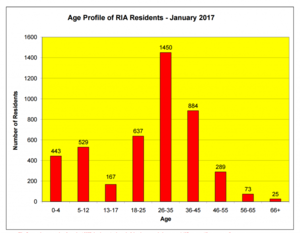
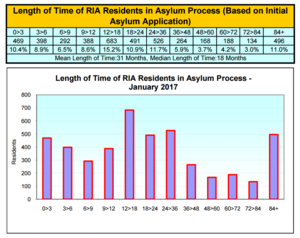
Graphs from the Reception Integration Agency report for January 2017
Some details pertaining to asylum seekers in Ireland…
According to the most recent report from the Reception Integration Agency, as of January 29, 2017, 57,644 people seeking asylum in Ireland have been accommodated in direct provision centres since April 10, 2000 – the year direct provision was set up as an interim measure.
This figure of 57,644 does not include the 2,838 unaccompanied minors – children who have arrived in the country without a parent or guardian – who have sought asylum over the same period.
Between 2000 and 2010, 513 separated children went missing from State care and 440 were still unaccounted for in 2011.
In 2009 – when, as of 2008, 454 separated children had gone missing and just 58 were subsequently accounted for – in a report on separated children, the Ombudsman for Children wrote:
“This large number of missing children is alarming as is the apparent lack of further investigation into incidents.”
The system of direct provision has never been set out in legislation or defined in any publicly available document.
A mechanism to allow asylum seekers make formal written complaints about the centres was only introduced by the Department of Justice in 2011 but it has been criticised by asylum seekers and advocacy groups for not being independent of the RIA.
In 2014, the High Court found that the lack of an independent complaints mechanism was unlawful.
Just last month, the Ombudsman for Children, Dr Niall Muldoon announced that the Ombudsman for Children’s office plans to start accepting complaints from children in Direct Provision from April 2017.
As of January 2017, 4,427 people – including 1,139 children aged under 17 – were living in 32 direct provision centres across Ireland. This number of people represents 0.09% of the population.
Just two of the 32 centres are self-catering centres – Watergate House on Usher’s Quay, Dublin 8 and Carroll Village in Dundalk, Co Louth – where a total of 118 people lived, as of January 2017.
Read Enda Kenny’s full luncheon speech here
Read the Reception Integration Agency report for January 2017 here
Previously: A Gesture To 1916