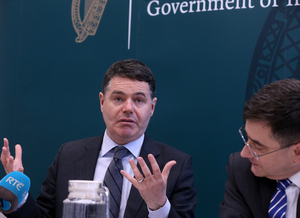

From top: Minister for Finance Paschal O’Donohue (left) and Department of Finance Chief Economist John McCarthy outlining the Stability Programme, which sets out revised macroeconomic and fiscal forecasts for the period 2019-2023; Dan Boyle
I’ve been mulling over a few figures. Ireland’s Gross Domestic Product has a value of around €300 billion. General government expenditure is little more than a quarter of our GDP. Total taxes collected are at a similar level, as we are balancing budgets.
Our general expenditure and overall taxation figures are the lowest among the OECD group of countries.
Much of our political debate centres around how money gets spent, often justifiably. Where we have a near absence of debate is on the efficacy or the efficiency of our taxation system.
Of course there are no shortage of all taxation is theft nuts. Nor those who see the proposal of any new measure as an assault on some exaggerated liberty.
What we have never properly have had is a debate on the advantages/disadvantages of high/low tax/spend policies.
For me public services are always better in high tax and spend countries. Conversely economic inequality is always worse in low tax/spend countries.
In Ireland we seem to want it both ways. We admire the sensibilities of the Nordic countries yet practice the fiscal aloofness of the US and the UK.
This is something we should be confronting before the start of the next (negative) economic cycle.
Not only are we on the wrong side of the tax and spend debate, we are to continuing not to learn the biggest lesson from 2008 – the need to widen the tax base.
More than a decade on from then we remain over dependent on particular taxes that are hugely exposed in the event of an economic downturn.
We should have a larger basket of taxation measures. The more taxation measures that are in place, and the wider their application, the better the economy would be able to withstand any putative collapse.
Aside from what we tax and how we tax, is truly unasked question – from where do we tax?
Ireland’s city and county councils spend about €5billion every year. While this might sound an impressive amount of money, it really isn’t.
As proportion of our GDP our local government spending is miniscule, putting Ireland again at the unacceptable end of international comparisons.
When compared to national government spending (itself poor by international standards) our local government spending is especially lamentable.
Contrast Ireland with Denmark. There, by a factor of almost two to one, most public expenditure occurs (and taxation is collected) through local rather than national government.
Denmark is a country that is smaller in size but is comparable in population to Ireland. There is no reason that what is done there can also be done here.
So the questions we should be addressing are, firstly, can we as a country ever have the maturity to accept that we cannot have high quality public services with low levels of taxation?
Secondly, can we increase the spread of taxes, reducing reliance on particular taxes, to better protect public spending in the event of a downturn?
Finally when will we realise that taxes collected (and spent) locally gives us a bigger bang for our euro?
We obsess too much on headline rates rarely considering effective tax rates (which are rarely that effective).
Smarter taxes would be better taxes. Never the most popular thing to say. Never enough to convince those for whom tax will always be a four letter word.
Dan Boyle is a former Green Party TD and Senator and serves as a Green Party councillor on Cork City Council. His column appears here every Thursday. Follow Dan on Twitter: @sendboyle
Sam Boal/RollingNews