



David Leventi’s large format photographs (captured with 4×5″ and 8×10″ Arca-Swiss cameras) of the interiors of opera houses around the world, many taken from the centre of the stage and thereby the unique perspective of the singer.
Author Archives: Admin

They’re bringing out the big guns.
Amy tweetz:
Dominos [pizza delivery] are you trying to politically lobby customers now? this came inside the menu?
Wasn’t Dominos founded by thaNOMNOMNOMNOM
Hold the pepperoni update:
@_aaamyy Thanks for bringing it to our attention. We have picked it up with our leaflet distribution company; pizza & politics don’t mix.
— Domino’s Pizza ROI (@Dominos_ROI) April 29, 2015
Blame the leaflet company.
That oldNOMNOMNOMNOM
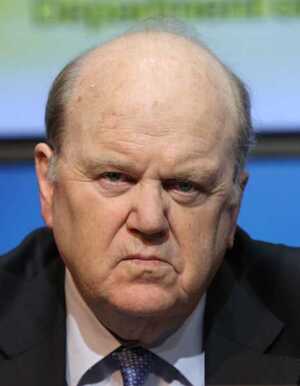 Minister for Finance Michael Noonan yesterday in government buildings
This morning.
Minister for Finance Michael Noonan went on RTÉ Radio One’s Today with Sean O’Rourke to discuss yesterday’s Spring Statement and the ongoing Siteserv crisis with the host in rare form (in fairness).
You could hear a pin drop.
As the minister chose to whisper.
Sean O’Rourke: “On the, em, Siteserv sale, Minister, you have, the inquiry announced there last week, just reviewing, eh, that and other transactions by IBRC, Mr Wallace, the liquidator who’s in charge of that and then he’s going to be overseen by [retired judge] Iarlaith O’Neill, do you regret now that you weren’t more forthcoming in the Dail when you were asked questions about that, that transaction and issue?”
Michael Noonan: “No, I was very forthcoming. The issues coming out now in the interviews done by Alan Dukes {former IBRC chairman] and Mr [Mike] Aynsley [former IBRC CEO] and so on, they’re giving their side of the story, I have a whole run of Dáil questions again this week and I’ll be answering them and giving full information. I gave the information to the Dáil. But no one expects in a Dáil reply to get the information they get under Freedom of Information and Catherine Murphy, doing a very good job, went on to the Freedom of information route and she got the background.”
O’Rourke: “But [Independent TD] Catherine Murphy had to ask, she was on question 19 to you before it ever emerged that you had concerns, and very serious concerns, about the way IBRC was doing business, and not just about Siteserv.”
Noonan: “First of all, it was all back in 2012. The issue was the accountability of IBRC to the Minister for Finance and to the Department of Finance. The Minister and the officials were in exactly the same space. We had a whole series of concerns which we dealt with with the Board of IBRC, we resolved the situation to our satisfaction by putting an Assistant Secretary in there, there is no evidence whatsoever that any misappropriate action took place in any of their transactions but because it has become such an issue of public concern it’s timely now that…”
O’Rourke: “But you could have defused all that ages ago, Minister, by being a little more up-front about the concerns that were there, instead of which as [political correspondent] Brian Dowling put it last Sunday on the [RTÉ Radio] This Week programme, anybody reading your replies would say, well, nothing to see here, there’s nothing that gives any indication that the Minister was concerned about the way business was done and those answers were really designed to conceal more than they revealed.”
Noonan: “No, no, no, that is not correct. The information that was requested was given. I have no grounds now, and I don’t think anybody else has any evidence, that anything untoward happened. I got assurance from the Board through their chairman that what they did was in the best interests of the Irish taxpayers and I accepted that insurance because the responsibility, the legal responsibility, of the Board was to do what they did and I was barred from getting involved in any commercial decision of the Board and I accepted it and we will see now whether my judgment was right or not when it is reviewed, but the review isn’t because evidence has come out the review is because there has been a public furore and its in the public interest that…”
O’Rourke: “Let’s just get a little flavour of it, two very brief clips, one’s from you and the other’s from Alan Dukes when you announced the thing last week, here’s just what you said, I think, in Limerick in Friday…”
[plays recording]
Noonan: “One, is just to establish were there were any malpractices or any criminal offence and secondly would what happened in these transactions be considered to be sound business practice.”
Dukes: “And that makes me extremely angry, that even though the Minister says that he doesn’t expect to find anything like that, the very fact that there’s any mention of criminality or malpractice to my mind is absolutely outrageous.”
O’Rourke: “He’s hoppin’ mad.
Noonan: “Of course he is, he is, very annoyed. But all the allegations made under privilege in the Dail were effectively allegations that fraud had occurred. Now how could I possibly have a review conducted that didn’t deal with that issue. Fraud is a criminal offence.
O’Rourke: “In other words it was quite calculated, it wasn’t a slip of the tongue on your part or anything like that when you said fraud, criminality.”
Noonan: “Yeah, when you go back, I don’t think anything happened like that but if you go back on the record in the Dail the allegations were, effectively were, that there were criminal transactions fraud is a criminal offence, I mean, what would you be saying to me this morning if I prevented the review from examining whether fraud occurred or not? Like, that is a ridiculous position.”
O’Rourke: “For Alan Dukes to take, yes.
Noonan: “Well I think he probably misunderstood what I was doing or else he hadn’t been tuned in to what were the allegations made in the Dáil, but one of the problems in all these things where there’s allegations of scandal is that all allegations are run under privilege as if they were true and then truth has to be proved.”
O’Rourke: “But you didn’t, I don’t think you made it quite clear when you were making the announcement last Friday that it was because of things said in the Dáil that you used those words fraud or criminality.”
Noonan: “I did, I did a very long interview with [RTE journalist] Sean Whelan and I think I referenced the fact that it had gone to the point where there were allegations made and they had to be answered.”
O’Rourke: “What about Alan Dukes’ suggestion that your secretary general in the department John Moran wanted to have a kind of arrangement whereby not only would he be appointed would he join the board of IBRC but himself and Alan Dukes would effectively ready up decisions that would be pushed through the Board and in a way that Alan Dukes certainly felt was inappropriate.”
Noonan: “I don’t know what the basis for the second charge is but on the first charge it was quite common in the past to have departmental officials on the boards of organisations like IBRC. Brian Lenihan, when he set up the Board, because you know there were an awful lot of allegations of political interference in Anglo, he excluded departmental representatives and he also put an arrangement in place that the political side and the departmental side would have no influence over transactions, anything commercial was excluded so that made the accountability difficult but my difficulty with IBRC was an issue of governance and they were independent in carrying out their functions but I had a function to hold them accountable, they did not give me full value for my role and I had to fight in the public interest to make sure I had it their examples in the literature and information that has been revealed first of all the Government brought in a pay policy that bankers couldn’t be paid in excess of €500,000, they tried to ignore that and they tried to hire people at higher salaries, we wanted the cost of IBRC to reduced and instead of that they kept hiring people against government policy, so there were a lot of issues, but they were issues about their independence and my responsibility to hold them accountable.”
O’Rourke: “I know that he main explanation and justification for shutting them down for liquidating them was because of things to do with promissory notes but was that tense relationship and your dissatisfaction and lack of trust in them, to what extent did it influence that government decision?
Noonan: “No it didn’t. The sequence of events was that, you know, coming into the late spring and summer things came to a head and I had that meeting the minutes of which were released with Alan Dukes and Mr Ainsley and after that we made a decision that John Moran would meet Mr Aynsley [IBRC CEO] and the result of that meeting was an agreement that an Assistant Secretary would be put in. As well as that…”
O’Rourke: “And that didn’t work out too well either.”
Noonan: “As well as that we had a new relationship framework as they call it, you know, a new contract governing the relationship between the Department and IBRC and that gave us oversight of transactions in excess of 100 million and then by September I was negotiating in Europe on the promissory note and it was clear to me by September that whatever the solution ended up at in its detail it would involve the liquidation of the Bank…”
O’Rourke: “And is there any suggestion on your part or suspicion that the Siteserv sale was hurried through to get done and dusted before the new regime whereby they would have to report to you in more detail would arrive because it was only a matter of days, a couple of weeks…”
Noonan: “No, I have no evidence and I don’t think anybody else has of any wrongdoing, there was a series of unsupported allegations and we have to have a review…”
O’Rourke: “I suppose, as [former Labour Minister for Communications] Pat Rabbitte put it in his column in The Sunday Business Post last Sunday, no matter how effective the rebuttal, any story that has a rotten bank losing taxpayers’ money the country’s most prominent businessman shareholders of a bust company extracting a pay off and a minister accountable to the Dáil will outpace the economic statistics any day.”
Noonan: “Yes, all that is probably true but the people who were running IBRC at Board level they had no involvement in Anglo, I mean the whole board in Anglo had stood down this was a new board put in by [then Minister for Finance] Brian Lenihan and there were a lot of eminent people of high repute who were on that Board and I would classify Alan Dukes who was on the Board first and then appointed Chairman by Brian Lenihan as a a person of high repute as well and I have no evidence that they did anything.”
O’Rourke: “A former colleague of both of you, [Newstalk Breakfast presenter and former Fine Gael Minister] Ivan Yates, has suggested that if you were minister at the start when that Board was being assembled you’d never have appointed Alan Dukes chairman, whatever about keeping him there.”
Noonan: “No we have a cordial relationship which we’ve kept up over the years.”
O’Rourke: “That’s what [Progressive Democrats founder] Des O’Malley used to say about Charlie Haughey.”
Noonan: “Now, now, it’s not like that, we don’t see one another very often but when we see one another we’re friendly.”
O’Rourke: “And are you satisfied that this matter can be investigated and put out there in the public domain, all kinds of reassurance provided, how quickly, I think the 30th August was mentioned…”
Noonan: “Yeah, yeah, the end of August the end of August but I see this as the first phase possibly. It may, you know, when we get the report this may end the matter but I’m going to put the Report to the appropriate Dáil Committees and if there’s something that has to go farther we’ll go farther.”
O’Rourke: “But to go back to where we started, Minister, you weren’t upfront about the concerns you had, you talked earlier about data sharing with the Dail…”
Noonan: “I was upfront, I was upfront.”
O’Rourke: “Really? And how come we had to wait for the FOIs then at all, why shouldn’t you have given all the information that was in the FOIs, why not give that to the Dail?”
Noonan: “Because why do we have FOIs only to get background information?”
O’Rourke: “But it’s, it shouldn’t really be a game of cat and mouse, it’s not today or yesterday that the late Judge [Liam] Hamilton said if Dáil answers or Dail questions were properly answered there’d be no Beef Tribunal.”
Noonan: “It’s not a game of cat and mouse but there are procedures there which TDs can get information…”
O’Rourke: “But is there not a mindset there and maybe in your case it goes back to your days as Minister for Justice, tell them nothing.”
Noonan: “Ah now, you’re really scraping the bottom of the barrel there when you’re talking like that, I mean RTÉ isn’t great at disclosure you’re sitting on reports for 12 months that you haven’t published, I mean reports about the future of RTÉ*, so get off the stage, get off the stage now.”
O’Rourke: “Attack is the best form of defence there Minister, I’m just wondering why should a public representative elected by the Irish people not get the same information in reply to a Dail question as is there in the files anyway, why put them through the business of FOI?”
Noonan: “Because the files are often background information there was nothing in the files that added to the sum of the knowledge, the files were about a disagreement between us and it was the Department exercising its governance and when the proper procedure was invoked, Freedom of Information, all of the information was given out.”
O’Rourke: “Wasn’t that a bit clumsy now?”
Noonan: “I don’t think it’s clumsy at all, it’s very effective and it has proved to be effective.”
O’Rourke: “And you don’t see a case for put it out there, if a TD asks the question give them the answer, give them the answer?”
Noonan: “Well you see, I don’t think it’s feasible to say if somebody mentions IBRC that I give, you know, out chestloads of information on IBRC just because it’s mentioned.”
O’Rourke: “We’re talking about exams later and you’re a former teacher, answer the question you’re asked, is that essentially what you’re saying?”
Noonan: “What I’m saying is that there are two ways, well, there are several ways that deputies can get information and one of them is by Dáil question and the other is by Freedom of Information and Catherine Murphy followed the correct procedure, she invoked both options and she got the information.”
O’Rourke: “Would the moral of the story then from a TD’s point of view be, forget about the Dáil question, go straight for Freedom of Information?”
Noonan: “No, no. They’re different I mean you get very precise accurate information on the Dail question, if you’re looking for background then it’s Freedom of Information.”
O’Rourke: “OK Minister, thank you very much for coming in. Michael Noonan, the Minister for Finance.”
Listen back here
* anyone?
Meanwhile…
Notwithstanding the State’s ownership of the bank, IBRC operates at an arm’s length capacity from the State in relation to commercial issues. It is a matter for the board and management to determine and implement such policy in their organisation. Therefore, commercial decisions in relation to IBRC are solely a decision for the bank. IBRC have informed me that KPMG Corporate Finance and Davy Corporate Finance ran a joint sales process to sell Siteserv which was in severe financial difficulties and was unable to service or pay back its loans to IBRC. The sale process was initiated by Siteserv and overseen by a subcommittee of the Siteserv Board. The sale process involved two stages and IBRC was briefed after each stage. The Board of Siteserv, as advised by KPMG Corporate Finance and Davy Corporate Finance, recommended the successful bid as representing the best return forIBRC. The Board of the bank are satisfied that this is the case.
Michael Noonan’s reply to Pearse Doherty on April 18, 2012
Notwithstanding the State’s ownership of the bank at the time, Irish Bank Resolution Corporation operated at an arm’s length capacity from the State in relation to commercial issues. It was a matter for the board and management to determine and implement such policy in their organisation. Therefore, commercial decisions in relation to IBRC were solely a decision for the bank. I am aware that KPMG Corporate Finance and Davy Corporate Finance ran a joint sales process to sell Siteserv which was in severe financial difficulties and was unable to service or pay back its loans to IBRC. The sale process was initiated by Siteserv and overseen by a subcommittee of the Siteserv Board. The sale process involved two stages and IBRC was briefed after each stage. The Board of Siteserv, as advised by KPMG Corporate Finance and Davy Corporate Finance, recommended the successful bid as representing the best return for IBRC. I am advised that the Board of the bank at that time were satisfied that this was the case.
Michael Noonan’s reply to Catherine Murphy on December 16, 2014
Right so.
Also…

Michael Noonan’s words used to scary effect in bowel-loosening letter from [REDACTED]’s legal team to Karl’s den the ‘sheet, January 2014.
Good times.
(Sasko Lazarov/Photocall Ireland)

Cheferendum
at
This morning.
Dolly and Cooks.
The launch of Taste of Dublin 2015 at the Merrion Hotel, Dublin.
A brace of Ireland’s best known cooks minus Rachel Allen and Bodger’s ma.
From left Clodagh McKenna, Richard Corrigan, recipient of the Taste Icon Award. Kevin Thornton, model Roz Purcell, Joy Beattie, Kevin ‘lay off the carrots’ Dundon and Ross Lewis.
Name YOUR favourite among those pictured (pound for pound) below.
Taste of Dublin will run in Iveagh Gardens, Dublin from June 11-14.
(Leon Farrell/Photocall Ireland)
Update:

Yikes.
Never leave overnight in the oven, etc.
A close up of Kevin WellDundon.
(leon Farrell/Photocall Ireland)

A mind-altering promo for issue three of Guts, the controversial Irish literary confessional title
The Drugs Issue features writers Kevin Power, Conor Creighton, Padraic E Moore, Grace Dyas, Amo Downey, Roisin Kiberd, Neil Watkins, Michael Egan, and Maeve Devoy on nodges ‘n’ neckin.
YOKESYOKESYOKESYOKESYOKESYOKESYOKESYOKESYOKESTOKESTOKESTOKESTOKESTOKES
Etc.

Splutterini.
Aisling writes:
Great typo in Dublin Italian…

This morning.
Croagh Patrick, Co Mayo.
Thanks Jim O’Callaghan

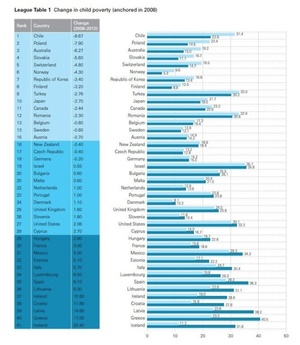
From ‘Children of the Recession: Children of the Recession: The impact of the economic crisis on child well-being in rich countries’ (Unicef, 2014).
Do Mothers and fathers matter?
Dr Carmal Hannan writes:
Most of you will have received a fancy brochure in your letter box telling you “7 Great Reasons to Keep Marriage as is”. The well-funded group “Mothers and Fathers Matter” are advocating a no vote in the upcoming referendum quoting evidence that two married parents, a male and a female, provide the optimal family for raising children.
Kate Bopp, of this group, announced that “studies have shown that teens who have grown up without a father are more prone to crime, they have greater presentations of emotional distress: volatile anger in young men and boys, and young women tend to gravitate towards abusive relationships”.
This is not the case. This is the classic misinterpretation of research which continues to be presented as fact; where association is interpreted as causation. Yes, family type matters, but they do not “cause” children to grow up unhappy, under-educated or prone to crime.
Growing up in Ireland, the national longitudinal study of children in Ireland provides a rich source of data on contemporary families in Ireland.
Brendan Halpin and I investigated the effects of growing up in a one parent family, examining data from over 8,000 nine year old children from this study. We concluded that marriage does not have a major direct influence on child development.
Across 14 measures collected from parents, teachers and the children themselves, differences across family types were indeed evident. In other words, growing up in a one parent family is associated with lower educational scores, lower levels of school attendance, and negative self-concept among 9 year olds.
However, these children are more likely, on average, to live with a mother who has low levels of education, to live in poverty and to attend a DEIS school – just to name a few important factors that differ across families and which should be taken in consideration.
Once you take account of the wide array of ways in which resources differ across family types, children whose parents were not married look remarkably similar to those whose parents were married on all these measures.
The reason for differences in child development is therefore not the marital status of parents, but rather child development is strongly related the background characteristics of the parents, particularly the mother’s education.
In a separate study, Prof Tony Fahey confirmed these findings and advocated a reform to the social welfare system so that income supports would be directed at families on the basis of their low incomes rather than the residential status of parents.
If we want to focus the debate on marriage equality on child development, the largest issue we need to address in this regard is the growing rates of child poverty.
The child poverty rate as measured by Eurostat rose from 18% to 28.6%, between 2008 and 2012, an increase of 10.6%. This corresponds to a net increase of more than 130,000 poor children in Ireland (UNICEF 2014).
The resources available to parents – be they black or white, old or young, gay or lesbian – is what really matters.
Parental access to education, access to childcare, employment opportunities that fit with the realities of every day family life are just some of the issues that need to be addressed. Irrespective of family structure, we want parents to be able to give children the best possible start to life.
Reason 7 to keep marriage as is states that “Every Child Deserves a Mother’s Love” rather every child deserves a roof over their head, food in their belly and access to a school of choice.
Dr Carmel Hannan is a Lecturer at the Department of Sociology, University of Limerick and a contributing author to a new book on “The ‘Irish’ Family” (Routledge 2014). Follow her on Twitter @CarmelHannan

A guide to idiot avoidance, chair wrangling, firearm use and other vagaries of air travel with Mario, Fafa and Johnny T.