

Just a nibble.
Ruth Meehan writes:
Any clever readers know what type of mushroom this is? Growing near my home.
Anyone?


Just a nibble.
Ruth Meehan writes:
Any clever readers know what type of mushroom this is? Growing near my home.
Anyone?

The otherwise romantic engagement shoot of Kelin Flanagan and Spencer Taubner at Banff National Park in Alberta, Canada is squirrelbombed.
Photographer refocuses.


Leave her alone.
Colm writes:
Forwarded from an agent friend of mine….
Previously: Demonising Michaella

Ah here.
Andy writes:
Spotted in Rotorua New Zealand…

In the event of a bail-in, the government and banks are likely to seek to impose deeper haircuts on creditors including depositors in order to bail-out and protect the failing banking system, writes Mark O’Byrne, of Irish gold brokers Goldcore,
He adds:
Deposit bail-in risks are slowly being realised in Ireland, after it emerged overnight that FBD, one of Ireland’s largest insurance companies, have been moving cash out of Irish bank deposits and into bonds.
Revelations regarding deposit bail-in risks came in the wake of warnings of a new property crash centred on the housing market in Ireland. The former deputy governor of the Central Bank warned in an op-ed in a leading international financial publication, Project Syndicate, that Ireland is at risk of another housing market crash.
Insurer FBD has moved over €150 million out of the Irish banking system and into corporate and sovereign bonds over the past year. The move was prompted by low returns offered by bank deposits and the risks that deposit bail-in rules could see deposits confiscated.
FBD chief executive Fiona Muldoon told the Irish Independent that the
“extremely low returns offered on term deposits by banks, coupled with fears that new bail-in rules introduced this year by the European Union could expose bank bondholders and depositors to bailing out a failed lender, meant it has shifted investments away from banks.”
The new deposit bail-in mechanism is designed to protect banks and is touted as a way to prevent taxpayers being liable for bailing out collapsed lenders. It is believed that it leaves bank bondholders and deposit customers with more than €100,000 on deposit at risk of footing the bill.
There is a belief that bail-ins only relate to “the wealthy” and “rich” depositors as they will be imposed on those with deposits greater than national deposit guarantees.
These deposit “guarantees” are generally the ‘big round’, arbitrary number of say €100,000, $250,000 and £75,000. These are not particularly large amounts and could amount to the entire life savings of a pensioner, a family or indeed it could be the entire capital of a small to medium size business enterprise.
An example of this is the UK where the deposit guarantee was arbitrarily, suddenly and with little fanfare quietly reduced from £100,000 to £75,000 just last year in July 2015.
Thus, it is important to note that the arbitrary round number in the various government deposit guarantees can be, and probably will be, reduced to a lower number – say the new round number of €50,000, £50,000 and $50,000 – depending on the severity of the next banking crash.
….FBD’s deposits with Irish banks were reduced from €451 million to €305 million in recent months. FBD made a €3.1m loss in the first half of the year….
The recent bank stress tests showed that Irish banks are the most vulnerable in the EU in the event of another financial crisis…
FIGHT!
Deposit Bail-in Warning In Ireland – Bail-in Risk In UK Very High (Mark O’Byrne, Goldcore)
Ilenkus – new single from post-metal Galwegians
What you may need to know…
01. Previous column featurees Ilenkus return with their first new material in nearly two years.
02. Emerging in 2011, the band combines heavy-duty riffage with atmosphere and technical proficiency, as best displayed on their 2014 sophomore effort The Crossing.
03. Streaming above is new single Hunny Bunny, which premiered last week on MetalSucks before going on general release via Bandcamp.
04. It’s taken from the band’s upcoming Hunger 7″ E.P., for released later this autumn, pending the current crush on vinyl production.
Verdict: Hunny Bunny takes the band’s dynamic and turns it on its head, as long-form compositions give way to more focused aggression.


From top: Pensioner on the Ha’penny Bridge, Dublin; Michael Taft
The pension debate is overly complex and full of scare mongering.
That ends here.
Michael Taft writes:
Get ready for the big upcoming pension debate. Hopefully it won’t be conducted like the ‘we-are-taxed-too-much’ debate or the ‘Irish-wages-are-too-high’-debate.
Hopefully the pension debate will be evidence-based, without unsubstantiated assertions or slogans masquerading as policy. Let’s keep hope alive by looking at a couple of issues arising out of the report from the Interdepartmental Group on Fuller Working Lives.
For many, pensions are as exciting as a snail race. But believe me, when you get to a certain age it becomes seriously interesting. And with the rising number of elderly, it will become even more prominent in the debate.
The Interdepartmental report focused on the specific dilemma facing people forced to retire at the age of 65 but not being eligible for a pension until they turn 66 (by 2028 the eligibility age will be increased to 68). But the report touches upon wider issues. Let’s look at two of them.
We Can’t Afford Them
We’re going to get a lot of ‘we-can’t-afford-them’ – that is, future pension costs will be fiscally unsustainable due to the rising number of pensioners: .
‘Expenditure on State Pension payments and relevant supplementary payments is estimated to rise from just over €6.5bn in 2015 to around €8.7bn in 2026, assuming no further changes in rates – an increase of 34%.’
While they don’t scare-monger these numbers, others will. But should we be overly-worried about this number?
As a proportion of national output (GDP or GNP) these numbers indicate that pensions will actually cost less in the future; at least up to 2026.
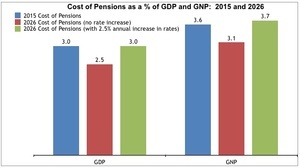
Using the report’s own numbers, pensions as measured as a proportion of national output will fall between 2015 and 2026 – whether measured by GDP or GNP. In my own calculations,
inserting a 2.5 percent annual increase in weekly pension payments, the cost remains the same. This doesn’t factor in the increased revenue – higher income and indirect tax revenue which will offset a small part of the cost.
Yes, there is a problem with GDP and GNP measurements, but the above measure trends. After 2021 I assume a 4 percent nominal increase in GDP and a 3.5 percent nominal increase in GNP).
This is not to under-estimate the challenges of funding people’s post-retirement income; after 2026 the cost will continue to rise. But it is important to keep these rising costs in perspective.
There’s Going to Be More of Them
More pensioners, that is. Which brings us to another issue – the age-dependency ratio. It has been pointed out that there will be fewer people at work supporting more people retired – a real social, economic and fiscal challenge.
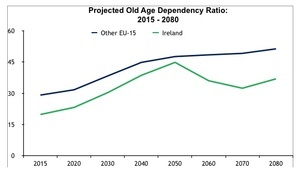
Ireland’s dependency ratio, while staying below the mean average of other EU-15 countries, will nonetheless double over the period to 2050 – to 45 percent. After that the ratio falls to the level that exists in other EU-15 average today – and then rises again.
A couple of things to note about this type of projections. First, it is highly sensitive to small changes in variables such as immigration levels, longevity, fertility, etc.
To show how fragile these projections can be, just remember Ireland in 1989. High emigration, low immigration; who would have imagined that within 10 years everything would be turned upside down. If it’s hard to project demographics over a decade, try attempting it over multiple decades.
Second, age and pension-dependency ratios are also a product of policy. For instance, even under same variables, the above chart is out-of-date. The age range is 65. But Irish policy is to increase the pension age to 68 by 2028. This will improve the dependency ratio under current projections.
Or how about this: the Government pledged to take in 4,000 Syrian refugees yet only 350 have arrived. If we were to have a more pro-active immigration policy, we could improve the dependency ratio.
Why do you think Germany committed to taking so many in? Under current projections, their dependency ratio will rise to a staggering 60 percent, with the population in decline (many EU countries are facing into falling populations).
That’s why what’s called the European ‘immigration crisis’ is actually a ‘social and economic opportunity’.
Again, this doesn’t under-estimate the challenge but hopefully it will point us to positive proposals, rather than an alarmist debate.
Just Outlaw It
The purpose of the inter-governmental report was to address the issue of raising the pension age while people were still required to retire at 65 years. The report calls for a number of interventions, mostly aspirational.
Why not just forbid forced retirement at the age of 65. Retirement should at least become mandatory only when someone is eligible for a state pension.
Or why not go further and just outlaw age-ism. People should be given a range of work-choices – continuing to work past the pension age, reduce working hours, or retire at the pension age. If someone is not considered fit to continue working in a company, it should be treated as a health and safety issue, not an issue of an arbitrary age.
There is no denying the complexity of the issues regarding ageing, pensions, life-time savings and the diminishing number of defined-benefit occupational schemes. We will need an informed debate based on evidence with proposals that are intended to enhance peoples’ life-options and living standards.
One might be pessimistic that this will happen when one considers the how debates over tax, spending cuts, competitiveness, etc. have been, and continue to be, conducted.
But one should live in hope – hopefully for a long, healthy and prosperous life-time.
Michael Taft is Research Officer with Unite the Union. His column appears here every Tuesday. He is author of the political economy blog, Unite’s Notes on the Front. Follow Michael on Twitter: @notesonthefront

They’re back.
The Thai Tims.
With a song to mark Skibbereen brothers Gary and Paul O’Donovan taking silver at the Olympics on Friday.
Previously: The Thai Tims on Broadsheet

https://www.youtube.com/watch?v=0T0OLR4MzrM
Highlights from last weekend’s 2016 Dødsing (“death diving” ie. bellyflopping) World Cup in Frogner, Norway.
You will wince.
Liffey tykes take note.
