Author Archives: Bodger

Dr Mike Ryan, Executive Director of the World Health Organization’s Emergencies Programme

Speaking on RTÉ’s Today with Claire Byrne, Dr Ryan said that although younger people may suffer a less severe version of the disease, it is not guaranteed that this will be the case and that there is always the risk of passing it to older populations.

If the disease is passed onto older generations again, he said, the hospitals will refill and “this is not something we want to see”.

Dr Ryan said it is not known yet about what kind of protection people will have if they contract the disease.

Anyone?

Ongoing shift of virus to younger adults – WHO expert Ryan (RTÉ)

Meanwhile…

Back in April.

Dr Ryan (@1.15) suggests entering homes and removing suspected Covid-19 patients.

Good times.

Meanwhile…

Oh.

Dr David Kenny (above) assistant professor at the Covid-19 law and human rights observatory of Trinity College Dublin

Yesterday.

At the Special Covid-19 committee, a number of legal experts went before the committee to answer questions about the rule of law during Ireland’s response to Covid-19.

The experts included Maura McNally SC, chair of the Bar Council of Ireland; Ken Murphy, director general of the Law Society; and Dr David Kenny assistant professor at the Covid-19 law and human rights observatory of Trinity College Dublin.

Dr David Kenny: said

“…there are several core rule of law concerns in respect of the pandemic regulations… One significant problem is the failure to promulgate or publish regulations in a timely manner. Ideally, this should be done before they come into effect, to allow scrutiny, comment and explanation.

We would recommend a statutory requirement, similar to the one found in New Zealand, that regulations be published 48 hours in advance of their coming into effect unless there are public health reasons that make this requirement unworkable.

Another major issue is the failure to properly communicate the content of regulations. This is most problematic in the repeated elision, in State communications, of legal requirements and public health advice.

For example, it was unclear to those “cocooning” in the most severe period of movement restrictions if they were legally required to remain in their homes; they were not.

It has been heavily implied in several instances and fora that the requirement to isolate for 14 days after travel is a legal obligation. It is not and never has been.

It might be thought in some quarters that this is a useful strategy for ensuring compliance with public health advice because people will be more likely to comply if they think they are legally obliged to do so.

“Such a strategy raises serious rule-of-law concerns and has real costs. It confuses members of the public, erodes public trust in communication about the law and is an abuse of State power, implying a legal threat that simply does not exist.

We believe this could have long term consequences in terms of public confidence in, and compliance with, legal obligations and public health advice in respect of the pandemic.”

The Law Society’s Ken Murphy said:

“It is thematic in the Law Society’s submission that the issue of being able to identify what is law and what is guidance and the difference between the two and the potential for sanctions for breach of the law is essential.

“There is confusion in this regard. I wish to clear up some confusion, if there is any, regarding a headline in The Irish Times this morning which seemed to suggest that it was a Law Society suggestion that the confusion between the two had been deliberate by the State. The Law Society is not suggesting that; it is not part of our submission.

“However, we think that just as the law always strives for certainty, inevitably in circumstances where there was an enormous need for speed of response, which the State rose to admirably during those crisis weeks and months, there was some absence of certainty in the capacity of the public to be able to distinguish what was law and what was guidance.

We are not suggesting there was a deliberate confusion of the two by the State or any organ of the State, but we believe, and this is thematic of the society’s submission, that for the future there should be greater clarity.

“We say in the submission there is a need for clearer communication as to what restrictions are being imposed, the reasons for them, whether they are intended to have legal effect and the sanctions for breaching them if they are legally binding. A consequence of an absence of that is confusion and, potentially, resentment due to that lack of clarity.“

Mr Murphy added:

“Part of the Law Society of Ireland’s submission has under a heading a discussion on house parties, which is something else the Deputy referred to. The proposal to empower gardaí to enter private dwellings with a view to enforcement of Covid-19 regulations is of some concern to the society, as we have said in our submission.

“Criminal statutes that provide for powers of entry by gardaí into private dwellings generally have safeguards that require certain preconditions to be met.

The Oireachtas has generally provided that powers of entry into private dwellings are reserved for the investigation of serious offences, for example, an arrestable offence, whereby the penalty for such an offence is a penalty of five years imprisonment or more.

Again, without expressing any definitive view on it I conclude with a sentence from our submission which states that the society cautions against introducing powers which are normally reserved for the investigation of serious criminal offences for the purpose of enforcing what are, in effect, health regulations.”

Mr Murphy added:

“Clearly, the Constitution provides protection for the dwelling houses or homes of citizens.

“The circumstances in which that can be violated are highly restricted. Again, it becomes a question for argument as to whether the power being introduced and the circumstances for which it is being introduced amount to a necessary and proportionate response.

I simply pointed to something that was in the submission of the Law Society of Ireland, which all Deputies received. It was no more than an expression of concern, not a definitive expression one way or another that we are for or against it. We are simply saying there are legal concerns about this.”

David Kenny added:

“The key thing about proportionality is that context is key. If a severe public health need could be shown, something might be proportionate while it might not be if that evidence cannot be presented. That is why it is difficult to speak in general terms about this. It really depends on the evidence that can be presented for such an extraordinary power to be necessary.

“What we can say is that there is certainly a credible constitutional objection to such a power of entry, not that it is certainly or definitely unconstitutional. It is for these Houses in debate to work out whether they believe that the evidence and threat is sufficient if that comes forward as a proposal.

“We have been saying repeatedly that there is a need for oversight of regulations. Perhaps it is essential that the primary legislation allows for some broad regulations which may even include making a civil offence relating to the establishment of dwellings.

However, we would need primary legislation to create a search power and then there would be Oireachtas oversight. We need Oireachtas oversight of these regulations as well because they are significant. Some of the most significant rule-making in this pandemic has been done by regulation. It is important that this oversight is in place.”

Yesterday: Sumption Happening Here

The three new Pilatus PC-12 Spectres (above) parked up in Denver and destined for Ireland. One of the PC12s in flight (top).

Today.

The Irish Air Corps are expected to take delivery of three new Pilatus PC-12 Spectre aircraft, which have been based at Rocky Mountain Metropolitan Airport, Denver, Colorado, USA since February 2019. The contract was signed in 2017

Via Alan Dwyer in Flying Ireland:

They were delivered here [Denver] from the Pilatus factory in Switzerland to be fitted out with their mission equipment and testing.

The three aircraft took off within minutes of each other on Tuesday from their temporary home heading for Burlington, Vermont where they landed after a flight of almost five hours.

Following an overnight stop they continued on to Goose Bay in Newfoundland for another overnight stop off before the Atlantic crossing.

They are scheduled to continue on to Iceland then make the final journey to their new home in Baldonnel today.

On arrival, the aircraft will take up the Irish markings and the Air Corps roundel will be added to the colour scheme….

New Irish Air Corps PC-12’s Due for Delivery this week (FlyingIreland)

Pics: Skippyscage

Thanks Jack Jones

Retired Chief Justice Susan Denham (left) and Séamus Woulfe, who, as Attorney General, signed off on regulations that prohibited gatherings like the golf outing he would attend a few weeks later as a Supreme Court judge

This afternoon.

Further to Golfgate….

Via The Irish Times:

Retired chief justice Susan Denham has met Supreme Court judge Séamus Woulfe concerning his attendance at the Oireachtas golf dinner, The Irish Times has learned.

Mr Justice Woulfe, a former Attorney General, was accompanied by Michael Collins SC when he met with Ms Denham in a boardroom on Tuesday at the Courts Service Green Street building.

…Senior Counsel Shane Murphy was also in attendance at Wednesday’s meeting which is understood to have lasted a number of hours

Séamus Woulfe meets former chief justice over Oireachtas dinner controversy (Irish Times)

Meeting reconstruction:

Denham: “What were you thinking?”

Woulfe: “Eh…”

[Four hours later]

Denham: “Lunch?”

[all present rush for door]

Meanwhile…

This morning.

Speaking on this morning’s Joe Finnegan show, in a wide ranging interview, Retired Judge [former Fianna Fáil member now with Sinn Féin] Sean MacBride says he would have said no if invited himself.

‘”I would have sent them a text saying no thanks, I am a permanent member of the third arm of government and I cannot be playing golf in an Oireachtas golf competition as you can appreciate, good luck and bye bye” and that’s simply how it would have been dealt with.’

“Seamus Woulfe is a very fine person and I have total respect and esteem for him” but he says he made a “tragic error of judgement” in attending the event in Clifden.

“I still don’t understand as to why he went there” and that he couldn’t see that people would think here was “a clear breach of the separation of powers”.

Listen here

This afternoon.

The Light House cinema, Smithfield, Dublin 7.

Some of Ireland’s LGBTQ+ artistic community help launch this year’s GAZE International LGBTQ+ Film Festival 2020, held at at the Light House, the Irish Film Institute and online.

Above from left: Stefan Fae and Sarah Devereaux (performers with Spicebag), Avoca Reaction (cabaret performer) and Chandrika Narayanan-Mohan (writer, performer, and arts manager).

The Festival runs from from September 30 – October 4 (details at link below).

GAZE International LGBTQ+ Film Festival 2020

Leon Farrell/Photocall Ireland

This afternoon.

Leinster House, Dublin 2.

Minister for Education Norma Foley (top left) is confronted by a group of publicans from Kerry, wearing their county jerseys, who are protesting against the continued closure of Irish pubs during lockdown.

This morning, NPHET”s guidelines for so-called ‘wet pubs’ to follow were revealed:

This includes a ban on any live music or dancing. Public health experts also recommended that TV volume must be turned down low to ensure people are not forced to speak over it.

International research has shown the virus spreads more quickly among people who are raising their voices – such as those attending sporting events or in other crowded situations.

Nphet also said some pubs may need to introduce extra toilets facilities to allow for social distancing.

Revealed: No music and TV volume turned down low – the new rules for pubs (Independent.ie)

Yesterday: Rejoice

Leah Farrell/Rollingnew

Meanwhile…

On me cap, son.

Independent Kerry TD Michael Healy Rae joins the attacking Kerry forwards.

Leah Farrell/Rollingnews


Rising.

An Irish-led, global short film collaboration in tribute to the ‘relentless resilience of the human spirit’.

From director duo GRIZZLY and creative agency The Tenth Man and narrated by Denise Chaila.

Grizzly’s Trevor Whelan writes:

During this global pandemic we have collaborated with an international array of 14 cinematographers to create this inspiring message of hope. In a time when the issues of the world would have us divided, this film demonstrates what can be achieved when we work together.

RISING shows the beauty of the world that surrounds us and the power of unity and human connection….

FIGHT!

Grizzly

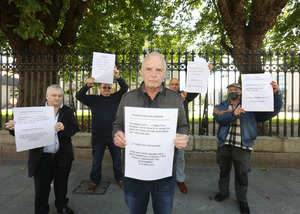
From left: George Kennedy, John Boland, David Phayer, Thomas Hogan and a man who did not wish to be identified by name

This afternoon.

Department of Education, Dublin 2.

A group of men who were sexually abused as children by a teacher at Creagh Lane primary school in Limerick protest outside the Dáil, over the State’s ongoing failure to grant them the redress they are due.

Via RTÉ:

Today is the fifth time in recent years that the ‘Creagh Lane men’, as they are known, have travelled from Limerick to Dublin to try to draw attention to their situation through protest.

A State redress scheme was established for survivors of abuse in national schools, after the European Court of Human Rights ruled in the Louise O’Keeffe case that the State did share liability for their abuse.

But the Creagh Lane men are among what is believed to be hundreds excluded by the scheme’s narrow interpretation of the European court ruling.

A year ago, the Government accepted a former judge’s finding that that the conditions of that scheme were “inherently illogical”, “fundamentally unfair” to applicants, and should be changed.

…Responding to the judge’s conclusions in the Dáil last year, the then minister for education Joe McHugh promised “action not words”. He established a second review.

…But there has been no offer made to the Creagh Lane men and others.

Sex abuse survivors protest over redress scheme (RTÉ)

Rollingnews

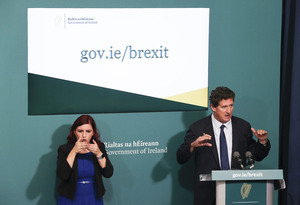
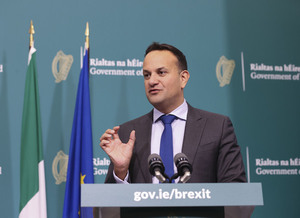
From top: Minister for Communications, Climate Action and Environment Eamon Ryan; Minister for Foreign Affairs Trade Simon Coveney; Tanaiste Leo Varadkar and Taoiseach Micheal Martin.

This afternoon.

Government Buildings, Dublin 2.

A media briefing on the publication of the government’s 2020 Brexit Readiness Action Plan ahead of the end of the ‘Transition Period’ on December  31 and building on earlier Action Plans of December 2018 and July 2019.

Action plan here.

Rollingnews