
Author Archives: Chompsky

Behold: the Ares S1 Project Spyder: a completely roofless variant of the S1 coupe created (like its sister) with computer-aided design and computational fluid dynamics to maximise slip.

The combination of a lightweight carbon fibre body and a 715bhp V8 engine rocket the thing to 100km’h in 2.7 seconds. 24 will be released next year and the price of yours is available on request.

Don’t forget your helmet unless you want to be picking flies out of your eye sockets.

uncrate

https://www.youtube.com/watch?v=9zoJP2FkpgU

In case you missed it: excerpts from the live stream of a recent SPFL Championship match (in an empty stadium on account of lockdown) between Inverness Caledonian Thistle and Ayr United.

Caledonian stadium has no camera operator, relying instead on an AI controlled tracking camera programmed to follow the ball.

Except it’s not following the ball is it?

kottke

Behold: the centre of NGC 6514, aka, Messier 20, aka the Trifid nebula. To wit:

Three prominent dust lanes that give the Trifid its name all come together. Mountains of opaque dust appear near the bottom, while other dark filaments of dust are visible threaded throughout the nebula. A single massive star visible near the center causes much of the Trifid’s glow. The Trifid, cataloged as M20, is only about 300,000 years old, making it among the youngest emission nebulas known. The star forming nebula lies about 9,000 light years away toward the constellation of the Archer (Sagittarius). The region pictured here spans about 10 light years. The featured image is a composite with luminance taken from an image by the 8.2-m ground-based Subaru Telescope, detail provided by the 2.4-m orbiting Hubble Space Telescope, color data provided by Martin Pugh and image assembly and processing provided by Robert Gendler.

Previously: Spitzer’s Trifid

(Image: Subaru Telescope (NAOJ), Hubble Space Telescope, Martin Pugh; Processing: Robert Gendler)

apod

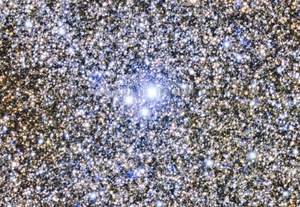
Behold: the stars at the centre of our Milky Way galaxy imaged by the Dark Energy Camera at the Cerro Tololo observatory in Chile.

The first image, while vast, shows a mere 10 million of the estimated 100-400 billion stars of the Milky Way, which is only one one of an estimated 2 trillion galaxies in the Universe.

Have your melon properly twisted by the full sized zoomable version here.

kottke