
A strangely pleasing work in progress by animator C4D4U.
Now stop looking at it.
Seriously, stop.



Last night.
Colum Cronin tweetz:
Finding magnificence in the mundane. Martin Street, Dublin 8 from across the Grand Canal.

At the Queens-bound platform of the Crosstown Local at Greenpoint Avenue, NYC.
(Pic: the Mister)





Behold: the 1955 Porsche 550 Spyder – one of just 97 such cars ever made, introduced at the 1953 Paris Auto Show and subsequently dubbed ‘giant killer’ in the wake of multiple victories over far more powerful rivals on the track.
This vehicle, (chassis number 550-0050, not far in order of assembly from James Dean’s death car) was originally exported to the US and fully restored in the mid 1980s.
It was once owned by Pablo Picasso’s son Claude, who raced it in the historic Targa Florio and the first Le Mans Classic.
Price on request.


A creepy graduation short by Jennifer Alice Wright of Denmark’s Animation Workshop in which Ranger Megan Patel ventures into the deep woods on a mission to understand the mysterious circumstances surrounding her brother’s death.
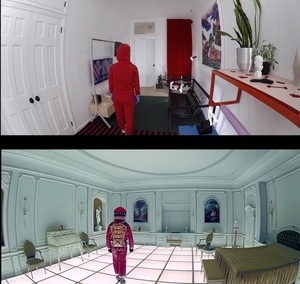
A dark parody by filmmaker Lydia Cambron, paralleling Dave Bowman’s hallucinogenic trip in Kubrick’s ‘2001: A space Odyssey’ with similar experiences we’ve all had since March of this year.

Clouds blocking the sun: a common sight. But that’s not all. To wit:
Averaging over the entire Earth, clouds block the Sun about 2/3rds of the time, although much less over many land locations. On the Sun’s upper right is a prominence of magnetically levitating hot gas. The prominence might seem small but it could easily envelop our Earth and persist for over a month. The featured image is a combination of two exposures, one optimising the cloud and prominence, and the other optimising the Sun‘s texture. Both were taken about an hour apart with the same camera and from the same location in Lynnwood, Washington, USA. The shaggy texture derives from the Sun’s chromosphere, an atmospheric layer that stands out in the specifically exposed colour. The uniformity of the texture shows the surface to be relatively calm, indicative of a Sun just past the solar minimum in its 11-year cycle. In the years ahead, the Sun will progress toward a more active epoch where sunspots, prominences, and ultimately auroras on Earth will be more common: solar maximum.
(Image: Rainee Colacurcio)