
Author Archives: Chompsky

One, right?

Wrong. To wit:

.. take a closer look at the object on the upper right. That seeming-star is actually the planet Jupiter, and your closer look might reveal that it is not alone – it is surrounded by some of its largest moons. From left to right these Galilean Moons are Io, Ganymende, Europa and Callisto. These moons orbit the Jovian world just like the planets of our Solar System orbit the Sun, in a line when seen from the side. The featured single shot was captured from Cancun, Mexico last week as Luna, in its orbit around the Earth, glided past the distant planet. Even better views of Jupiter are currently being captured by NASA‘s Juno spacecraft, now in a looping orbit around the Solar System’s largest planet. Earth’s Moon will continue to pass nearly in front of both Jupiter and Saturn once a month (moon-th) as the two giant planets approach their own great conjunction in December.

(Image: Robert Fedez)
apod

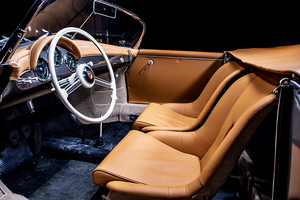
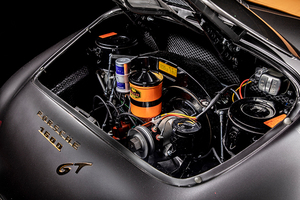
Behold: the 1958 Porsche 356 A Speedster, or rather, an enhanced ‘restomod of the original Erwin Komenda design – a fully documented ground-up restoration with upgraded Carrera exhaust, lights, air intakes, magnesium rims, disc brakes front and back, stabiliser bars and adjustable dampers – none of which improvements detract from the original factory appearance.

Price on request.

hiconsumption

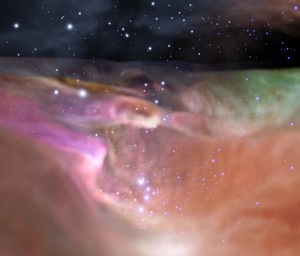
Behold: Messier 42, the Orion Nebula, or rather a visualisation of it based on astronomical data and movie rendering techniques. To wit:

Up close and personal with a famous stellar nursery normally seen from 1,500 light-years away, the digitally modeled frame transitions from a visible light representation based on Hubble data on the left to infrared data from the Spitzer Space Telescope on the right. The perspective at the center looks along a valley over a light-year wide, in the wall of the region’s giant molecular cloud. Orion’s valley ends in a cavity carved by the energetic winds and radiation of the massive central stars of the Trapezium star cluster. The single frame (top) is part of a multiwavelength, three-dimensional video that lets the viewer experience an immersive, three minute flight through the Great Nebula of Orion.

Any excuse…

(Visualization: NASA, ESA, F. Summers, G. Bacon, Z. Levay, J. DePasquale, L. Frattare, M. Robberto, M. Gennaro (STScI) and R. Hurt (Caltech/IPAC)

apod