https://www.youtube.com/watch?v=TTnwYmEWvPI
A short feature on one of the simplest but most effective mood and focus defining artistic choices in film by movie essayist wolfcrow.



The ‘highways, arteries and veins of our cities’ replicated and extrapolated by Yiannis Bilaris of Hong Kong-based production house Visual Suspect.

Behold: SS 433 – one of the most exotic eclipsing x-ray binary star systems we know of. And that’s saying something. To wit:
Its unremarkable name stems from its inclusion in a catalog of Milky Way stars which emit radiation characteristic of atomic hydrogen. Its remarkable behaviour stems from a compact object, a black hole or neutron star, which has produced an accretion disk with jets. Because the disk and jets from SS 433 resemble those surrounding supermassive black holes in the centres of distant galaxies, SS 433 is considered a micro-quasar. As illustrated in the animated featured video based on observational data, a massive, hot, normal star is locked in orbit with the compact object. As the video starts, material is shown being gravitationally ripped from the normal star and falling onto an accretion disk. The central star also blasts out jets of ionised gas in opposite directions – each at about 1/4 the speed of light. The video then pans out to show a top view of the precessing jets producing an expanding spiral. From even greater distances, the dissipating jets are then visualised near the heart of supernova remnant W50. Two years ago, SS 433 was unexpectedly found by the HAWC detector array in Mexico to emit unusually high energy (TeV-range) gamma-rays. Surprises continue, as a recent analysis of archival data taken by NASA‘s Fermi satellite find a gamma-ray source — separated from the central stars as shown — that pulses in gamma-rays with a period of 162 days – the same as SS 433’s jet precession period – for reasons yet unknown.
(Animation: DESY, Science Communication Lab)


The world of the doughty Oecophylla – a new animated feature from German educational design studio Kurzgesagt To wit:
Deep in tropical jungles lie floating kingdoms ruled by beautiful and deadly masters: They are sort of the high elves of the ant kingdoms: Talented architects that create castles and city states. But they are also fierce and expansionist warriors and their kingdoms are ensnared in a never ending war for survival. Oecophylla weaver ants.
Previously: Asteroid Mining
Behold: Pismis 24-1 at the heart of the open cluster Pismis in the nebula NGC 6357 some 6,500 light years away. At 200 times the mass of our own sun, it’s one of the most massive stars known. To wit:
This star is the brightest object located just above the gas front in the featured image. Close inspection of images taken with the Hubble Space Telescope, however, have shown that Pismis 24-1 derives its brilliant luminosity not from a single star but from three at least. Component stars would still remain near 100 solar masses, making them among the more massive stars currently on record. Toward the bottom of the image, stars are still forming in the associated emission nebula NGC 6357. Appearing perhaps like a Gothic cathedral, energetic stars near the center appear to be breaking out and illuminating a spectacular cocoon.
(Image: NASA, ESA and Jesús Maíz Apellániz (IAA, Spain); Acknowledgement: Davide De Martin (ESA/Hubble)



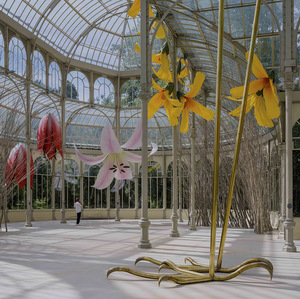


“To a raven and the hurricanes which bring back smells of humans in love from unknown places”: an elaborately titled but rather adorable exhibition at Madrid’s Reina Sofia’s Palacio de Cristal by Kosovar visual artist Petrit Halilaj in collaboration with his fellow artist (and partner) Álvaro Urbano.
A metaphorical nest with oversized oversized forsythia, palm seeds, cherry blossom, poppy, carnation, and lily blooms – all based on the elaborately decorated nests created by courting bowerbirds (Ptilonorhynchus violaceus): ‘a place for the celebration of love’, according to Halilaj.
Mmf.