






Author Archives: Chompsky
Hot Wheels
at
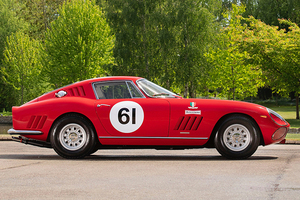


Behold: the 1965 Ferrari 275 GTB/C – one of 275 GTBs to have survived since they were first released in 1964, at least two of which are among the ten most expensive cars ever sold.
This vehicle however is one of only ten GTB/C variants produced in 1965. Three – including this one – were right hand drive. Still equipped with its original (Ferrari Classiche Department verified) frame, body, V12 engine and gearbox, it was purchased new by Irish motorsports mogul, Paddy McNally, before passing to European Formula 5000 winner and three-time British Saloon Car Champion, Frank Gardner.
Yours, with just under 134,000km on the clock, for an undisclosed but almost certainly vast sum of money.
X-Ray Sky
at
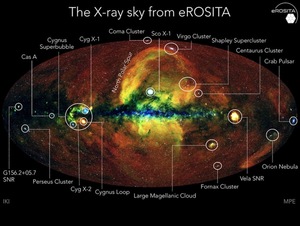
The night sky would present a very different vista if you had X-ray vision (and could tear your eyes away for two seconds from looking at people in their pants). To wit:
X-rays are about 1,000 times more energetic than visible light photons and are produced by violent explosions and high temperature astronomical environments. Instead of the familiar steady stars, the sky would seem to be filled with exotic stars, active galaxies, and hot supernova remnants. The featured X-ray image captures in unprecedented detail the entire sky in X-rays as seen by the eROSITA telescope onboard Spektr-RG satellite, orbiting around the L2 point of the Sun-Earth system, launched last year. The image shows the plane of our Milky Way galaxy across the centre, a diffuse and pervasive X-ray background, the hot interstellar bubble known as the North Polar Spur, sizzling supernova remnants such as Vela, the Cygnus Loop and Cas A, energetic binary stars including Cyg X-1 and Cyg X-2, the LMC galaxy, and the Coma, Virgo, and Fornax clusters of galaxies. This first sky scan by eROSITA located over one million X-ray sources, some of which are not understood and will surely be topics for future research.
(Image: J. Sanders, H. Brunner, A. Merloni & eSASS Team (MPE); E. Churazov, M. Gilfanov, R. Sunyaev (IKI))

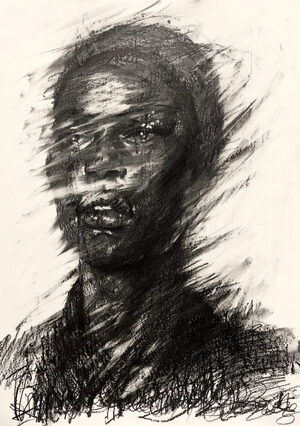


The fretted, smudgy, powerful deconstructed/reconstructed monochrome portraits of Korean artist GyoBeom An – all impressively rendered in thick pencil.
More of his work here.

Messiah Down
at
Tomas tweetz:
Seen this (yesterday) in a field at the back of a nursing home* in North Dublin.. Kinda sad I thought..
* St Doolagh’s nursing home, Kinsealy, Dublin.

Yesterday.
Colum Cronin tweetz:
Crossing the Grand Canal over McKenny’s [Mount Street] Bridge [Dublin 4]

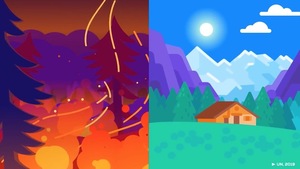

We are, silly.
German educational design studio Kurzgesagt lays out the science with its trademark authoritative calm. To wit:
Since the Industrial Revolution, humans have released over 1.5 trillion tonnes of carbon dioxide or CO2 into the earth’s atmosphere. In the year 2019 we were still pumping out around 37 billion more. That’s 50% more than the year 2000 and almost three times as much as 50 years ago.
Previously: The Coming Storm










Threenus
at
Three planets rising behind the Moon? No, just the one. And it’s not the Earth. To wit:
Just after sunrise two days ago, both the Moon and Venus also rose. But then the Moon overtook Venus. In the featured image sequence centered on the Moon, Venus is shown increasingly angularly close to the Moon. In the famous Earthrise image taken just over 50 years ago, the Earth was captured rising over the edge of the Moon, as seen from the Apollo 8 crew orbiting the Moon. This similar Venus-set image was taken from Earth, of course, specifically Estonia. Venus shows only a thin crescent because last week it passed nearly in front of the Sun, as seen from Earth. The Moon shows only a thin crescent because it will soon be passing directly in front of the Sun, as seen from Earth.
(Image: Dzmitry Kananovich)