
Author Archives: Chompsky

Behold: LDN 1471 – a windblown star cavity created by a newly forming star which can be seen at the peak of the parabola. To wit:

 This protostar is experiencing a stellar outflow which is then interacting with the surrounding material in the Perseus Molecular Cloud, causing it to brighten. We see only one side of the cavity — the other side is hidden by dark dust. The parabolic shape is caused by the widening of the stellar-wind blown cavity over time. Two additional structures can also be seen either side of the protostar, these are known as Herbig-Haro objects, again caused by the interaction of the outflow with the surrounding material. What causes the striations on the cavity walls, though, remains unknown. The featured image was taken by NASA and ESA’s Hubble Space Telescope after an original detection by the Spitzer Space Telescope.

(Image: Hubble, NASA, ESA; Processing & License: Judy Schmidt)

apod

An especially succinct précis of the Trump administration’s unhinged approach to the COVID-19 pandemic (published two days before today’s proclamation from Trumpton) by NYU Professor of Journalism, Jay Rosen.
The plan is to have no plan, to let daily deaths between one and three thousand become a normal thing, and then to create massive confusion about who is responsible — by telling the governors they’re in charge without doing what only the federal government can do, by fighting with the press when it shows up to be briefed, by fixing blame for the virus on China or some other foreign element, and by “flooding the zone with shit,” Steve Bannon’s phrase for overwhelming the system with disinformation, distraction, and denial, which boosts what economists call “search costs” for reliable intelligence.

Stated another way, the plan is to default on public problem solving, and then prevent the public from understanding the consequences of that default. To succeed this will require one of the biggest propaganda and freedom of information fights in U.S. history, the execution of which will, I think, consume the president’s re-election campaign.

MORE: The Plan Is To Have No Plan (Jay Rosen, Pressthink)

(Pic: via New Yorker by Andrew Caballero-Reynolds / AFP / Getty)

kottke

Behold: the Carina Nebula, aka The Grand Nebula – one of the very few nebulas visible to the unaided eye, but you have to be well south, looking south. To wit:

The featured image had to be taken from a very dark location to capture the Carina Nebula with such perspective and so near the horizon. The Great Nebula in Carina, cataloged as NGC 3372, is home to the wildly variable star Eta Carinae that sometimes flares to become one of the brightest stars in the sky. Above Carina is IC 2944, the Running Chicken Nebula, a nebula that not only looks like a chicken, but contains impressive dark knots of dust. Above these red-glowing emission nebulas are the bright stars of the Southern Cross, while on the upper left of the image is the dark Coalsack Nebula. This image was composed from six consecutive exposures taken last summer from Padre Bernardo, Goiás, Brazil. Even with careful planning, the astrophotographer felt lucky to get this shot because clouds — some still visible near the horizon — kept getting in the way.

(Image: Carlos Kiko Fairbairn)

apod

Behold: the 1975 Mercedes-Benz 600 Pullman Maybach W100  – the ultimate limousine of its day.

This car has had a seven year, €2.75 million upgrade and restoration by Mercedes-Benz Classic and Daimler AG including a complete rebuild of the 6.3-litre V8 and transmission despite having a mere 1,600km on the clock.

Get your Aristotle Onassis on for a trifling €2,140,000.

uncrate

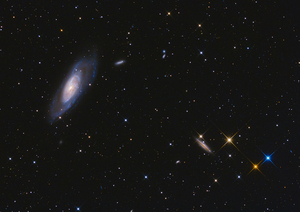
Behold: beautiful spiral galaxy Messier 106 (as it was about 17 million years before the evolution of humans), dominating a cosmic vista toward the well-trained constellation Canes Venatici, near the handle of the Big Dipper. To wit:

Also known as NGC 4258, M106 is about 80,000 light-years across and 23.5 million light-years away, the largest member of the Canes II galaxy group. For a far far away galaxy, the distance to M106 is well-known in part because it can be directly measured by tracking this galaxy’s remarkable maser, or microwave laser emission. Very rare but naturally occurring, the maser emission is produced by water molecules in molecular clouds orbiting its active galactic nucleus. Another prominent spiral galaxy on the scene, viewed nearly edge-on, is NGC 4217 below and right of M106. The distance to NGC 4217 is much less well-known, estimated to be about 60 million light-years, but the bright spiky stars are in the foreground, well inside our own Milky Way galaxy. Even the existence of galaxies beyond the Milky Way was questioned 100 years ago in astronomy’s Great Debate.

A closer look, perhaps?

(Image: Joonhwa Lee)

apod