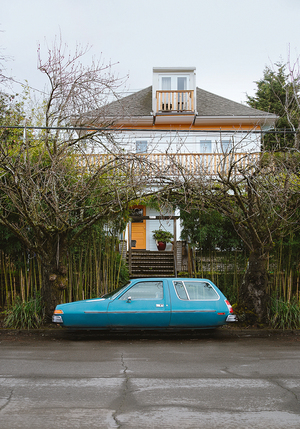


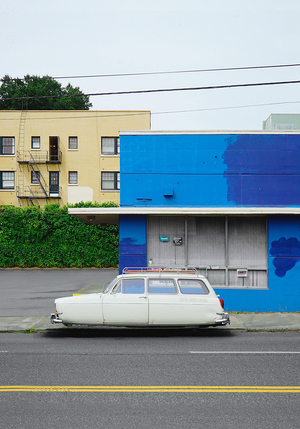

Just out of the ‘shop.
Photographer Jack De Caluwé adds his tuppence to an already crowded oeuvre.



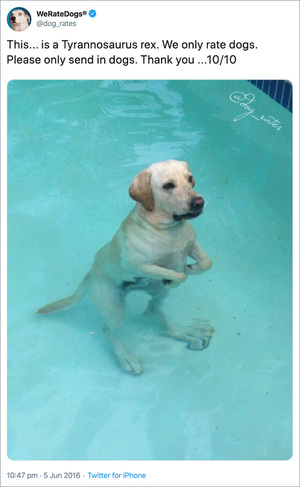





 The twitter account @WeRateDogs rates submitted pictures of dogs from 1-10.
Also, pictures of things that are clearly not dogs.


German educational design studio Kurzgesagt examines Peto’s Paradox. To wit:
Cancer is a creepy and mysterious thing. While we tried to understand it, to get better at killing it, we discovered a biological paradox that remains unsolved to this day: large animals seem to be immune to cancer. Which doesn’t make any sense – the bigger a being, the more cancer it should have. To understand why, we first need to take a look at the nature of cancer itself.
Previously: Got White Poison?


Behold: the entirely conceptual Bugatti Hypertruck – a vision of what could (but almost certainly won’t ever) be by designer Prathyush Devadas of Chinese auto firm Dongfeng.
The front of the eight-wheeler adopts the luxury brand’s signature ‘C-line’- with the drivers cab suspended inside. The prow, redolent of a futuristic steam-engine’s cow-catcher signifies progress and utility though, in fairness, none of this really signifies anything.
Still. Cool truck, yeah?


A crêpetacular short by Tom Wrigglesworth and Matt Robinson about a boy’s action packed voyage to the moon – in which pancakes (600 in total) are used as the medium of chNOMNOMNOMNOM.

A two-hemisphere view of earth’s night sky composited from images captured at two corresponding latitudes – one at 29 degrees north of the equator, the other at 29 degrees south. To wit:
On top is the northern view from the IAC observatory at La Palma taken in February 2020. Below is a well-matched southern scene from the ESO La Silla Observatory recorded in April 2016. In this projection, the Milky Way runs almost vertically above and below the horizon. Its dark clouds and and bright nebulae are prominent near the galactic centre in the lower half of the frame. In the upper half, brilliant Venus is immersed in zodiacal light. Sunlight faintly scattered by interplanetary dust, the zodiacal light traces the Solar System’s ecliptic plane in a complete circle through the starry sky. Large telescope domes bulge along the inverted horizon from La Silla while at La Palma, multi-mirror Magic telescopes stand above centre. Explore this two hemisphere night sky and you can also find the Andromeda Galaxy and the Large and Small Magellanic Clouds.
(Image: Petr Horálek/ESO, Juan Carlos Casado/IAC (TWAN))


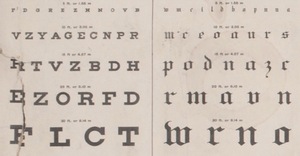
An international eye test chart (part of the collection of the US National Library Of Medicine) designed by German optometrist George Mayerle around 1907. To wit:
Running through the middle of the chart, the seven vertical panels test for acuity of vision with characters in the Roman alphabet (for English, German, and other European readers) and also in Japanese, Chinese, Russian, and Hebrew. A panel in the center replaces the alphabetic characters with symbols for children and adults who were illiterate or who could not read any of the other writing systems offered. Directly above the center panel is a version of the radiant dial that tests for astigmatism. On either side of that are lines that test the muscular strength of the eyes. Finally, across the bottom, boxes test for color vision, a feature intended especially (according to one advertisement) for those working on railroads and steamboats.
You can buy a limited edition print of it here.