



A rather adorable short by Daphna Awadish featuring the words of immigrants who’ve left their home and crossed borders for love.
Also, bears.
Mmf.



A rather adorable short by Daphna Awadish featuring the words of immigrants who’ve left their home and crossed borders for love.
Also, bears.
Mmf.



In production since 1957, the Sportster has long since been the Harley Davidson of choice for customisers.
This take on the 2019 XL1200CX by Taiwanese builder Winston Yeh features upgraded brakes, switchgear and suspension, dual pipe exhaust, one-off tail section, tank, and oil tank cover in black-on-black marbled carbon.
Easy now. It’s just for looking at.

Rob Cross tweets:
My restored and colourised c1890s Robert French photo of High Street in Graiguenamanagh “Gráig na Manach” (village of the monks) which is located on the River Barrow in County Kilkenny.





Behold the 2017 Alfa Romeo Disco Volante Spyder – one of 15 special edition ‘modern interpretations’ of the legendary 1952 Disco Volante experimental racecar. This vehicle, with a 450bhp Ferrari-derived 4.7-litre V8 engine and a six-speed paddle-shift transaxle was the last of seven based on the original Competizione Spyder.
With one careful owner and a modest 3,540km on the clock, it’s yours, complete with car-cover, documentation and its own bespoke luggage set, for an unspecified amount, on request.
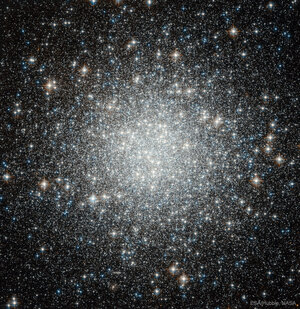

Behold: M53, aka NGC 5024 – one of the Milky Way’s 250 surviving globular clusters – a cosmic nightclub filled with stars, among them, late arrivals to the party, clearly under the influence of recent ‘refreshment’. To wit:
Most of the stars in M53 are older and redder than our Sun, but some enigmatic stars appear to be bluer and younger. These young stars might contradict the hypothesis that all the stars in M53 formed at nearly the same time. These unusual stars are known as blue stragglersand are unusually common in M53. After much debate,blue stragglers are now thought to be stars rejuvenated by fresh matter falling in from a binary star companion. By analyzing pictures of globular clusters like the featured image taken by the Hubble Space Telescope, astronomers use the abundance of stars like blue stragglers to help determine the age of the globular cluster and hence a limit on the age of the universe. M53, visible with a binoculars towards the constellation of Bernice’s Hair (Coma Berenices), contains over 250,000 stars and is one of the furthest globulars from the centre of our Galaxy.
Melon-twisting full sized image here.
(Image: ESA/Hubble, NASA)


The short lived 1989 Legend Of Zelda cartoon expertly re-dubbed by editor KhalidSMShahin with the voice of Link replaced by appropriately sourced dialogue from Beavis.
Butthead also features.

There’s a reason why stars appear to twinkle and it’s this: constantly moving pockets of slightly off-temperature air in the Earth’s atmosphere that distort the light paths from distant astronomical objects.
But how to counter the blur caused by this atmospheric turbulence? To wit:
The telescope featured in this image, located at ESO’s Paranal Observatory, is equipped with four lasers […] tuned to a colour that excites atoms floating high in Earth’s atmosphere — sodium left by passing meteors. These glowing sodium spots act as artificial stars whose twinkling is immediately recorded and passed to a flexible mirror that deforms hundreds of times per second, counteracting atmospheric turbulence and resulting in crisper images. The de-twinkling of stars is a developing field of technology and allows, in some cases, Hubble–class images to be taken from the ground. This technique has also led to spin-off applications in human vision science, where it is used to obtain very sharp images of the retina.
(Image: Juan Carlos Muñoz / ESO; Text: Juan Carlos Muñoz)
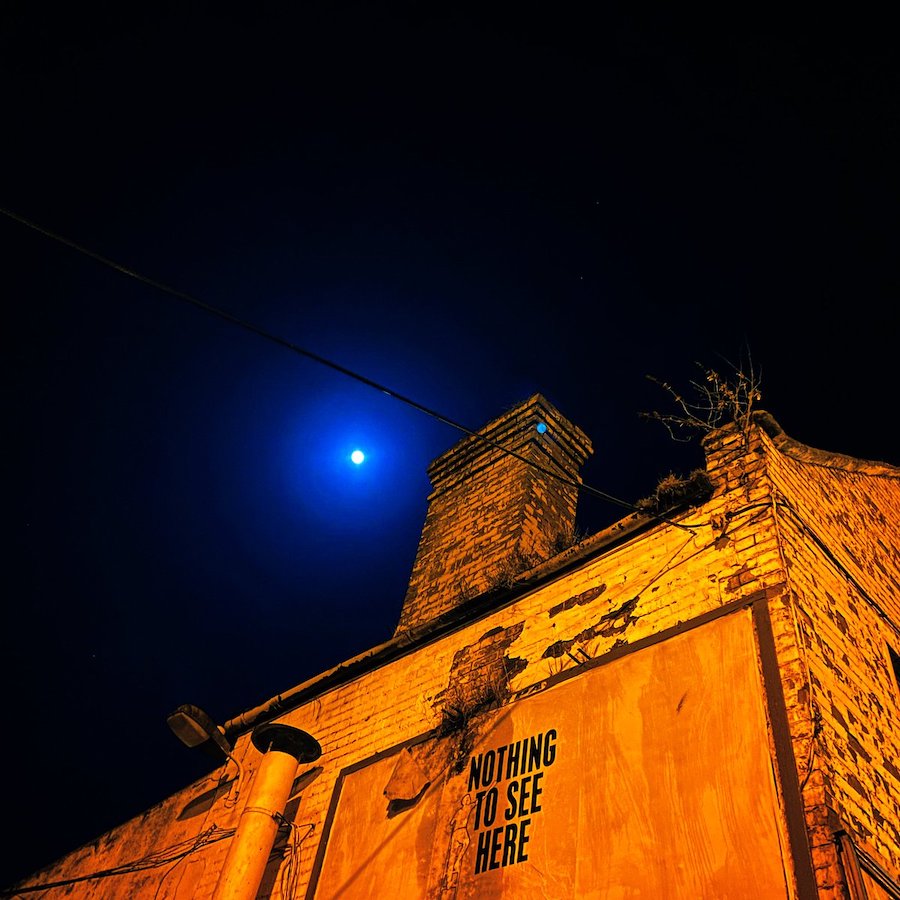
Last night. Clanbrassil Street Lower, Dublin
Colum Cronin tweets:
Billboard seems appropriate for a city under level 5 lockdown restrictions.


A 2015 short by animator and CG artist Antoine Delacharlery – a dreamlike immersion into the organic structures of Paris as if the city was a cell, viewed through the lens of a microscope.


