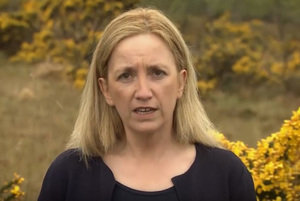

From top: Housing Minister Simon Coveney; Dr Rory Hearne
A strategy for the rent sector proposed by Housing Minister Simon Coveney which includes rent restrictions in Dublin and Cork city s due to come into effect in the new year.
Rory Hearne writes:
The government’s Strategy for the Rental Sector, while containing the welcome provision of rental restrictions is ultimately flawed because it does not link rent increases to inflation, excludes areas outside Dublin and Cork (particularly the commuter counties), does not provide security of tenure, proposes the sale of public land ‘below market value’ (i.e. give away/privatising a valuable public resource) to global real estate funds to increase ‘supply’, and is based on the failed (and contradictory) market assumptions that increasing rents will lead to further supply and increased supply will lead to affordable rents/house prices.
Firstly, in relation to the Strategy for the Rental Sector, there is no evidence or research provided by the government or the Department of Housing as to how the 4% increase in rents is being justified.
For example, 4% per annum represents 8 times the increase in annual earnings for full-time employees in 2015. It has no justification from price inflation as the (Consumer price index) is running at -0.3%. Within the CPI there is a specific category, Furnishings, Household Equipment & Routine Household Maintenance, which you would think would be a reasonable indicator as to the main on-going cost for landlords. Inflation for that category is running at -4.3%.
Furthermore, the most recent PRTB rent index for Dublin showed in the last quarter that rental growth moderated significantly, and fell to 0.6% and the annual % change for Dublin houses was 3.3% in Quarter 3 of 2016. So the 4% level is above this ‘market’ level. This is why rent increases should be linked to inflation (the CPI) which is running at -0.3%.
Secondly, it excludes areas outside Dublin and Cork from the designated ‘pressure-zones’. But it indicates they could be included at some point next year. All areas across the country have seen significant increases in rents in recent years – so why are they being excluded?
For example rent in Wicklow increased by 9%, Meath 15%, and Kildare 12% last year. Landlords are very likely (as is already reportedly happening today in Dublin) to inform tenants of substantial rent rises immediately in anticipation of being designated a rent pressure zone in these areas across the country in the coming months. This is why the entire country has to be included in the rental restrictions.
Thirdly, the Strategy for the Rental Sector does not sufficiently address the other major aspect of the rental crisis – that is security of tenure. There is no change to the situation whereby landlords can evict tenants if they intend to sell the property or want it for ‘family ‘use’ and there is insufficient protection for tenants being evicted from buy-to-let properties in receivership being sold on to vulture funds.
Without proper tenant security the rental sector is not a secure form of tenancy whereby people can make a long term home as tenants are left living in constant fear and threat of eviction and homelessness.
The rental strategy proposal actually gives landlords a potential incentive for evicting existing tenants.
Properties that are ‘renovated’ or not let for ‘two years’ are exempt from the rental restrictions so a landlord could evict lower paying tenants, engage in renovations (or leave it idle for two years) and then get new tenants in and charge them much higher rents – which gives the landlord a bigger return over the long term.
The Rental Strategy in fact could worsen security of tenure and homelessness through its proposal for a “fast track process…to enable landlords to regain possession quickly where the non-payment of rent constitutes the grounds for termination.”
Finally, the strategy does not address the fundamental issue of the current unaffordability of rents.
Rents are already too high. So rather than facilitating a further increase in rents there needs to be a strategy to reduce rents. An affordable rent is around 20% of your disposable income. Yet tenants are paying 50% and more on their rent and as a result are going without basic necessities in order to cover their housing costs.
An alternative strategy for affordable homes: A ‘New Deal’ for housing
What is needed to provide affordable rental and homes for ownership is a Roosevelt-like ‘New Deal’ for housing. A massive state-led house building and renovation programme that provides 30,000 affordable homes per year.
It could be done through a new affordable housing state authority – like the ESB delivered electricity across Ireland –that would launch a new housing tenure – community affordable housing involving housing for a broad range of income groups from the lowest income to average and above average income workers.
It would use the huge existing land banks – including that of NAMA – to build mixed income affordable community homes for rent and ownership. Crucially though, the land and housing would always be held ‘in trust’ by the state and not sold on the market – owners could sell it back to the trust – housing wold thus be kept affordable.
Local authorities, housing associations and co-operative housing associations could do it directly or through arms-length trusts. It is cost-neutral as the state can borrow at very low interest rates and it would make a return from the range of rents and ownership models. It would also direct some of the 500 million going to private landlords back to the state.
It could purchase and bring it to use the 35,000 vacant homes in wider Dublin area, and the 27,042 buy-to -lets in arrears (and derelict sites and land being hoarded by vulture funds, NAMA and developers.
Rental Strategy privatises much-needed public land
This is what the public land of local authorities should be used for and not, as the Strategy for the Rental Sector outlines, to be sold to private developers and speculators providing ‘build-to-rent. The proposal to sell off local authority lands is the most serious mistake (and indeed tragedy) in the rental strategy and the government’s wider housing plan.
Page 15 of the strategy outlines that, in order to ““Kick-start supply in rent pressure zones” …”Lands held by local authorities in rent pressure zones will be brought to market on a competitive tendering basis, with a view to leveraging the value of the land to deliver the maximum number of units for rental targeting middle income private rental households”.
This is a shameful use of public land – selling it cheaply for global vulture funds to provide ‘unaffordable’ housing. As the strategy notes through this land subsidy for private developers and financiers “the cost of providing rental units will be permanently reduced by lowering the initial investment and development costs for providers”.
Local authorities are being given immediate instruction, by end January 2017, to “identify a number of sites with the potential for up to 1,000 units of accommodation and will move forward, as soon as possible, to issue calls for proposals from parties interested in developing rental accommodation for middle income households”. As the report notes “these developments are potentially a major engine of growth of supply for the rental sector by tapping new sources of finance from institutional investors such as pension funds and Real Estate Investment Trusts”.
The ironic thing is the private interests who will get below market land from the state will then not be subject to the 4% restriction rent caps as they will be providing new housing. This is the same approach being used in the land initiative for public land in social housing estates like O Devaney Gardens and St Michaels Estate.This is a new form of Public Private Partnership, but as in the previous housing PPPs, the value of the land will be appropriate in the main by the developers and financiers.
Political Choice and Public Attitudes-time of opportunity
So there is a clear political choice here. To focus, as the government is, on achieving ‘supply’ through global wealth investors, vulture landlords and speculative property finance- or the state to lead in a historic programme of providing affordable homes for rent and ownership. One approach will enshrine unaffordable rental and house prices into the future and associated poverty and financial stress for large sections of our population.
It will increase economic inequality as wealth is transferred from the lower income groups in Ireland (renters, young people, first time buyers) to the top 10% wealth holders (from Ireland and across the world). the other approach can deliver and guarantee the human right to housing for all our citizens.
It is a choice the government, and we as a country, have to make. But it is one where we already know the outcomes for each path.
Dr Rory Hearne is a policy analyst, academc, social justice campaigner. He writes here in a personal capacity. Follow Rory on Twitter: @roryhearne
Rental strategy insufficient for affordable homes (Rory Hearne, Progressive Economy)
Previously: Rory Hearne on Broadsheet.ie