The absolute state of Griffith avenue @DubCityCouncil and the state of these lads- parked right across the cycle lane. 👍 pic.twitter.com/7bS582g1k5
— Dr Hilary Murray (@artboxhill) November 8, 2021
Ah here.
Thanks Alan Bracken



The absolute state of Griffith avenue @DubCityCouncil and the state of these lads- parked right across the cycle lane. 👍 pic.twitter.com/7bS582g1k5
— Dr Hilary Murray (@artboxhill) November 8, 2021
Ah here.
Thanks Alan Bracken


Good grief.
This afternoon.
Kevin Higgins, Galway-based poet and UK Labour Party member, upsets the party with some flagrant wrongthink.
Kevin sez:
“I will be contesting the case. I would like a copy of the ‘complaint’ against me. And I would like, indeed will be insisting on, the right to question in person this rather amusing “evidence” which all has to do with my sharing poems on social media.”
That’ll learn him.
Ken Loach video here
Previously: Kevin Higgins on Broadsheet
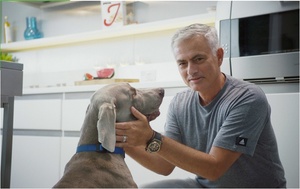
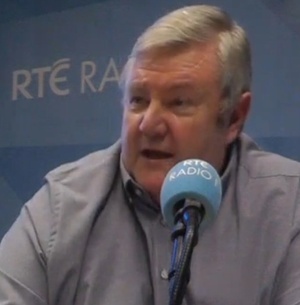 From top: Paddy Power campaign with football manager Jose Mourinho; Derek Mooney
Maybe it’s the recent media talk about the perils of online gambling. Perhaps it’s the publicity around Minister James Browne’s proposed Gambling Regulation Bill. Whatever the cause I am sure I am not alone in noticing a dramatic increase in the volume of gambling ads on TV, but especially, online.
It’s striking. I cannot count how many times I have heard “the special one” ad coming at me from my screens, both small and big.
I read somewhere that gambling adverts have now replaced beer and drinks adverts, in pre-eminence, particularly when it comes to an association with sports.
The argument is that gambling advertising has now filled the void left by the disappearance of beer advertising. It’s a potential void which also has an entertainment component, thanks to the vast amounts of money the big breweries spent on creating entertaining and memorable adverts.
Which brings me back to that annoying Jose Mourinho/Special One advertising campaign. It first appeared on our screens over two years ago. While it has none of the wit or creativity of a “Wassup” Budweiser commercial or the memorable Guinness dancing man ad of the 1990s, the ad’s makers knew their audience. So the ad is more targeted, including some clever easter eggs for the more informed viewer.
But could there be another reason why we seem to be seeing so many more gambling ads these days?
It is just to do with them replacing drinks ads, or might the pandemic have something to do with it? Could the reduced opportunities for us to pop down to the bookies to place the occasional bet, persuaded the gambling companies that they had to drive more of us to start using their Apps and websites?
Might this explain why some of the adverting, particularly the ones promoting online gaming and virtually casinos, have the underlying theme of: now that we cannot together in the real world, let’s get together to have a punt in the online world instead?
But it’s not just the volume of online gambling advertising that has risen. So have the problems. It’s as if the two things have some correlation. There is more than a little evidence that problem gambling has increased during the pandemic.
GamblingCare.ie, a website which aims to help people with gambling problems, observed back in March that its site was was seeing a 180% increase in visits. The website is funded and administered by the Gambling Awareness Trust, a charity funded by donations from the online and retail betting and gaming industry in Ireland.
Studies on gambling patterns during Covid-19 lockdowns found that while the general population gambled less frequently during lockdown, partly due to betting shops being closed, some forms of gambling increased.
Research from the University of Bristol and published in May, found that occasional gamblers were more than twice as likely (than before the pandemic) to gamble online, while regular gamblers were six times more likely to gamble online.
In these cases online gambling included playing online poker, bingo, and casino games.
Professor Alan Emond, of the University of Bristol’s Medical School, said:
“This study provides unique real time insights into how people’s attitudes and gambling behaviour changed during lockdown, when everyone was stuck inside and unable to participate in most social activities. The findings reveal that although many forms of gambling were restricted, a minority of regular gamblers significantly increased their gambling and betting online. As with so many repercussions of the pandemic, inequalities have been exacerbated and particularly vulnerable groups were worse affected.”
It can be entertaining to take a chance and have a bet on a race, a football match, or the outcome of an election. Most of us can gamble occasionally with no negative impacts. There is no argument for outlawing gambling.
But many cannot do this. Gambling can be a addictive and it is an addiction which causes huge problems for a sizeable number of us. The increasing move to online gambling may make is easier for many to have a harmless punt, but it causes a potential crisis for some, particularly young males. Minister James Browne’s move to regulate both advertising and online gambling is to be welcomed, but based on the experience of other countries it will take more than just a piece of legislation.
The phrase “gamble responsibly” now features prominently on many of these adverts, but what does it mean? Isn’t it an oxymoron that is along the lines of advising someone to drink drive soberly?
The phrase itself comes from the industry itself, being coined by a Las Vegas casino.
Though the sentiment behind it is well meant, the problem for many is that this approach takes all the blame away from the addictive nature of the games and puts it on the addicted player instead. To quote Sol Boxenbaum, a Canadian expert on gambling addiction:
“the compulsive gambler can no more gamble responsibly than the alcoholic can drink responsibly or the drug addict can inject cocaine or heroin responsibly.”
Derek Mooney is a communications and public affairs consultant. He previously served as a Ministerial Adviser to the Fianna Fáil-led government 2004 – 2010. His column appears here every Monday. Follow Derek on Twitter: @dsmooney
Pic: Paddy Power


This afternoon.
Dublin Airport.
Lady Liberty welcomed Aer Lingus customers back on board its long-haul service to the United States, as the ban on travel into the US was lifted. The airline has launched a 48-hour flash sale offering €100 off return flights to the US ending tomorrow at midnight.
I think I prefer the old uniforms.
Travel to US reopens for fully vaccinated (RTÉ)
Leon Farrell/Photocall Ireland

Trinity College Dublin (left) and The Berlin Wall in the 1980s
This morning/afternoon.
Via University Times:
Trinity Ents has cancelled an upcoming event inspired by the fall of the Berlin wall after criticism that the tone of the event was insensitive.
Tuesday’s “Fall of the Wall” event was due to coincide with the 32nd anniversary of the Berlin wall coming down. A 1980s-themed “Pick-n-Mix” will now take place instead.
A statement on the Trinity Ents Instagram story said: “We have made the decision to change the theme for Tuesday’s event.”
“It came to our attention that this is a sensitive topic for many people, and that this theme was causing offence”, the statement said. “As an apolitical, student-run organisation, we never meant to cause offence, and apologise that we did.”
After Criticism, Trinity Ents Cancels Berlin Wall-Themed Event (David O’Connell, University Times)
Meanwhile…
After criticism from whom? The Stasi?
What is happening with students nowadays?@tcdalumni https://t.co/NAtxK0XTqS.
— Shrillsiren (@MikadoofJapan) November 8, 2021
Anyone?

‘sup?
Last night/this morning.
But is Oscar the Grouch anti-vax, as rumoured?
We may never know.
Meanwhile…
Brought to you by the letter P for Pfizer. https://t.co/f8ffZ0ex6t
— Dr. Joseph Mercola (@mercola) November 8, 2021
Pfight!

The stars of The Little Mermaid, this year’s Gaiety Panto
Just found out I cannot bring my kids to the Gaeity panto this year. They are requesting the discrimination cert. Bought the tickets in Dec 19. It has been an annual family tradition. 😭🎄
— Crazy Mum (@CrazyMu84137572) November 8, 2021
This morning.
Oh yes they did.
Boo, hiss.
Meanwhile…
My son is 5 and autistic. He is being denied speech and occupational therapy because my wife and I are unvaccinated.
We are not even allowed to drop him off and pick him up.
This is just sick. Even if I was vaccinated, HE wouldn’t be!
— Geronimo 🇦🇺 ✝ (@NototyrannyNOW) November 8, 2021


Valerie Judge and Ava Kenny read Gerry The Giraffe Goes To Hospital in The Gutter Bookshop, Dalkey, county Dublin this morning.
This morning.
Dalkey county Dublin.
‘Gerry Giraffe Goes To Hospital’, a children’s illustrated book written by mother of two Valerie Judge during lockdown, demystifies the experience of hospital for child patients.
Via Gerry Giraffe Goes To Hospital:
Valerie Judge, a management consultant who has returned to her artistic roots, wrote and illustrated ‘Gerry Giraffe Goes to Hospital’ during the pandemic lockdown.
The book is inspired by Valerie’s daughter Anna Rose McKeever who trained in CHI Crumlin and is now a cardiac children’s nurse at Great Ormond Street hospital in London and knows all about the anxieties children may have when going to hospital.
Gerry Giraffe Goes To Hospital‘ is on sale from Amazon at €20 per copy. To find a copy, search in your browser for ‘Gerry Giraffe Goes To Hospital’ by Valerie Judge, or visit the Gutter Bookshop (at link below).
Pic: Sara Hanley

Yesterday.
Why is Covid ‘surging’ in Ireland despite almost 100 per cent vaccine uptake?
Via Sky News:
Waterford, in south-eastern Ireland, epitomises the country’s coronavirus conundrum. Why is there a surge in COVID-19 in a nation where around 92% of adults are fully vaccinated?
A huge 99.5% of over-18s in Co Waterford are double-jabbed, but the easing of restrictions and increased travel are thought to be contributing to high infection rates.
Speaking to Sky News, Immunologist Professor Luke O’Neill also added that the “primary goal” of jabs is to “stop illness and death” – not to eradicate the virus.
I’m Just going to throw this out there.
Could it be something in the jabs?
*edges slowly from room*
FIGHT
Earlier: Get It In You
Meanwhile…
…Ireland’s National Immunization Advisory Committee (NIAC) has advised its government not to include healthcare workers in its COVID booster roll-out.
De Bara explained this decision to the Irish Times: “Most Healthcare workers have adequate immune systems, and it is unlikely they will need serial boosters as COVID doesn’t change at the same rate that flu does.”
This was a complete reversal of the government’s previous policy in January, suggesting it is undergoing a major rethink. Then, out of the first 94,000 vaccines that were administered, 71,000 (76 percent) were prioritised for those very same healthcare workers, over the elderly who were most at risk of dying from the disease.
The Irish government’s vaccine booster program is being made available for all over-60s—unless, it appears, they are frontline health care workers. This will now begin in January or February of next year as this third jab is understood to be most effective when administered five to six months after receiving the second one.
And the biggest take-up of vaccines in Ireland, particularly the second jab, took place during the months of July and August 2021, which were the very same months that fatalities began to rise again in Ireland.
Could there be a correlation between those two events?
Anyone?
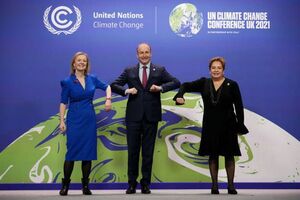
From top: Taoiseach Micheál Martin is flanked by British Foreign Secretary Elizabeth Truss (left) and United Nations Framework Convention on Climate Change Executive Secretary Patricia Espinosa (right) as he arrived for day two of COP26 on November 1 in Glasgow, Scotland; Eamonn Kelly
The week that was
Most people instinctively sense that when politicians start making promises they might as well be blowing up balloons. A politician’s promise has a half-life that can be counted in minutes and there is no reason to suppose that this will change relative to the importance of the issue at hand, in this case, climate change.
It would be nice to be optimistic, but with capitalism married to consumption and the majority of politicians in its back pocket, we are ultimately dependent on the largesse of a few billionaires to save the world, which is a whole new species of philanthropism.
Still, it was good to see the Cop 26 conference go ahead, even if Russia and China couldn’t be arsed sending a representative. But the fact of the conference taking place is a bit like the US having to acknowledge the possible existence of God. Even if they don’t believe in a deity, they at least have to cut their cloth to make it seem like they do.
So, in that sense the conference may serve some positive purpose. But realistically, what are we actually going to do to save the environment? Stop consuming? Sit in the cold and the dark eating cold beans waiting for the climate to right itself? Is anyone seriously going to do that?
But not to worry. The politicians are on the case, hoping to create new markets of consumption in the sale of electric cars, windmills and solar panels, continuing with the basic paradigm of capitalism, endless consumption, greenly tweaked by politicians.
Fine Words
Boris Johnson most likely has a team of researchers working full time to find the right things for Boris to say, which they then type up and put before him. But by the time the words move from Boris’s eyes to his mouth they invariably develop a patina of a sneer, and somehow, despite the fine words, Boris’s sub-textual message is always one of smirking insincerity.
He was at it again at COP 26, immediately turning the conference into Cop-Out 26. It’s Boris’s brand of cynicism that will likely finish us, because it’s everywhere, residing comfortably in high places.
Micheál Martin seemed delighted to be on the world stage at last, framing a first for a Fianna Fail taoiseach in setting out his stall to save the Earth. Prior to this they were happy luring multinational companies to set up base in Ireland. But Micheál is going for the big one before handing the reins back to Leo.
The Irish Examiner reported that Facebook is responsible for disseminating up to 90% of the climate denial rubbish that appears online, and the majority of it comes from less than twelve identifiable pages, which Facebook refuses to close-down because that might undermine their click-based business model. Mark Zuckerberg, estimated to be worth $98 billion, still apparently needs those few extra cents from fake news merchants.
Blackouts and Copouts
Facebook’s activities, along with Google, may also result in blackouts here in Ireland in the near future, because data centres are hogs for electricity and when push comes to shove the tax-free corporate giants will get first preference. It’s important that they safeguard your data to sell to advertisers because that’s the business model that helps sustain the economy, and the cost for you may be sitting in the dark while your data is being cooled by 24/7 computer fans.
Michael’s contribution towards saving the Earth might begin by paying a visit to Facebook down the road and maybe use the tax exemption deal as a lever to put some pressure on Facebook to close down those climate denial pages, and maybe reduce some of that data hoard and free up the grid for people to charge their new electric cars.
The problem with politicians managing the climate crisis, and with corporations pledging all kinds of reforms, is that both are winners in a capitalist system that relies on cynicism to make its sales.
You can have your markets for windmills and electric cars and solar panels, but until the cynicism that lies at the root of market capitalism is faced head on, all of it will be just the same old marketing spin, with advertising shaping up to sell a shiny, hollow version of environmentalism, without ever challenging the fundamentals of capitalism, such as perpetual growth and built-in obsolescence. Maybe it’s time to start fixing machinery again rather than dumping it. That would be something.
Turning Point
Cop 26, though it was peopled by many of the leading cynics of the corporate consumer system, sporting their spin, was also a positive gesture in the face of that cynicism, most notably in the figure and words of naturalist David Attenborough, and in its sincere attempt to put survival of the species on the agenda, ahead of apparently more important considerations, such as Mark Zuckerberg’s click profits.
David Attenborough, who, at 95, likely won’t be with us much longer, could see the conference in its historic perspective, in the way in which it might be viewed in 50 or 100 years, either as a turning point, or as a last missed opportunity.
Eamonn Kelly is a Galway-based freelance Writer and Playwright. His weekly round-up appears here every Monday.