

From top: Taoiseach Enda Kenny at the Low Pay Commission report on the minimum wage last year; Michael Taft
The relationship between wages and competitiveness is not a crude reductionist equation.
We pay a real cost for our low wage levels.
Michael Taft writes:
There is a narrative among the Left that claims that capital has not wasted the recessionary opportunity, that capital has exploited the crisis to depress wages in order to boost profits.
We should, of course, be sceptical about such sweeping narratives. We live in a complicated, complex world where exceptions and caveats invariably rule.
So let’s test this claim and see if it holds – at least in Ireland; at least on the issue of wages.
There are many ways to measure wages (Dr. Tom Healy of the Nevin Economic Research Institute looks at it this way). I will use employee compensation as a percentage of Gross National Income (GNI).
Employee Compensation: this is made up of the direct wage (what the employer pays the employee) and the ‘social’ wage (what the employer pays into a social insurance or similar fund – out of which employees access public services at below-market costs such as health, and in-work benefits such as sick-pay, maternity benefit, etc.).
Gross National Income: this is essentially GNP. This is not an optimal benchmark as it excludes a significant amount of wealth that is generated in the economy.
However, it does have the advantage of excluding both multi-national profits that are generated in other countries but end up here for tax avoidance purposes, along with profits that are actually generated here but then repatriated. Therefore, GNI is the bottom-line of bottom-lines.
So how do Irish workers fare?
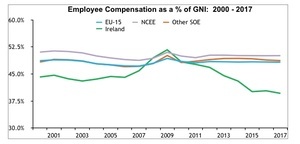
We don’t fare well.
Up to the crash, when wages were rising, Ireland was still below the main European comparators – the EU-15, Northern and Central European economies (NCEE – this excludes the poorer Mediterranean countries), and other small open economies – (Other SOE, countries with a similar open, export-dependent structure: Austria, Belgium, Denmark, Finland and Sweden).
When the crash hit, the graph shows Irish wages spiking but one has to be careful. Between 2007 and 2009 wages rose – as a proportion of GNI (from 46 to 52 percent of GNI); yet, during this period total wages actually fell by 6 percent. In fact total wages fell a further 8 percent up to 2012.
The reason for the spike is not rising wages but falling national income.
But as we came out of the recession, wages didn’t recover their pre-crash levels. Between 2000 and 2007, Irish wage levels averaged 44.2 percent of GNI. In 2017, the EU estimates this will have fallen to 39.6 percent.
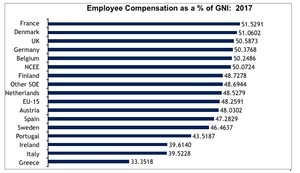
And it’s not like Ireland is a ‘poor’ country.
When we measure GNI per capita we find that Irish levels are 10 percent higher than the EU-15, marginally ahead of Northern and Central European economies and at that same level as other small open economies.
Unite the Union recently published its The Truth About Irish Wages. Using EU labour cost data it found that Irish wages are well below the European benchmarks.
But the real story is how low Irish wages in low-paid sectors are.

Irish compensation levels in these sectors are well below the average of other European countries – well below.
The Irish low-paid are ultra-low paid.
Some might argue that we need low wages so that our exports are/become/remain competitive. However, other small open economies have much higher wage levels than we do and it doesn’t seem to affect their export levels.
Further, in our main export sectors – chemicals/pharmaceuticals and the information & communication sector – our wages are at average European levels. These sectors haven’t been affected negatively.
The relationship between wages and competitiveness is not a crude reductionist equation.We pay a real cost for our low wage levels.
First, is the low level of tax revenues. Taxes on labour are higher than taxes on capital. Therefore, when the latter is privileged, tax revenues are not optimised.
Second, our business sector suffers from low levels of consumer income. This not only affects businesses that primarily sell into the domestic markets; it makes it difficult for domestic businesses to transition to export markets.
Moving into exports requires a considerable investment which higher sales revenue from domestic income can help finance.
Third, it affects workers’ living standards and especially those in sectors that are reliant on discretionary spend; less revenue coming into sectors like restaurants means less money that goes on pay.
So, yes, those lefties and their sweeping narrative appear to be on to something. Now we have to start debating how we write another narrative.
Growing wages to the European level – including both direct and social wages – is one of our main challenges. We need a strategy to make a fundamental shift from an economy reliant on low wages and low-paid sectors.
This goes beyond just increasing wages. It is about creating high-road employment and businesses that are focused on investment, R&D, re-skilling and innovation, rather than sweating labour.
The big question is: do we have the capitalists to do that?
And if we don’t, what do we do then?
Michael Taft is Research Officer with Unite the Union. His column appears here every Tuesday. He is author of the political economy blog, Unite’s Notes on the Front. Follow Michael on Twitter: @notesonthefront