Category Archives: Misc

Screen Shot 2016-05-25 at 15.32.32000c4a0b-642

Gardaí at Avondale House Flats in North Cumberland Street yesterday morning, stills from CCTV footage released to media


Further to the shooting of father-of-one Gareth Hutch yesterday morning outside Avondale House complex on North Cumberland Street, Dublin – which was captured on CCTV and distributed to media outlets

Dublin City Social Democrats Cllr Gary Gannon, who represents and was born in Dublin’s North Inner Cityl, writes:

Whatever you may think about the so-called feud and the people involved, at the end of the day, these are human beings and to circulate footage of a man being butchered on a city street is akin to circulating a snuff movie. It is grotesque and does society a huge disservice.

If we allow these victims to be dehumanised in such a way then we, as a society, abdicate responsibility for maintaining law and order and protecting all citizens equally.

Whatever about those who released the footage I firmly believe it is incumbent on our media not to provide a platform for this type of footage which has the effect of sensationalising these murders as if we were dealing with an episode of Love/Hate rather than a real family and their loved one.”

Rollingnews

GBKMidadoTT

GULP!

Sinéad  writes:

Ireland’s iconic Jacob’s Mikado biscuit is the inspiration for Gourmet Burger Kitchen’s mind-meltingly good new milkshake, The GBK Mikado Shake! Available from today (Wednesday, 25th May) for a limited period,.

This new must-try concoction is cool, creamy, coconutty, strawberry swirled and best of all, topped with an actual Mikado!

The GBK Mikado Shake is now available from all five GBK restaurants, priced €4.75. You can find GBK at South William Street, South Anne Street and Temple Bar in Dublin City Centre and Swords and Liffey Valley.

It tastes even better than it looks 50 free shakes being given out from 3pm today. Just rock up and ask!!

To celebrate we have a meal for FOUR at Gourmet Burger Kitchen with a GBK Mikado Shake for dessert to giveaway to a Broadsheet reader.

To enter, just complete this sentence:

‘Biscuit-wise my most pleasurable dunking experience involves a (name of biscuit) into a cup of (name of beverage)’

Lines MUST close at 4.45pm 6.30pm

GBK

Screen Shot 2016-05-25 at 14.28.56Screen Shot 2016-05-25 at 14.32.50

From top: Garda Commissioner Nóirín O’Sullivan and Justice Minister Frances Fitzgerald at the launch of ‘joint agency response to crime’ strategy last November; Clare Daly

Independents 4 Change TD Clare Daly spoke to Audrey Carville on RTÉ’s News At One this lunchtime.

The interview came after Garda Commissioner Nóirín O’Sullivan released a statement at midday, saying, “I can confirm that An Garda Síochána’s legal team was not at any stage instructed to impugn the integrity of Sergeant Maurice McCabe or to make a case that he was acting maliciously.”

Grab a tay…

Audrey Carville: “Just to repeat, Nóirín O’Sullivan states, ‘I can confirm that An Garda Siochana’s legal team was not, at any stage, instructed to impugn the integrity of Sergeant Maurice McCabe or to make a case that he was acting maliciously. We’re joined now by Independent socialist TD Clare Daly. Clare Daly, thanks for joining us, do you believe the Commissioner when she says that?”

Clare Daly: “I think she’s saying very little. I think, if you read it carefully, her statement is very well put together. She’s selecting the word, ‘integrity’ which of course, we know from the leaked transcript, was exactly the expression used by her senior counsel Colm Smyth in November [2015] when he said the integrity bit was his words but she’s very silent on the allegations which were upheld that they were instructed to question the credibility and motivation of Maurice McCabe. And I think while she says and we can take it maybe, in some sense, they had to cross examine the evidence of everybody including Maurice McCabe, and I think everybody would accept that but this wasn’t about cross examining the evidence, this was about questioning his motivation, his credibility and having two senior officers prepared to give false testimony to back that up. And those allegations are still unanswered.”

Carville: “But isn’t she right though? In relation to the documents that have been leaked, she calls it the selected information purporting to relate to these proceedings out into the public domain, the transcripts of no more than three minutes of what happened at a Commission which ran for 34 10-hour days.”

Daly: “I think it’s interesting that she did choose to focus on that and says they’re selective but she doesn’t say they’re not true and they’re very comprehensive in their entirety of what they’re claiming and the claim hasn’t been denied anywhere – that Garda authorities instructed their legal team to basically go in and give false testimony to mislead the Commission as regards the credibility and motivation of Maurice McCabe…”

Carville: “How do you know that though? You can’t say that for certain.”

Daly: “I can say that for certain. And nobody disputed it any where, including the Garda Commissioner. To say that the evidence that was leaked is not valid or that it’s only part of the story – that’s not the case. It’s a very comprehensive transcript which stands up in its own ground and that added to other testimony that I’m absolutely aware of that the Garda legal team adopted an incredibly adversarial approach to Maurice McCabe where it was repeatedly stated at the Commission that he was, in effect, being put on trial – that treatment was not given to anybody else. I think it’s interesting that the Commissioner says she’s now asked the minister to investigate the matter of the two senior officers but the reality is is that this claim, with these two officers, was made over a year ago and it was only withdrawn last November – just before, on the eve if you like, of Noirin O’Sullivan herself giving evidence to the Commission. But if that information was out there, which it was, why hasn’t she, as the Garda Commissioner, already investigated that matter and why is she doing it now that it’s in the public domain because she’s aware of it.”

Carville: “Do you welcome though that it has gone to GSOC to investigate?”

Daly: “I think sadly GSOC are not equipped to deal with these matters adequately, it’s interesting that she talks again about dissent not being disloyalty for the current Garda whistleblowers whose cases are before GSOC. They haven’t been able to get a proper hearing and dissent is very much disloyalty under Noirin O’Sullivan’s watch as far as they’re concerned. So I don’t think GSOC are adequately equipped to deal with this. I’m glad somebody is investigating but to be honest with you, the real answers have to come from the Minister for Justice [Frances Fitzgerald] who, in legislation, ultimately is accountable for the behaviour of the Commissioner and I don’t think she’s accounted for her actions adequately. I think this is a longer statement basically saying what she did the last time and hiding behind confidentiality and legal points which have not been validated by any independent source again talking about Section 11 of the Commission of Investigation which is factually incorrect because that simply deals with evidence and the information here is not evidence, it’s a legal position being put forward.”

Carville: “But if there was a position, if there is an implicit admission in this statement that perhaps Sgt McCabe’s motivation and credibility were to be challenged, before the Commission, isn’t that fair enough because, as she says, the Gardai were being subjected to the most serious of allegations, from Maurice McCabe. So, in any court, isn’t the person making the allegations cross examined to the fullest?”

Daly:I’d be fully in favour of evidence being cross examined and indeed motivation can be but that’s entirely different to senior garda officers, in order to substantiate that, being prepared to give false evidence to the Commission. And that big, giant elephant is still in the room because that is a fact that has been undisputed and we need answers on that because that evidence was apparent to the Commissioner as late as a year ago and nothing has been done on it. Now we’re being told she is going to do something on it, or asked the minister, that’s not good enough for the head of An Garda Siochana. We’re talking about, in essence, perjury to a sworn commission. It’s highly serious.”

Carville: “But we don’t know exactly what those two senior Garda were prepared to do because it hasn’t made it in to the final report. And it’s not really dealt with in any of the leaked documents either.”

Daly: “And it is very much out there in the public domain, that the Garda Commissioner’s statement hasn’t answered it, and we need very clear answers on it, I mean I’d like to know, for example, why is Noirin O’Sullivan only acting on it now?”

Carville: “But it’s only a suspicion, Clare Daly, about what the two senior officers did. And she is now referring it to GSOC to be investigated.”

Daly:The people who were at the Commission are very clear on what the two officers said, very, very clear and there were quite a number of people at that Commission and I honestly believe the truth will out and I’m perfectly satisfied and safe, if you like, in saying that they were prepared to give evidence to mislead and only withdrew that when taped evidence was produced by Maurice McCabe to say what they had said was not true. That was the trigger that led to it being withdrawn. This man could have been ruined had be not had that tape recording.”

Carville: “Yeah, well, the matter is gone now to GSOC to investigate that and, as I say, it’s not fully clear from Mr O’Higgins’ commission that was indeed the case. Some people have said that it is time to draw a line under this. That nothing good can come from repeatedly going over this same situation in relation to Maurice McCabe, what do you say to that?”

Daly: “I think we can’t move forward until we honestly deal with what has happened. And I think we have repeatedly made the point that since the exit of Commissioner [Martin] Callinan and Minister [for Justice, Alan] Shatter, unfortunately, under the watch of Noirin O’Sullivan, and Frances Fitzgerald, the same very bad practice regarding the vilification of whistleblowers has continued and there’s nothing new in that and we know that from the treatment of Keith Harrison and Nick Keogh, current Garda whistleblowers, whose dissent has been very much treated as disloyalty. These people are out of work sick, they’ve been vilified, demonised, their life has been made an absolute hell – all on Noirin O’Sullivan’s watch…”

Later

Carville: “Thank you very much indeed, Independent socialist TD Clare Daly. And just to reiterate that no allegations have been proven against two senior gardai, that they deliberately misled the O’Higgins commission.”

Listen back in full here

Previously: Nóirín Speaks

Rollingnews

75%rentincreaseevictionswagesrent

Dublin’s rental crisis.

Private tenants get their hashtag on.

Finally.

Sive Bresnihan writes:

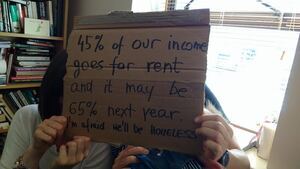
Sky-high rents, chronic mould and regular evictions. These are just some of the problems tenants are sharing via social media as part of the #rentripoff campaign.

The campaign was launched by the Dublin Tenants Association, a support and advocacy group for tenants in the private rented sector.

The DTA have launched the campaign to get public support behind their submission to the government’s Oireachtas Committee on Housing and Homelessness. The submission calls for the immediate introduction of measures to regulate rent increases and to provide security of tenure for tenants.

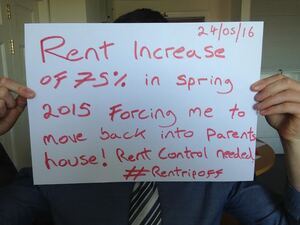
Using the #rentripoff tenants have already shared stories of 75% rent increases, repeated evictions and dreadful conditions.

The DTA are calling for rent certainty measures to link rent increases to the Consumer Price Index, echoing similar proposals from Threshold and housing experts like DIT’s Dr. Lorcan Sirr. The DTA are also calling for a number of measures to strengthen security of tenure:

End the ‘grace period’ whereby landlords can end a tenancy at any time during the first 6 months without any reason;

End the right or landlords to end a tenancy because they require the property for family use

End the right of landlords to end a tenancy due to sale of property.

FIGHT!

Dublin Tenants Association

Screen Shot 2016-05-25 at 13.15.02

Fine Gael MEP Brian Hayes

They say the most important part of a debate is defining the arguments. Suzanne Lynch’s excellent article explaining TTIP (Transatlantic Trade and Investment Partnership) is a perfect example of how TTIP opponents have been successful in defining what an EU-US trade agreement, like TTIP, might contain.

Opponents to Atlantic trade are focusing on the straw men of genetically modified food and hormone-treated beef. Let’s be clear – no EU trade agreement will ever lower our level of protection of consumers or food safety. European food standards are not up for negotiation.

Many of these issues arose in the EU-Canada trade deal and were resolved. The scare tactic put forward of some sort of malevolent investor court ruling for multinationals against governments is not borne out by history.

Investment protection exists in 1,400 bilateral agreements signed by EU member states since the 1960s. These have not stopped governments legislating in the public interest. Little if any attention has been given to the massive steps forward for workers rights and the environment a potential trade agreement between Europe and America could bring.

The sustainable development provisions the EU negotiators put forward are the most ambitious provisions on sustainable development, labour protection and the environment put to any trading partner. Europe’s negotiators want TTIP to include the International Labour Organisation’s core standards. The sustainable development chapter ensures high standards for labour and addresses health and safety at work and workers’ rights.

TTIP allows Europe to bring our environmental standards on biodiversity, shipments of chemicals and waste, and sustainable management of natural resources to bear on a global scale. The EU legal text enhances co-operation between the EU and US to fight illegal logging, illegal fishing and the illegal trade in endangered wildlife.

TTIP would make it easier to trade goods and services that help us tackle environmental problems, such as climate-friendly and resource-efficient products. We have an international agreement to combat climate change, and TTIP can help us implement it.

International trade negotiations are complex and cannot be boiled down to a slogan on a placard. The details of TTIP need to be discussed openly, honestly and fairly. A good start is to look at the totality of the negotiating documents and not straw men put forward by opponents to trade.

Brian Hayes MEP,
Donnybrook,
Dublin 4.

TTIP negotiations and global trade (Irish Times letters)

Previously: Luke’s TTIP

Leah Farrell/Rollingnews

90374533

Garda Commissioner Nóirín O’Sullivan

“The O’Higgins Commission Report presents inescapable lessons for An Garda Síochána, based on our shortcomings in a number of critical areas including our dealings with whistleblowers.

We must radically and permanently change that pattern and we will apply the insights and learnings from our recent experiences in developing a Garda Whistleblower’s Charter. As will be detailed below, actions to address this have already been undertaken and others are in progress.

There are clear constraints around the question of making public comment about this matter. I cannot offend against the basic principles of the rule of law; and that regard must be had to the statutory confidentiality of Commission proceedings, the relationship between lawyers and their clients and questions of basic fairness.

With reference to my previous statement of the 16th May 2016, there have been calls for further clarification regarding the instructions given to the legal team representing An Garda Síochána and the approach adopted by it, in relation to the proceedings of the Commission.

What is at the heart of the present controversy is that, despite legal prohibitions and the clear view expressed by Mr Justice O’Higgins about the confidentiality of the Commission’s proceedings, certain selective information purporting to relate to those proceedings has been put into the public domain.

By “selective”, I mean transcripts of no more than three minutes of what happened at a Commission which ran for 34 ten-hour days, generating thousands of pages of transcripts. This has been accompanied by an unsourced and unverified account of an alleged part of the proceedings.

Whatever the sources of information or misinformation that has been put into the public domain the inevitable effect is the risk to public confidence in An Garda Síochána being damaged in a very unfair way.

Mr Justice O’Higgins, as the Sole Member, having had the opportunity to hear and examine 97 witnesses and weigh the submissions made by the legal representatives of all parties subject of the proceedings, decided what should and should not be included in his Report.

In this context, it is worth noting that the Commission points out that it conducted its proceedings with particular regard to its duty of compliance with the requirements of constitutional and natural justice.

As Garda Commissioner, having fully accepted the findings of the Report, it falls to me to move swiftly to implement its recommendations. This I have done.

While it is important to dispel any public concern in relation to this issue, I have to be mindful of section 11 of the Commissions of Investigation Act 2004 which provides that a commission shall conduct its investigation in private. I am advised that everyone involved in the proceedings of the O’Higgins Commission is bound to respect the privacy of those proceedings.

Furthermore, in relation to communications with the legal team representing An Garda Síochána, it is important in terms of receiving advice and giving instructions that privilege in such communications is protected so as not to adversely impact on the workings of An Garda Síochána and its entitlement to seek and obtain legal advice on a confidential basis in this instance and in the future.

These constraints, which reflect important principles of law, restrict my capacity to address the issues which have been raised in relation to the approach taken by An Garda Síochána before the O’ Higgins Commission.

However, I can confirm that An Garda Síochána’s legal team was not at any stage instructed to impugn the integrity of Sergeant Maurice McCabe or to make a case that he was acting maliciously.

I would emphasise that the overriding objective of An Garda Síochána, and its legal team, was at all times to assist the Commission in carrying out its statutory functions and to establish all relevant facts in relation to the matters referred to it for investigation as set out in its terms of reference.

This brings me to the charge which is in the public domain that is the most difficult to deal with sensitively and which is one of the reasons I have been reluctant to enter into public comment about this matter.

Whatever its source, the net charge that is now being made is that the credibility and motivation of Sergeant McCabe was challenged. I can only deal with this on the basis of what is set out in the Commission Report and I am conscious that this involves dealing with certain findings in relation to allegations of corruption and malpractice.

I have no wish to rehearse this matter again but it is simply impossible not to do so in addressing it.

As Commissioner of An Garda Síochána I have a duty to all its members and former members. Having regard to the nature and seriousness of the allegations, and the duty to assist the Commission in its task of establishing the facts and truth, I cannot see how it would be in any way unreasonable, improper or avoidable to appropriately test and cross examine the evidence of all persons giving evidence to the Commission including Sergeant McCabe.

The Commission found, in relation to certain allegations; these hurtful allegations to be unfounded and in at least one case based on a belief, but unsupported by evidence, and that those against whom such complaints were made lived for many years under the strain of those allegations.

An Garda Síochána is fully accountable for its actions or indeed inaction. We operate fully within the framework of accountability and oversight which the Oireachtas sets. I will be appearing before the Policing Authority tomorrow where I will deal with these matters to the fullest extent possible.

In addition to the above, I have taken the following steps to address other matters arising:

There has been a suggestion in recent reportage that two senior officers had sought to misrepresent before the Commission the contents of a meeting they held with a Sergeant in Mullingar in 2008.

In those circumstances, and in order to resolve any public disquiet, misplaced or otherwise which may arise, and in the interest of fairness to all involved, I have requested the Minister for Justice, pursuant to her powers within the Garda Síochána Act, to refer that aspect to the Garda Síochána Ombudsman Commission for the purpose of investigating it in the public interest.

• On receipt of the Report, I directed Deputy Commissioner John Twomey to fully examine the content, findings and recommendations of the Report and to address any issues arising from that examination, including lessons learned that may further inform An Garda Síochána’s Modernisation and Renewal Programme. The programme which addresses, among other things, the fundamental issues arising in the O’Higgins report in relation to renewal of our culture, training, supervision, victims support and investigative practices, will be formally published in early course.

• In relation to whistleblowers, I have been consistent at all times: dissent is not disloyalty and as a service we are determined to learn from our experiences. An Garda Síochána agrees that whistleblowers are part of the solution to the problems facing the service. In this regard, yesterday we met with representatives from Transparency Ireland who have agreed to work with us to create an environment to ensure protected disclosures and people making them are welcomed and protected in An Garda Síochána.

• A Protected Disclosures Manager has now been appointed and we have begun establishing a dedicated team who will be appropriately trained to oversee all matters related to whistleblowers.

In conclusion and as stated at the outset, An Garda Síochána fully accept the findings of the O’Higgins Commission and we are committed to learning all lessons and fully implementing the recommendations.”

A statement from Garda Commissioner Nóirín O’Sullivan released at midday.

Previously: ‘They Tried To Blame McCabe For Everything. It Was Bullshit’

Clarifying Matters

Rollingnews

planet_pollution_vectorluke_holland_headshot

From top: Glum globe; Luke Holland

GDP tells us how big an economy is.

But says nothing about what things going on inside all that economic activity.

Relentless overconsumption and environmental destruction to name just two.

Luke Holland writes:

There is certain cognitive dissonance hidden between the lines of both the Paris Climate Agreement and the new global development framework approved last year at the United Nations.

“Agenda 2030”, a set of 17 goals and targets approved at the United Nations in September, covers everything from ending hunger and poverty to reducing inequality and combatting environmental degradation, while the Paris Agreement promises to keep global warming within manageable limits.

These proposals are laudable in their scope and ambition, but there is a deliberate naivety in their insistence that all this can be done within the same old vision of endless growth that has caused most of our problems in the first place.

In effect, these documents promise to achieve the world’s social and environmental goals while also facilitating eternal economic growth; in so doing, they propose to bring about a global transformation without rocking the boat of relentless overconsumption.

Many of those who were involved in the negotiations accept that infinite growth in a world of finite resources is simply not possible, but discussion over alternative ways to measure economic success has remained in large part a subject for the margins.

Corporate domination of both sets of talks successfully ensured that perpetual growth remains the prime objective of economic planning, even as this model of exponential consumption carries us into the abyss of environmental disaster

Admittedly, breaking the habit of a lifetime is no easy task.

The relentless pursuit of growth has, for many decades, been the most fundamental goal of global economic policy. So widely accepted is the wisdom of this approach that to question it generally results in being branded, at best, an idealist.

But as the global capitalist system continues to stagger forward with multiple enmeshed crises besetting it on all sides, it is becoming more and more difficult to ignore the shortcomings of our most prized economic indicator.

The problems with GDP as a measure of economic health are well-known. Originally thought up by the US and British governments during the Great Depression, it provides a quantitative snapshot of economic output. By simply measuring all goods and services produced over a given time period, it tells us how big an economy is but doesn’t say anything about what’s going on inside all that economic activity.

As such, the production of cigarettes and firearms, for example, is deemed just as valuable as the provision of healthcare services, while clearing huge swathes of rainforest to make way for agro-industrial farms that fuel, rather than ameliorate, climate change is likewise recorded as worthwhile economic activity.

GDP also ignores the distribution of resources, so one individual making a billion dollars while a million starve is considered better than that same million making $999 each – the aggregate figure is all that counts. The myriad non-market services that an economy depends on, such as parenting and community-building, are likewise left out of the equation.

In recent years, the need for better ways to measure economic health has become increasingly urgent, and several governments and development agencies have set about designing alternative indicators. Perhaps the best known of these is the UN Development Program’s Human Development Index, which combines statistics on life expectancy, educational achievement, and per capita income to deliver a composite evaluation of economic development and human wellbeing.

Another measure that has been gaining ground is the Genuine Progress Indicator, which takes GDP as its base but makes deductions for social ills including inequality, crime and environmental degradation, along with additions for positives such as volunteer work and leisure time.

But none of these metrics have come anywhere close to dislodging – or even challenging – GDP when it comes to evaluating economic performance, and perhaps this is not surprising.

Alternative systems of measurement would go some way to shifting the goals and motivations of development efforts and, with this fact foremost in their minds, powerful elites with a vested interest in maintaining the status quo will do everything they can to prevent such changes. As the old saying goes, “we measure what we treasure, and treasure what we measure”.

Some are already arguing that infinite growth in a world of finite resources is, in fact, possible, and that it can be achieved without destroying the planet. As technology advances, they say, greater energy efficiency will rein in environmental degradation. But the pattern of recent decades shows that greater energy efficiency tends to lead to higher consumption, not less pollution.

They will also push the idea than an information-based economy will ‘decouple’ from resource use. But again, the pattern we have seen in recent years shows that, although economies are becoming less material intensive, economic growth more than outweighs the gains garnered through ‘decoupling’.

We may generate more wealth per unit of resources used, but we are still using more resources, and creating more waste, overall.

So what would a post-GDP economic system look like? The British philosopher John Stuart Mill believed that economic growth should eventually give way to a steady state economy, in which both capital and population levels remained constant. As societies matured, he predicted, individual greed would ebb away as cooperative enterprise became more and more the norm.

“It is scarcely necessary to remark that a stationary condition of capital and population implies no stationary state of human improvement,”

There would be as much scope as ever for all kinds of mental culture, and moral and social progress; as much room for improving the art of living and much more likelihood of its being improved, when minds cease to be engrossed by the art of getting on.”

Is this a utopian proposal? Perhaps, but there can be little doubt that our current pursuit of endless growth is no longer feasible. As the environmental crisis has intensified, more and more economists and environmental experts have been forced to state the unthinkable; that we are going to have to consume less. And the key issue here is that we are going to consume less.

The only question is whether we reduce our consumption in a controlled way or, alternatively, lurch forward into an environmental collapse which will in turn force this reduction upon us.

As John Maynard Keynes once said, “the difficulty lies not in the new ideas, but in escaping from the old ones”.

Luke Holland is an independent human rights and development consultant. He is the author of the Center for Economic and Social Rights briefing ‘Mauled by the Celtic Tiger: human rights in Ireland’s economic meltdown’.

Top pic: Adobe (rights agreed)