Category Archives: Misc

babybecken-BB_40x30_12C1049 inselbad-sprungturm_12C1303 Leo-Sprungturm2_12C1185 mineralbad-BB_-40x30-12C1043 sifi-sprungbecken-40x30_12C1124 Vaihinger-kinderbecken-2_12C1341

A series exploring the privatisation of a public asset (water) by German photographer Stephan Zirwes. To wit: private swimming pools observed (and isolated) from a helicopter. Sez he:

The pools and people are real, I only copied parts of the original pool tiles and enlarged them in a simple, visible way to create a kind of mount in patterns.” The removal of distractions only focuses our attention more fully on the pools themselves. These pools are reserved for private usage and are a massive waste of drinking water. Public pools can still be a symbol for the importance that water should be free and accessible to everyone.

featureshoot/thisisnthappiness

Human Rights Watch released a report today in relation to the deportations that have taken place from Greece to Turkey, as part of the EU/Turkey deal – of which Ireland has contributed €22million.

The report paid particular attention to Chios island where the UN claimed 13 people – 11 people from Afghanistan, and two people from the Democratic Republic of Congo – were wrongly deported on April 4.

The report states:

In visits to the VIAL detention center on Chios on April 7 and 8, Human Rights Watch spoke with 12 friends and one relative of 19 Afghans who were deported from Chios on April 4.

Based on those interviews and text messages exchanged between those interviewed and the deportees, Human Rights Watch documented an array of irregularities and violations.

The authorities did not inform people that they were going to be deported, did not tell them where they were being taken, and did not allow some of them to take their personal possessions.

According to the UN Refugee Agency, thirteen of those deported from Chios had expressed a desire to seek asylum in Greece, and that number could be higher,

The Greek authorities appear to have hurried the forced returns from Chios, and the 136 other deportations that day from the nearby island of Lesbos, to meet a publicized deadline for the start of returns under the ill-conceived EU-Turkey deal that went into effect on March 20, 2016.

That deal allows the return of asylum seekers to Turkey on the presumption that Turkey is safe for asylum seekers and refugees.

…The deportations from Chios began around midday on April 3, when Greek police at the VIAL detention facility took dozens of people to the main building [Tabakika] where police and Frontex register new arrivals, and where the Greek asylum service is located.

The authorities separated the 66 people they had identified for return, witnesses said. The 12 friends and one relative of the 19 deportees, who did not want their names published, told Human Rights Watch that the police had called people on the false pretext that they were to be registered, including for asylum.

“Salim,” a 24-year-old man from Afghanistan, said the police took three of his Afghan friends, Ilias Haqjo, Mohammad, and Reza (full names unknown), all between 20 and 25 years old, without their possessions.

“They came here and told them they have to go to register,” he said. “They left happy and when they came out the police were waiting for them…. If the guys knew they were going to be deported, they would have taken their bags, their papers, their money.”

On the other side, in Dikili, Turkey, the authorities hung blue tarps on the fence around the registration tents to block journalists and human rights monitors from contacting the deportees. The police commander at the area denied a Human Rights Watch request to access the site.

The deportees were then loaded onto buses and driven away. Police at the site told Human Rights Watch that they were headed to Kirklareli, near Edirne, and the media subsequently reported that the people deported from Greece were being held at the Pehlivankoy removal center in that town.

The deportees on the buses in Turkey, however, seemed not to know where exactly they were going. “Now we’re in the bus, they’re taking us to a camp,” Mohsen Ahmadi wrote his friend “Amir” around 3 p.m. “Why there?” “Amir” asked. “I don’t know, the camp is near Istanbul,” Ahmadi replied.

“When you arrive, let us know,” “Amir” wrote. “OK,” Ahmadi wrote back at 8:28 p.m., but that was the last message that “Amir” received.

Human Rights Watch collected the phone numbers of four of the people who were deported from Chios on April 4. As of April 18, none of them had replied to messages on Viber, the application they had been using. When called, three of the phones appeared to be shut off and one of the numbers was not working.

The legal basis of confiscating phones from people being deported, if any, remains unclear. Given that asylum seekers and migrants rely on their phones to stay informed and to keep in touch with family, such measures appear unnecessary and cruel, as well as a violation of the individuals’ personal property rights, Human Rights Watch said.

EU/Greece: First Turkey Deportations Riddled With Abuse (Human Rights Watch)

Previously: Meanwhile, On Chios

‘Is Our Response To Be Defined By Barbed Wire, Tear Gas And Rubber Bullets?’

UPDATE:
12985627_10154133891423620_2194855552103379206_n

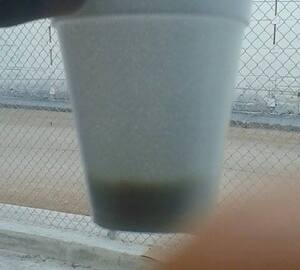
The amount of powdered baby milk each infant in Vial allegedly gets every day

Further to the picture (above) circulating on social media last Thursday…

Patrick Kingsley, of The Guardian, reports:

Babies detained in Greece under the terms of the EU-Turkey migration deal are being denied access to adequate supplies of milk formula, refugees and aid workers have alleged.

Approximately 25 babies under the age of six months, whose mothers are unable to breastfeed, are being given roughly 100ml of milk formula just once a day on the island of Chios, according to photographs sent by detained refugees and testimonies provided by phone.

… A 35-year-old Afghan construction manager, detained in a detention centre on Chios since 21 March, said he had been forced to mix water with bread to stop his five-month-old daughter going hungry.

The man, who said he worked as a contractor for the British army in Afghanistan but asked not to named for fear of victimisation, said: “They are only giving us half a cup of milk for all 24 hours – but that’s not enough. There’s no more milk for lunch or dinner or during the night. This is a big problem. There are maybe 24 or 25 babies under six months.”

The Norwegian Refugee Council, which maintains a presence on Chios, confirmed the claim and said the number of infant children may even be higher. “It’s clear that baby milk [formula] is not being routinely distributed,” said Dan Tyler, the NRC’s protection and advocacy officer on Chios. “I did a series of meetings with refugees last week, and mothers brought up [the issue of] baby milk all the time.

Refugee babies detained on Greek island ‘not getting adequate milk’ (Patrick Kingsley, The Guardian)


corkairport

Dr Maria Gonzalez, a dermatologist, and her husband arrived in Cork Airport (top) recently, on their way to Kerry for a conference at which Dr Gonzalez was speaking, when her husband was stopped by immigration officials for allegedly smelling of marijuana.

Dr Gonzalez has a British passport while her husband has a French passport. They were the only black people on their flight.

In an interview with PJ Coogan, of Cork’s 96 FM, Dr Gonzalez explained:

“After I got out of the toilet, I saw him [her husband] standing by, what I didn’t know at the time was an immigration officer. And I came up to my husband and I said, ‘what’s happening?’ And he said, ‘he said to wait here’. So obviously, I don’t think the officer realised I was with my husband, so I stood waiting with him aswell.

“And he said, ‘oh you’re travelling with him?’. I said, ‘yes’. And once he had waved everybody off that flight off and they had gone to get their bags or whatever, then he looked at my husband and said, ‘you, come with me, because you’re smelling of marijuana’, or something to that effect.”

“In other words he accused him of having a smell of marijuana, you know, on him…Then a couple of Customs officers appeared. One was female, one was male, he also called another person on his phone while he was standing there, saying, ‘come along, are you free to come and help us’ because obviously we were terrible criminals, he needed loads of people to help him.”

They then started saying, ‘Even the passport smells of marijauna’ and so on. So, of course, I’ve never been in Ireland, nor my husband, and it’s a very surreal moment when you’re caught in this kind of exchange and, even though I do a huge amount of travelling, and so we just kept very quiet and just cooperated and went along with our bags and put them wherever they said to and, during the course of the search of our bags – now it was only two small bags because  we were only there for two nights – one of the immigration officers, one of the Customs officers actually, handed my my husband’s passport and said, ‘can’t you smell marijuana on this?’ And I said, ‘well I don’t know the smell of marijuana and this smells like a passport to me’. And I gave it back to him.”

“It was a very unusual series of circumstances and when the staff came and joined him and he was now searching my bag, I actually said, ‘this is only, I’ve been in the UK for 23 years and travelling all over the world and nothing like this has ever happened’, so I said, ‘where are the sniffer dogs because, you know, sniffer dogs, they have 10,000 times the sense of smell as humans which is why they are used for this. And I said, ‘this is a very unscientific approach’. That’s all I said. And he said, ‘well I have 30 years’ experience of doing this kind of work’ and I thought, ‘well that’s it then’.”

“…[Later] they kind of mumbled, they didn’t say, you know, ‘you can go because we found nothing, sorry to keep you’ or anything, they kind of mumbled that since they didn’t have sniffer dogs that we could go.”

“So it was almost like, ‘well, we couldn’t really find what was going on so you can go now’. So, I was happy to take that but the immigration officer, obviously wasn’t best pleased that it ended like that. And he then said, started to target my husband and started shouting at him saying that my husband was insulting his intelligence. In other words he was saying that, you know, he didn’t believe any of this.”

“And then he said to him, ‘so I’m going to caution you, I’m going to caution you, I’m going to keep your details on the system and if you come back into Cork, you know, you’ll be arrested and I think at that point my husband probably said, ‘don’t worry, I won’t ever be back to Cork’.”

“I think that incensed him more and then he started shouting at me and saying that I had insulted his intelligence too. So I was concerned this was not going in the right direction…”

Dr Gonzalez has made a formal complaint about the incident.

Thanks Deirdre O’Shaughnessy

9041569090415624

This afternoon.

Castleknock Hotel, Castleknock, Dublin 15

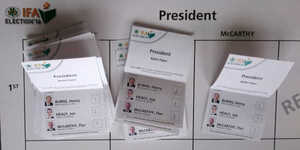
Irish Farmers Association (IFA) Presidential candidate Joe Healy (top) watching the results come in for the 15th President of the IFA. Joe is currently leading a field that includes Henry Burns and Flor McCarthy.

More as we get it.

Rollingnews

Update:

90415631

Semi-formal tallymen in the Castleknock Hotel this afternoon doing their thing. Tallying mainly.

Rollingnews

90415653

90415649

The lads.

This afternoon.

Talks between Fianna Fáil and Fine Gael on the formation of the next government relocate to Trinity, College Dublin.

Top pic, Fine Gael:  from left: : Leo Varadkar, Simon Coveney and Paschal Donohoe.
Bottom pic: Fianna Fáil, from left: Barry Cowen, Michael McGrath, Charlie McConalogue and Jim O’Callaghan.

Sam Boal/Rollingnews

[soundcloud url=”https://api.soundcloud.com/tracks/259595293″ params=”auto_play=false&hide_related=false&show_comments=true&show_user=true&show_reposts=false&visual=true” width=”100%” height=”450″ iframe=”true” /]

Oireachtas Retort’s latest podcast:

Abortion in Ireland and lack thereof.

OR writes:

This show begins with Fláiva Simas from Galway Prochoice reading a migrant’s perspective on Savita Halappanavar. A musical interlude from Sissy and then I am joined in conversation with Niamh Puirséil and Máiréad Enright. Topics covered include just about everything from law, politics, respectability and media ‘balance’.

Closing things out, Linda Kavanagh from the Abortion Rights Campaign and Goretti Horgan from Alliance For Choice give us an activist update from north and south.

Oireachtas Retort Podcast Episode Three (Oireachtas Retort)

Thanks Oireachtas Retort

Screen Shot 2016-04-18 at 16.00.11

Paddy Slattery

Paddy Slattery is an award-winning filmmaker living in Tullamore, Co. Offaly.

When he was 17, he became paralysed following a car crash on the way to his construction job on Monday, October 14, 1996.

On the morning of the crash, the van in which he and his workmates would normally travel in was being repaired and they got a lift from a stranger.

In a radio interview with Colm Flynn for BBC World Service, Paddy explained how the crash happened and how, ultimately, it led to him becoming a filmmaker.

From the interview…

Funny enough, a strange car pulled up beside us and literally let down the window and said, ‘do yiz want a lift, lads?’. I was thinking, ‘this is a miracle’ because the chances of that happening for three people, three strangers… And, I swear to god, I’m not just saying this for the sake of saying it. But I remember getting in, I didn’t recognise the driver and I remember thinking, ‘I should put on my seatbelt’.”

“And I literally, for a few seconds, in my mind I was thinking, ‘oh maybe I will, maybe I won’t. I remember saying, ‘you know what? I won’t put on the seatbelt’ because this driver beside me, I didn’t know who he was from Adam, but I knew he was kind of young enough and I thought, ‘jeez, maybe I’ll offend him’ if I put on my seatbelt.”

“As we were going to overtake [a] van, the van happened to pull out to overtake a tractor which was parked on the lefthand side of the road and I knew we were running out of road.”

After he was told he was paralysed…

There was no anger, no resentment. I don’t know, an amazing thing happened. When your body switches off, well at least for me, my imagination actually switched on and that’s when I literally began a process of self-discovery, understanding who I actually really was – that’s where I discovered the possibilities I suppose.”

“The boundaries started to withdraw and the canvass became blank again and I started, I guess, to paint my own picture of what I thought life was all about. My own imagination, my own power of attention could alter my physical reality, not just that but also physically heal certain wounds.”

“…Essentially, for two or three years, my life after that accident, I was 24/7 being looked after, I had people around me all the time, no privacy and I really valued my private space.”

“So I’ll be honest with you, I was given a gift of a keyboard at that time with a piece of paper and I was set up in a little room in my house and I was basically left to my own devices and I was sitting in that room and I started literally expressing myself like, I don’t know, nobody’s business. I just constantly had so much to say and that was my channel for saying it.”

On his award-winning short, The Moment

“…I had spent a lot of time in hospital, I was put in a geriatric ward which basically means I was in a ward with a lot of older people. Now I could look across the way, through the gap of a curtain into another guy who was in a bed across from me, an old guy. Now I didn’t realise at the time but he was in the process of passing away.”

“Tragically, there was no visitors, only a nurse who sporadically popped her head, in and out of the curtain, and that was it, he was wheeled out at two o’clock in the morning.”

“I felt, here’s a guy who just went through the process of the second most important part of his life, there was no one there to celebrate or even remember it with him and my heart was broken for this guy. So I sat down and wrote this little short story, called The Moment about basically the last ten minutes of this guy’s life.”

“And we tried to figure out, what is his motivation? Does he want to stay alive to hear the results of the hurling match on the radio? Does he want to stay alive to hear the punchline of the joke Paddy is telling across the ward or is there something else that drives him forward and we eventually find out in the story…”

“I got very lucky, I sent the script to a guy called Mark McAuley, a BAFTA-award winning cinematographer. He calls me one day, out of the blue, and says, ‘Paddy, I printed out your script and I read it out to my family at the breakfast table and I’m blown away by it, I want to make this film with you’. And I said, ‘Mark, I’m afraid I can’t afford you, I was chancing my arm sending it.’ He said, ‘forget about the money, I’ve a few connections, let’s make this film’.

We made the short film and suddenly it takes me all over the world, I think it was screened in over 50 different film festivals around the world, it won awards in Mexico, Africa, India, it was nuts. It was a story that basically translated to every audience…”

Listen back in full: “My body switched off but my mind switched on” (BBC World Service)

Thanks Paddy