
Category Archives: Misc

milesahead
https://www.youtube.com/watch?v=CeBR3Jo0FHM

What you may need to know:

1. Sorry… What?

2. Don Cheadle directs himself in this biopic of Miles Davis.

3. He should have directed himself to speak up a bit.

4. “Mumble mumble jazz mumble guns mumble mumble nice bit of heroin. *Cough*.”

5. Cheadle also co-wrote the script. He’s taken some obvious liberties with the truth.

6. Broadsheet prognosis: Have you seen this cat?

Release Date: April 22.

burton

This morning.

Ormond Quay, Dublin 1.

Paul D writes:

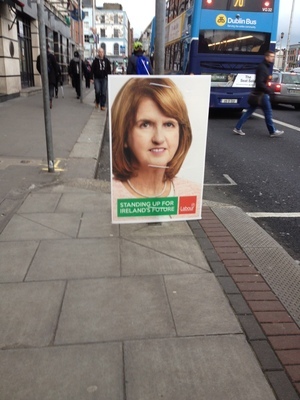
You’d want to be blind to fall for her!

Meanwhile…

CacRgmVWwAAlTnL

This morning.

Some Dad writes:

Council workers removing low hanging Renua & FF posters on the Malahide Road Dublin 5

Meanwhile…

byrne

Last night.

Jane writes:

Fianna Fáil Thomas Byrne advertising transport taking up 3 spaces in Stamullen, Co.Meath

feb4poll

poll

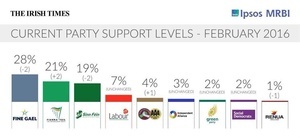
Today’s Irish Times/Ipsos poll

Today’s poll.

What does it all mean?

Shane Heneghan writes:

At face value, there is little to take away from this poll. Fine Gael would seem to have a pre-campaign ceiling of just below 30%. Fianna Fail and Sinn Fein are up and down 2% respectively which would suggest that moderate Republicans may be headed home to the soldiers of destiny. Perhaps this is a back and forth worth watching in the run up to the 1916 commemorations.

Labour on 7% seem to be struggling with their goal of getting to a base of 10% but of even greater concern to them will be the disappointing score of 11% in Dublin- home to most of their safer seats. Fianna Fail are also on 11% in Dublin and this will be the most negative ‘takeaway’ for them here as they seek to reclaim some of their losses from 2011.

Renua and the Social Democrats remain within the margin of error and the perceived wisdom that they will both be doing well to hang on to their sitting parliamentarians seems to be true.

When we break down the numbers demographically, it is interesting to see that if only farmers were allowed to vote Fianna Fail would probably be heading towards an overall majority. Fine Gael are similarly way out ahead with the high income AB group. In terms of age groups, both of the two civil war parties continue to do best among the over 65s.

All of the four main party leaders have alarmingly low approval ratings ranging between 28 and 32% – all of them down somewhat bar a minor increase for Joan Burton. This would hint at much disenchantment with politics in general.

This is the last ‘peace time’ poll before the campaign proper and the high number of voters backing independents and others (usually quite a fickle group) coupled with a reasonably large amount of undecideds would indicate the prospect of lot of voter volatility once the party machines get into full swing.

The glaringly obvious thing to note here is that were these numbers subbed into a general election, it’s likely that the heretofore nearly unspeakable “notion” of a Fine Gael/Fianna Fail grand coalition- (perhaps we could call it the “ara-sure-it’s-grand” coalition*) would be the only combination that might yield a stable government. The leadership of both parties may be faced with the unpalatable choice of this shotgun wedding versus another election within six months.

*Note to self -trademark this term

Shane Heneghan is Brussels-based election expert/Irish political anorak/poll number-cruncher and an integral part of Broadsheet’s ‘crack’ General Election 2016 team.

2015-03-28_iri_8173451_I1

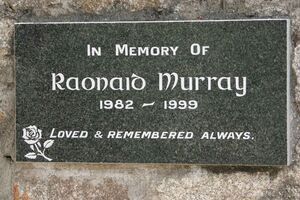
Raoinaid Murray

Gemma O’Doherty writes:

A key suspect in the murder of Dublin teenager Raonaid Murray has been shielded for almost 17 years due to Garda misconduct during the original investigation, a source close to the case has alleged.

The suspect knew the 17-year-old student well and had a personal grudge against her, the source claims.

Raonaid was repeatedly stabbed just metres from her home in Silchester Park, Dun Laoghaire, Co Dublin on September 4, 1999.

Her body was found by her sister minutes after the attack, which took place around midnight. The murder weapon is believed to have been a kitchen knife.

The original Garda investigation was crippled by a litany of ‘mistakes’ which many say point to a cover-up.

It has come to light that ever since her killing some gardai had evidence that the suspect knew her well.

Raonaid was not the victim of a sexual assault or theft.

The alleged motive for the attack centred around a personal disagreement between her and her attacker, the source asserts.

The suspect was prone to violent outbursts and has since attacked at least one other female.

It is alleged the individual has never been questioned properly by An Garda Siochana for Raonaid’s murder and was treated leniently in the early stages of the investigation.

After the killing, a relation of the suspect expressed serious concerns about their involvement but no action was taken.

Unusual behaviour by the individual in the period after the murder, and beyond, was also ignored.

The person subsequently came to the attention of gardai in relation to other matters.

New evidence has also emerged aboutthe behaviour of the lead officer in the original investigation, Detective Inspector Eamon O’Reilly

His failure to investigate vital evidence in the days after the murder provided the key suspect with immunity from investigation, claims the source, who adds that suspicious activity by other individuals who knew the suspect was ignored.

It is also believed that a house the suspect attended on the night of the murder was never adequately searched despite a number of unusual events that took place there.

A Cold Case review of the case, which began in 2008, identified several mistakes in the original investigation including the revelation that no search of the killer’s potential escape route was ever carried out.

Now in their 30s, the suspect lives periodically in Dublin. They are prone to aggressive outbursts, takes medication for violent mood swings and has assaulted at least one other woman. The individual has also been in psychiatric care.

Pic: An Garda Síochána

Raonaid-Murray-scene-190115117

Raonaid was the daughter of Deirdre and Jim Murray, a principal in a local boys’ school. She had two older siblings Daniel and Sarah.

She had just completed her Leaving Cert when she was killed and was hoping to study Arts in UCD.

An avid reader who loved poetry, her dream was to become a professional writer.

At the time of the murder, she was working in a clothes shop called Sally West in Dun Laoghaire Shopping Centre and was preparing to repeat the Leaving Cert at the Institute of Education on Leeson Street.

On the night she was killed, she finished work at 9pm and went for a drink with a friend in Scott’s Bar, a short walk from her home.

She left at about 11.20pm, and was planning to go home and change before going to a night club.

When she got to Silchester Crescent, a laneway close to her home, she was heard having a row with a person she knew. Witnesses heard her telling the person to ‘Fuck off’ and ‘Leave me alone’ before letting out a loud scream.

As she tried to drag herself away, the killer continued to attack her until she could no longer walk and collapsed. She died at the scene.

Claims several years ago that a blood-marked kitchen knife was found on the rooftop of an abandoned building very near the murder scene have never been formally verified by Gardai.

Gemma O’Doherty


000a0c9b-642 Mazars-logo

From top: RTÉ Investigations Unit; auditors Mazars

On December 17, 2014, journalist Ken Foxe sought from the Houses of the Oireachtas, under FOI, copies of invoices and receipts submitted by 22 TDs and Senators.

Every year the expense claims of 10% of national politicians are randomly audited by Mazars.

It was these politicians Mr Foxe was focusing on for an RTÉ Investigations Unit project, called No Expenses Spared.

On January 16, 2015, this request was refused with the Oireachtas claiming it never physically held the records. It claimed the records passed from the politicians to Mazars.

On February 9, 2015, Mr Foxe sought an internal review of this refusal.

But, on February 25, 2015, the Oireachtas again refused claiming, under section 42(l) of the FOI Act, that the records Mr Foxe was seeking were considered to be the politicians’ ‘private papers’.

Further to this, Mr Foxe, who lectures at the Dublin Institute of Technology, writes:

That seemed to me to open the door to their release. It seemed clear to me that the Oireachtas were no longer relying as strongly on the idea that they did not hold the records – when the invoices and receipts were so clearly in possession of a contractor that they had employed.

Equally, the idea that the “private papers” argument could really apply to invoices and receipts that had been issued from local newspapers, or other such businesses, seemed a stretch.

Similar material has, as we know, been routinely released under FOI in the past in Ireland, and of course in the United Kingdom.

Solicitor Fred Logue – who worked closely with Gavin Sheridan on a number of high-profile cases over NAMA and the ECB – helped me in putting together a new appeal, this time made to the Information Commissioner.

The case, at least to me, seemed open and shut.

However.

One of the very first big decisions made by the Information Commissioner [in 1999] in a case involving Richard Oakley, now of the Times Ireland, had covered some very similar terrain.

In that case, then Commissioner Kevin Murphy said that he could not accept that expenses of members could come within the term “private papers of its [Oireachtas] members”.

I will let the new Information Commissioner Peter Tyndall come in here with his decision:

“Against this background, it would seem reasonable to conclude that receipts and invoices for expenses incurred by [Oireachtas] members in the course of the performance of their functions would not ordinarily be considered to be private papers of the members. However ….”

That turned into a big however.

Mr Tyndall said that under the Houses of the Oireachtas (Inquiries, Privileges, and Procedures) Act 2013 – these invoices and receipts were clearly “private papers”.

He explained the inconsistency with the decision that had been made by his predecessor Mr Murphy about political expenses by pointing out that the new FOI Act 2014 – in particular Section 42(l) – contained new provisions.

“It is quite broad in nature,” Mr Tyndall said, “and affords a more significant protection for private papers of members of the Houses than previously existed.”

Quick aside – there is only one group of people who can benefit from this new and “significant protection”.

Mr Tyndall continued to say that it could be argued that this “broad protection” was “inconsistent” with requirements of public bodies to achieve greater openness, strengthen accountability, and so on.

He concluded:

“Nevertheless, while it might be expected that information relating to expenses of members of the Oireachtas should be fully transparent and subject to public scrutiny under FOI, I must have regard to the prevailing legislation at the time of my decision.”

The decision to refuse access for me – and the broader public – to even a selection of the expense claims of our elected TDs and Senators was upheld.

By the way, this is the expenses system, which we are repeatedly told is “fully vouched”.

Two questions:

Who benefits from this arrangement?

Answer: About 166 TDs and 60 Senators.

More importantly though, who introduced this significant extra protection for politicians (already benefitting from an incredibly opaque and non-transparent expenses system) when the FOI Act was being drafted?

Answer:
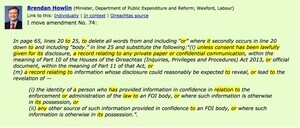
howlin

Read the decision in full here

New FOI Act added “significant protection” from scrutiny for expense claims by TDs and Senators (No Expenses Spared)

Freedom of Information Act 2014

Thanks Kildarestreet.com