

This afternoon.
Dame Street, Dublin 2.
€98,000.
Thanks James Loughman



Last year’s Dubai Irish Derby, Curragh, Co Kildare ; Michael Taft
The recovering economy will lift all boats, we are assured
But beneath the surface all is not well
Michael Taft writes:
The economy is in strong growth, but if polls are anything to go by most people are not feeling the breeze. As Goodbody economist Dermot O’Leary says:
‘While people broadly accept that the country is better off than a year ago, a large majority believe that it has not yet benefited them personally. One recent survey suggested that only 15pc of people feel that they have personally benefited. Trickle-down economics appears to be clogged up.’
For many this will change over the coming months. Employment is rising, wage increases are occurring. However, social protection payments, with the exception of pensions, have been largely frozen (that is, they have been cut in real terms) and there is some evidence that wage increases are primarily going to managers and professionals.
The CSO shows that in the last two years, weekly income for managers and professionals increased while all other employees (sales, clerical, service, production, building and transport workers) saw their weekly income fall.
Trying to nail down the ‘who is benefitting’ numbers from the data can be difficult, as in many cases it lags by a year or two and in other cases it doesn’t exist. So we have to go about connecting-the-dots.
With the help of Seamus Coffey’s useful post on household income, we can make a start. This tracks the rise of household disposable income by comparing the first nine months in each of the last four years.
Seamus’s full table can be found here; what follows shows the increases in the main income categories.
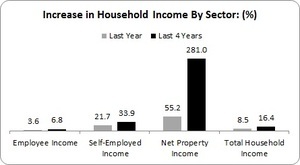
Total household income rose by 16 percent over the last four years. Employee income rose by 7 percent, while total self-employed income rose by over a third.
Net property income – mostly dividend income according to Seamus – nearly trebled, though this is a small category.
Another way of looking at the data is:
In the last four years, employees received 32 percent of the total rise in household income (in the last year it made up 28 percent)
Self-employed took 46 percent of the rise in income (54 percent in the last year)
Net property income accounted for 22 percent of the rise in income (18 percent in the last year)
Clearly, it is self-employed income that has been the main beneficiary of the rise in total income. Who accounts for this? Farmers, professionals (doctors, lawyers, consultants), craft workers? The data is silent. Nor, from this table, do we know how the increases are distributed among different income groups.
Let’s turn to another dataset – the Survey of Income and Living Conditions (SILC). This cannot be overlaid on the above data which is taken from the national accounts – different methodologies, slightly different categories. The data from SILC refers to equivalised income – that is, it takes account of how many people are living in the household.
However, we can get a sense of who is benefitting (the CSO didn’t publish the 2011 data, and 2015 will come on stream later this year).
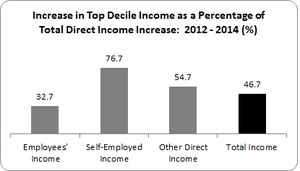
What is this table telling us?
Of the increase in all direct income (direct income excludes social transfers), the top 10 percent income group took nearly 47 percent.
Of the increase in employees’ income (wages and salaries), the top 10 percent took nearly a third of the total increase in employee income.
Regarding self-employed income, the top 10 percent took 77 percent of the rise.
And 55 percent of the total increase in Other Direct Income (in SILC this refers to interest, dividends, rent and private pensions) went to the top 10 percent. It would be reasonable to assume that increases in employee income are more widely distributed among different income groups; less so for self-employed and other direct income.
So let’s summarise:
Household income is increasing. In the last year it jumped by 8.5 percent. However, over 50 percent of this rise was taken up by the self-employed with another 18 percent going on net property income.
Within the self-employed, SILC shows that the main beneficiaries are the top 10 percent; ditto for other direct income like dividends and rent.
So we have a clear and substantial rise in overall household income. However, when we look below the surface we find evidence (not necessarily conclusive evidence but certainly persuasive) that most of it is landing in the pockets of the self-employed and capital/private pension income – and most of that is landing in the pockets of the top 10 percent.
Maybe that’s why people are not feeling it. Because the money is not heading in their direction; nor is there any uplift in social transfers.
In any recovery boats lift at different times and at different rates. That’s why in the upcoming election it’s not enough to learn about what parties will do about growing the economy.
Just as importantly, we need to learn how they are going to spread that growth around, how they are going to ensure that all boats are lifted; and what special attention they will give to the many, many small boats that are in bad need of repair.
Otherwise the economic pond will be dominated by a few big boats which will sail right over the rest of us.
Michael Taft is Research with Unite the Union. His column will appear here every Tuesday. He is author of the political economy blog, Unite’s Notes on the Front. Follow Michael on Twitter: @notesonthefront
Oh.
Anne writes:
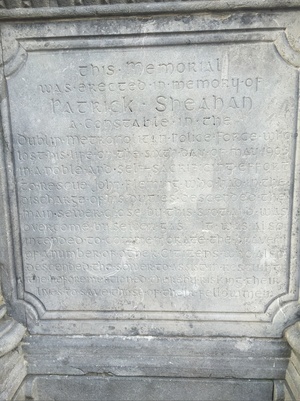
Memorial in central Dublin I never noticed before. A nasty way to go. Perhaps of interest to Broadsheet readers?
Update:
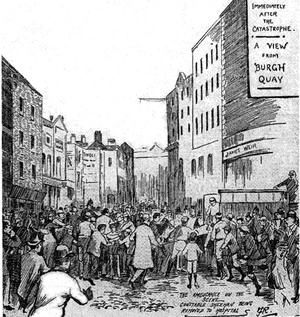
The Burgh Quay Sewege Catastrophe, May 6, 1905
What kind of man would do that
Wade through poo smelling foulness we can’t even imagine or maybe we just don’t want to?
Sibling of Daedalus writes:
Constable Patrick Sheahan was a well known figure in the turn-of-the-century Dublin Metropolitan police force, indeed he may have been the Dublin equivalent of Captain Carrot in Terry Pratchett’s ‘Men at Arms‘ books.
The Constable’s obliging nature and impressive size – 6 foot 4 inches tall and 18 stone in weight – resulted in him being called up for the jobs no one else in the force felt able for, such as – on one famous occasion – wrestling a runaway bull to the pavement of Grafton Street.
He also regularly rescued old ladies from collapsing buildings and received a reward for recovering a city flag from a group of Trinity students in Dawson Street and restoring it to the Mansion House.
Constable Sheahan’s luck ran out in the labyrinthine sewers of Burgh Quay on Saturday May 6, 1905, when – having gone on duty to cover for a friend who had wanted to go to the theatre – he died of suffocation trying to rescue a Dublin corporation workman overcome by deadly gas.
His funeral in Mount Argus was a grand affair and the streets along which the cortege proceeded to Kingsbridge Station – from which his body was taken by train to his native Limerick for burial – were thronged with Dubliners respectful of his courage.
Mmf.
Any excuse.
illustration: Limerick City Journal
Today’s Irish Times.
Be Your Own Reason tweetz:
“Plain Cockamamie Part 2 [Part 1 at link below], on steroids…”
Survey finds 95% of homes for rent too high for rent allowance (Irish Times)
Meanwhile:


This afternoon.
Glasnevin, Dublin 9
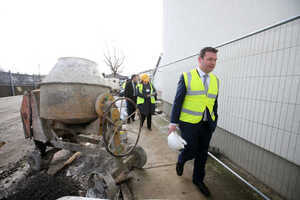
Minister for the Enviornment Alan Kelly (above left) at the Fold housing development Agency development with new resident Hilda Hickey Wrenn (above centre) and local Labour TD John Lyons TD .
Sam Boal/Rollingnews

An artist at studio space in Block T, Smithfield, Dublin 7
You may recall a post last week about how the people of Block T [inexpensive studio space for artists] have to vacate their premises in Smithfield, Dublin 7 – after six years – due to rent increases.
Further to this.
“This week, the team at BLOCK T are sad to announce to members the date they will be vacating their premises in Smithfield, which currently houses over 70 creative studios and workshop facilities. Our organisation is now presented with a new challenge of rehousing their 120 members, who create and produce their work from this hub on a daily basis and have been supported by BLOCK T’s independent subsidies since 2010.”
“Established in the midst of the economic recession, BLOCK T was one of the first creative projects to seize the opportunity of the many vacant spaces in Smithfield, breathing a new lease of life into the area. When funding was hard to come by BLOCK T provided a new and unique model of operating artist-led initiatives and advocating for independently run cultural spaces not solely reliant on public funding.”
“Our co-founding team worked voluntarily during the start-up years, allowing it to grow into a primarily self-funded organisation.
This team of creative entrepreneurs collaborated with open-minded landlords, local businesses and arts organisations, and developed a variety social and cultural initiatives over the years, with public funding making up only 2% of its annual turnover.”
“BLOCK T has played a crucial role in the rejuvenation of the Smithfield area, welcoming over 150,000 visitors throughout the past six years. Alongside its cultural partners such as Lighthouse Cinema, Jameson Distillery, Generator Hostel Dublin, Brown Bag Films, Cobblestone and other old and new enterprises, it has fought the uphill battle to establish Smithfield and its surrounding area as a dynamic cultural destination in the city.”
“…To date BLOCK T holds an impressive list of accolades, having been the recipient of multiple awards and an instigator of unique partnerships in the city, nationally and internationally. It has facilitated and collaborated with some of Ireland’s finest cultural influencers such as Nialler9, Ensemble Music, Body & Soul, Dublin Flea, Upstart, All City Records, Knockanstockan Festival, Red Bull Music Academy, Darklight Festival, Spirit of Folk Festival, SCOOP Foundation, Hollywood Babylon, Slipdraft, Steve Doogan, Mary Cremin, Sven Anderson, Rhona Byrne, Aoibheann Greenan, Chequerboard, Patrick Kelleher, Alarmist, Meltybrains?, Fringe Festival, Innovation Dublin, Electric Picnic Festival, Bottlenote Festival, and many many more. For these partnerships, BLOCK T provided a much needed platform for creating, showcasing and exchange, which often saw new projects springboard into existence.”
“We have seen the influence of the economic turn in the market with the closure of more than half of the much loved and successful artist-led initiatives over the course of the past two years including Broadstone Studios, Basic Space, The Joinery, Moxie Studios, Mabos and Bio Space. Their presence in the cultural landscape of the city is already sorely missed.”
“…We’re inviting advocates, champions for Irish culture, interested patrons, local TDs, mentors and entrepreneurs to support us through this time of transition with advocacy, space provision and capital.
We’re looking for new partners who understand the value of social and creative enterprises, and who share our vision for sustainable creative communities for Dublin. We believe these independent spaces are not only necessary in times of economic decline, but also in time of growth.
“Alternative and independent cultural spaces are what makes a city a vibrant, authentic place. Their programmes and projects enrich and diversify the output of Irish culture, which greatly contributes to its tourism industry and global reputation.
More importantly these projects play an integral role in community development, offering innovative ways to nurture and support the talent of this industry that will help fuel our economy in the years ahead.”
“…We are now facing the biggest challenge to date, and are putting out an S.O.S to the city, culture is calling!”
Previously: Meanwhile, In Smithfield

Emily Gallagher writes:
Spotted in Dunnes earlier….Comforting to know.
Anyone?

This afternoon.
Steve Kingston writes:
“Rainbow landing on the Google offices in Dublin…insert witty title here…”
Meanwhile,

This morning.
The Samuel Beckett Bridge, Dublin
Thanks Daniel
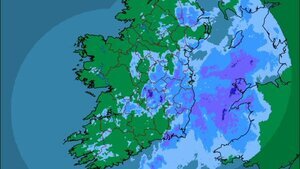
A rainfall radar image issued earlier today by Met Eireann.
James O’Brien tweetz:
Rain the size and shape of Ireland prepares to slot into place.
Wind and rainfall warnings in place for most of the country RTE News)
Related The Broadsheet Book Of Unspecified Things That Look Like Ireland (Aidan Coughlan, New Island, €5)

An app that allows you to reconnect with people you met the night before but in all the excitement forgot to get their detaiuls.
Finally.
Whatifi co-founder Ken Fitzgerald write
We are a Dublin based Events Reconnection Dating App called Whatifi What we offer is something new in the Dating App space…
We are a next day app. We are the only app that reconnects people that
attended the same events the day after the event. We actually want people
to go out and enjoy themselves and not have their heads buried in their
mobile phones.Whatifi remembers all the places you visit on a night out. The next day your
timeline screen refreshes and shows you all the places you visited the
previous day. Users can then tap on a venue they attended and view all the
other users that were there at the same time.The user timeline screen is completely private to each user. Only fellow
users that attended the same events can contact each other….

Yikes.
Declan Varley tweetz:
When they said ‘dip your headlights,’ they hardly meant this. The scene in Salthill this afternoon.
Pic: John Howard.
Earlier: Meanwhile, In Galway