Category Archives: Misc

Dublin City Council councillor Christy Burke has stepped down as chairman of Inner City Helping Homeless

This morning/afternoon.

Further to the resignation last night of former Lord Mayor of Dublin Christy Burke as chairman of Inner City Helping Homeless, a role he took on following the death of Anthony Flynn.

…Via Breakingnews.ie:

…As only one board member remains from the original 15, the charity now faces two options according to sources. The appointment of a liquidator which could result in the winding up of the charity or else an inspector being legally charged by the Charities Regulator to examine the organisation.

A new board had been due to meet last Monday following the proposed appointment of Social Democrats TD Gary Gannon as its new chairman along with Clare O’Connor, a previous board member, and Gavin Elliot, a barrister, as two trustees.

An Emergency General Meeting (EGM) scheduled for last Tuesday was scheduled to take place but was postponed due to Mr Gannon, Ms O’Connor and Mr Elliot withdrawing from the nominations.

…Meanwhile, a woman is expected to be co-opted onto Dublin City Council next month to fill Mr Flynn’s seat

Anyone?

Christy Burke steps down as Inner City Helping Homeless chair (breakingnews.ie)

‘We believe more victims will now come forward’ – gardaí continue investigation into claims against late Anthony Flynn (Maeve Sheehan, Sunday Independent)

RollingNews

Incendiary.

Meanwhile…

The introduction of vaccine passports in Northern Ireland is a “no brainer“, the infrastructure minister has said.

SDLP MLA Nichola Mallon said she has raised the issue at Stormont executive meetings on “a number of occasions”.

“It’s frustrating that we’re still sitting having this discussion,” Ms Mallon told the BBC’s Sunday Politics programme.

Covid-19 vaccine passports a ‘no brainer’, says Nichola Mallon (BBC)

This afternoon.

Via the Data Protection Commissioner:

As the economy and society continue to open up with the lessening of COVID-19 restrictions, many employers are seeking to understand what information they can process in relation to their employees return to the workplace. In particular, as the rollout of the National Vaccination Programme progresses, the question has been raised as to whether employers can lawfully collect and process information about the COVID-19 vaccination status of their employees.

As a general position, the DPC considers that, in the absence of clear advice from public health authorities in Ireland that it is necessary for all employers and managers of workplaces to establish vaccination status of employees and workers, the processing of vaccine data is likely to represent unnecessary and excessive data collection for which no clear legal basis exists. This is particularly the case when there is no public health advice pertaining to what the purpose of such data collection would be. For example, advice as to what employers would be expected to do with knowledge of vaccination status of workers i.e. to send non-vaccinated workers home or segregate vaccinated and non-vaccinated workers in workplaces?

Specific Employment Contexts

The processing of health data in response to the COVID-19 pandemic, in all contexts, should be guided by the Government’s public health policies. The current version of the Work Safely Protocol: COVID-19 National Protocol for Employers and Workers suggests that there are a limited set of circumstances in which vaccination should be offered as a workplace health and safety measure (as provided for under the Safety, Health and Welfare at Work (Biological Agents) Regulations 2013 and 2020).

There may be further situations, such as in the provision of frontline healthcare services, where vaccination can be considered a necessary safety measure, based on relevant sector specific guidance. For example, the Medical Council’s Guide to Professional Conduct and Ethics for Registered Medical Practitioners states that practitioners “should be vaccinated against common communicable diseases”. In these situations, it is likely that an employer will be in a position to lawfully process vaccine data on the basis of necessity.

Data Minimisation

The Work Safely Protocol: COVID-19 National Protocol for Employers and Workers also states that, “Irrespective of the vaccination roll-out, Public Health infection prevention and control measures (such as physical distancing, hand hygiene, face coverings, adequate ventilation), and working from home unless an employee’s physical presence in the workplace is necessary, will all need to remain in place”.

This makes it clear that there remains a full suite of measures that employers should employ to maintain workplace safety before considering whether knowledge of vaccination status is a necessary measure. In accordance with the principle of data minimisation, employers should implement all such measures that avoid processing the personal data of employees in the first place.

Voluntary Nature of Vaccination

Information about a person’s vaccination status is special category personal data for the purposes of the GDPR. It represents part of their personal health record, and is afforded additional protections under data protection law. The Work Safely Protocol: COVID-19 National Protocol for Employers and Workers states that the decision to get a vaccine is voluntary and that individuals will make their own decisions in this regard. This further suggests that COVID-19 vaccination should not in general be considered a necessary workplace safety measure and consequently, the processing of vaccine data is unlikely to be necessary or proportionate in the employment context.

Due to the nature of the National Vaccine Programme, individual workers are not in control of when they will receive a vaccine, and due to its age-based nature many younger workers will not be fully vaccinated for several months. For these reasons, it is not clear that processing vaccination status can be considered a necessary or proportionate measure in most employment situations. In addition, the long-term efficacy of vaccination in terms of immunity is not yet clear i.e. where new COVID variants may arise, or vaccine top-ups may be required. For these reasons, there does not appear to be a sufficiently evidence based justification to consider that knowledge and processing of vaccination status can be considered necessary in employment at this time.

The processing of personal data in the context of employment takes place in a situation where there is an imbalance between the data subject (employee) and data controller (employer). Therefore, employees should not be asked to consent to the processing of vaccine data as this consent is not likely to be freely given.

Medical Officer of Health

In the course of carrying out their public health duties under the Infectious Diseases Regulations 1981, as amended, a Medical Officer of Health may require access to the vaccination status of employees. This limited type of processing is specifically permissible under data protection law where carried out on a case- by-case basis, subject to the determination of necessity and at the request of the Medical Officer of Heath.

Employees and Travel

Situations may arise where employers need to be made aware of when an employee will be available for work after travelling to Ireland from abroad and undergoing any required periods of self-isolation. It should not be strictly necessary for employee’s vaccination status to be recorded in such instances, rather the employee can be asked to indicate the date on which they will be in a position to return to work.

Processing COVID-19 Vaccination Data in the context of Employment (DPC)

Earlier: Can He Get Lower?

Meanwhile…

 

This morning.

Via RTÉ News:

The report by myhome.ie claims prices in Dublin were 7.3% higher in the period between July and September compared to the same three months in 2020.

Daft.ie’s analysis, however, puts that rate of price growth in the capital at 4.9%.

Myhome.ie calculates that outside of Dublin inflation ran at around 10.1% over the period.

This compares to daft.ie’s estimate, which puts the increase during the quarter outside of the main cities at 12.9% year on year.

Despite the differences in the findings of the two reports, both agree that the rate of residential property price inflation continues to be driven by a chronic lack of supply and high demand.

Asking prices for homes rose 9% in third quarter, but rate eases (RTÉ)

RollingNews

Ah here.

Also: YIKES!

Saturday’s Guardian magazine.

The Transformation of Greta Thunberg (The Guardian)

Meanwhile….

Um.

Meanwhile…

Ah here.

Ardú Street Art Initiative members from left: From left: Clare Keogh, Peter Martin, Louise Barker, Rose-Anne Kidney, Paul Gleeson and Shane O’Driscoll in front of a mural by Aches

Last night.

Louise writes:

Ardú Street Art Initiative arrives with the intention of injecting colour, vibrancy, and life into Cork city and aims to unite the Leeside community through art, lifting its creative energy at a time when it needs it most. Ardú welcomes seven of Ireland’s most respected and renowned street artists: MASER, Shane O’Driscoll, Deirdre Breen, Peter Martin, James Earley, ACHES, and Garreth Joyce, to create works at key city centre locations, in response to a theme inspired by the 1920 Burning of Cork.

The Ardú team are delighted to announce their return to Cork city’s streets from today September 27th, until October 11th, with four more large scale murals to brighten up the city centre landscape. Commissioning artwork from home grown talent of the highest level is the main aim of Ardú. The 2021 edition will welcome artists: Friz, Shane O’Malley, Conor Harrington and Asbestos…

Ardú Street Art Initiative

Pics: Clare Keogh

“I have no issue with the principle of (vaccinating children as young as five)…..But I would be bound by public-health guidance in respect of it, because public health will have to weigh up the benefits for the child in respect of receiving the vaccine as opposed to the risks to the child.”

Taoiseach Micheal Martin (above) on Saturday

Meanwhile…

‘…Younger children have had a difficult pandemic to date. In the beginning they were incorrectly labelled as “vectors”, which led to avoidance and for many to feel stigmatised, according to recent expert evidence before an Oireachtas committee. Children’s education has also suffered. The long-term psychological effect of Covid is unknown.

Children in the Pfizer trial were given 10 microgram doses, rather than the 30 micrograms recommended for over-12s. The antibody responses and side effects were comparable. In other words, the safety profile and immunogenicity data in children aged five to 11 vaccinated at a lower dose are consistent with those in other older populations at a higher dose. The researchers plan to submit the results to regulators to seek approval for vaccinating children younger than 12, the current age limit. However, there remain differing opinions as to whether young children will need to be vaccinated.

…Taoiseach Micheál Martin has signalled the State will move to vaccinate children aged between five and 11 if advised to do so. The approval of the European Medicines Agency and then consideration by the National Immunisation Advisory Council and the chief medical officer, Dr Tony Holohan, will be required. These authorities have provided sound advice so far. There will be no reason to doubt whatever recommendation is made.’

Editorial, Sunday Independent.

Should we vaccinate young children against Covid? (Sunday Independent)

RollingNews

Meanwhile…

Saturday.

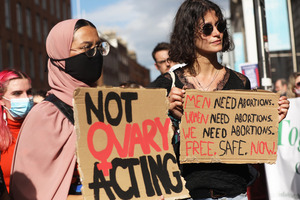
Kildare Street, Dublin 2.

The 10th Annual March for Choice took place today outside Leinster House where the Abortion Rights Campaign held a socially distanced, ‘static rally’ for ‘free, safe, legal and local abortion access’.

Leah Farrell/RollingNews