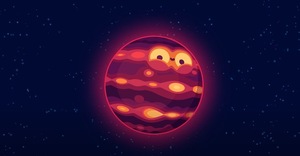
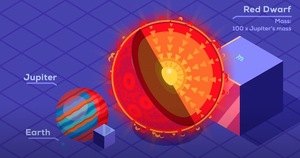

German educational design studio Kurzgesagt asks:
What is the largest star in the Universe? And why is it that large? And what ARE stars anyway?
Prepare to be enlightened.
Previously: What Is This? Rivendell For Ants?



German educational design studio Kurzgesagt asks:
What is the largest star in the Universe? And why is it that large? And what ARE stars anyway?
Prepare to be enlightened.
Previously: What Is This? Rivendell For Ants?

Behold: five hemispheric views of the icy Saturnian moon Endceladus (the sixth largest of 82) captured by the Cassini spacecraft. To wit:
In false colour, the five panels present 13 years of infrared image data from Cassini’s Visual and Infrared Mapping Spectrometer and Imaging Science Subsystem. Fresh ice is coloured red, and the most dramatic features look like long gashes in the 500 kilometre diameter moon’s south polar region. They correspond to the location of tiger stripes, surface fractures that likely connect to an ocean beneath the Enceladus ice shell. The fractures are the source of the moon’s icy plumes that continuously spew into space. The plumes were discovered by by Cassini in 2005. Now, reddish hues in the northern half of the leading hemisphere view also indicate a recent resurfacing of other regions of the geologically active moon, a world that may hold conditions suitable for life.
(Image: VIMS Team, SSI, U. Arizona, U. Nantes, CNRS, ESA, NASA)

Images of the International Space Station silhouetted in front of the Sun or even the moon are rare enough. But catching an image of the space station transiting a minuscule Mars is somewhat more of a challenge. To wit:
Using online software, the featured photographer learned that the unusual transit would be visible only momentarily along a very narrow stretch of nearby land spanning just 90 meters. Within this stretch, the equivalent ground velocity of the passing ISS image would be a quick 7.4 kilometers per second. However, with a standard camera, a small telescope, an exact location to set up his equipment, an exact direction to point the telescope, and sub-millisecond timing — he created a video from which the featured 0.00035 second exposure was extracted. In the resulting image capture, details on both Mars and the ISS are visible simultaneously. The featured image was acquired last Monday at 05:15:47 local time from just northeast of San Diego, California, USA. Although typically much smaller, angularly, than the ISS, Mars is approaching its maximum angular size in the next few weeks, because the blue planet (Earth) is set to pass its closest to the red planet (Mars) in their respective orbits around the Sun.
(Image: Tom Glenn)

No, the other kind.
Behold: NGC772, aka Arp 78 – an odd shaped galaxy 100 million light years from our own Milky Way in the constellation of Aries. Most peculiar, in fact. To wit:
…the island universe is over 100,000 light-years across and sports a single prominent outer spiral arm in this detailed cosmic portrait. Its brightest companion galaxy, compact NGC 770, is toward the upper right of the larger spiral. NGC 770’s fuzzy, elliptical appearance contrasts nicely with a spiky foreground Milky Way star in matching yellowish hues. Tracking along sweeping dust lanes and lined with young blue star clusters, Arp 78’s large spiral arm is likely due to gravitational tidal interactions. Faint streams of material seem to connect Arp 78 with its nearby companion galaxies.
(Image: Bernard Miller)

Silent footage from 1923 of a USAS plane dropping a ‘curtain’ of titanium tetrachloride creating a hanging curtain of opaque gases to conceal ships.
This is where the phrase originates.
The technique would go on to be used in WW2.

Solar activity follows an approximately 11 year cycle, the minimal point of which occurred last December. Solar Cycle 25 has now begun. To wit:
…[the] quiet Sun, at minimum activity, appears on the right of this split hemispherical view. In contrast, the left side shows the active Sun at the recognised maximum of Solar Cycle 24, captured in April 2014. The extreme ultraviolet images from the orbiting Solar Dynamics Observatory highlight coronal loops and active regions in the light of highly ionised iron atoms. Driving the space weather around our fair planet, Solar Cycle 24 was a relatively calm one and predictions are that cycle 25 will be calm too. The cycle 25 activity maximum is expected in July 2025. Solar Cycle 1, the first solar cycle determined from early records of sunspot data, is considered to begin with a minimum in February 1755.

Behold: asteroid Bennu. Nobody knows why this carbonaceous behemoth (which could impact the Earth sometime in the next 180 years) ejects gravel into space. But that’s what it does. To wit:
The discovery, occurring during several episodes by NASA‘s visiting OSIRIS-REx spacecraft, was unexpected. Leading ejection hypotheses include impacts by Sun-orbiting meteoroids, sudden thermal fractures of internal structures, and the sudden release of a water vapour jet. The featured two-image composite shows an ejection event that occurred in early 2019, with sun-reflecting ejecta seen on the right. Data and simulations show that large gravel typically falls right back to the rotating 500-metre asteroid, while smaller rocks skip around the surface, and the smallest rocks completely escape the low gravity of the Earth approaching, diamond-shaped asteroid. Jets and surface ejection events were thought to be predominantly the domain of comets, responsible for their tails, comas, and later meteor showers on Earth. Robotic OSIRIS-REx arrived at 101955 Bennu in late 2018, and is planned to touchdown to collect a surface sample in October 2020. If all goes well, this sample will then be returned to Earth for a detailed analysis during 2023. Bennu was chosen as the destination for OSIRIS-REx in part because its surface shows potential to reveal organic compounds from the early days of our Solar System, compounds that could have been the building blocks for life on Earth.
(Image: NASA‘s GSFC, U. Arizona, OSIRIS-REx Lockheed Martin)
But have you ever heard the wolf cry to a blue one?
Never mind.
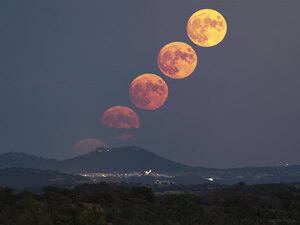
Moonrise can be a stunning sight. But there’s nothing quite like a rising Corn Moon. To wit:
A rising Full Corn Moon was captured early this month in time-lapse with a telephoto lens from nearly 30 kilometres away — making Earth’s ascending half-degree companion appear unusually impressive. The image was captured from Portugal, although much of the foreground — including lights from the village of Puebla de Guzmán — is in Spain. A Full Corn Moon is the name attributed to a full moon at this time of year by cultures of some northern indigenous peoples of the Americas, as it coincides with the ripening of corn. Note that the Moon does not appear larger when it is nearer the horizon — its seemingly larger size there is only an illusion. The next full moon — occurring at the beginning of next month — will be known as the Full Harvest Moon as it occurs nearest in time to the northern autumnal equinox and the northern field harvests.
(Image: Zarcos Palma)

Behold: M2-9, aka, the Twin-Jet or Wings Of A Butterfly nebula – the last great work of a cosmic luminary To wit:
…stars usually create their most artistic displays as they die. In the case of low-mass stars like our Sun and M2-9 pictured here, the stars transform themselves from normal stars to white dwarfs by casting off their outer gaseous envelopes. The expended gas frequently forms an impressive display called a planetary nebula that fades gradually over thousands of years. M2-9, a butterfly planetary nebula 2100 light-years away shown in representative colours, has wings that tell a strange but incomplete tale. In the center, two stars orbit inside a gaseous disk 10 times the orbit of Pluto. The expelled envelope of the dying star breaks out from the disk creating the bipolar appearance. Much remains unknown about the physical processes that cause and shape planetary nebulae.
(Image: Hubble Legacy Archive, NASA, ESA – Processing: Judy Schmidt)
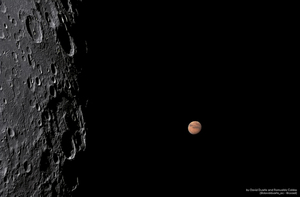
Mars reappears from behind the Moon last Sunday. To wit:
Of course to reappear it had to disappear in the first place. It did that over an hour earlier when the sunlit southern edge of the waning gibbous Moon passed in front of the Red Planet as seen from Maceio, Brazil. The lunar occultation came as the Moon was near apogee, about 400,000 kilometers away. Mars was almost 180 times more distant. It was the fourth lunar occultation of Mars visible from planet Earth in 2020. Visible from some southern latitudes, the fifth lunar occultation of Mars in 2020 will take place on October 3 when the Moon and Mars are both nearly opposite the Sun in planet Earth’s sky.
Remember last month when Saturn did this?
(Image: David Duarte and Romualdo Caldas)