
Category Archives: Science

Pity poor NGC 7714: a galaxy stretched and distorted by a recent collision with neighbouring galaxy NGC 7715. To wit:

This smaller neighbour, NGC 7715, situated off to the left of the featured frame, is thought to have charged right through NGC 7714. Observations indicate that the golden ring pictured is composed of millions of older Sun-like stars that are likely co-moving with the interior bluer stars. In contrast, the bright centre of NGC 7714 appears to be undergoing a burst of new star formation. The featured image was captured by the Hubble Space Telescope. NGC 7714 is located about 130 million light years away toward the constellation of the Two Fish (Pisces). The interactions between these galaxies likely started about 150 million years ago and should continue for several hundred million years more, after which a single central galaxy may result.

(Image: NASAESAHubble Legacy Archive)

apod

Behold: the Horsehead Nebula – the most famous (and beloved) interstellar cloud in the sky. To wit:

It is visible as the dark indentation to the red emission nebula in the centre of the above photograph. The horse-head feature is dark because it is really an opaque dust cloud that lies in front of the bright red emission nebula. Like clouds in Earth’s atmosphere, this cosmic cloud has assumed a recognisable shape by chance. After many thousands of years, the internal motions of the cloud will surely alter its appearance. The emission nebula‘s red colour is caused by electrons recombining with protons to form hydrogen atoms. On the image left is the Flame Nebula, an orange-tinged nebula that also contains filaments of dark dust. Just to the lower left of the Horsehead nebula featured picture is a blueish reflection nebulae that preferentially reflects the blue light from nearby stars.

(Image: José Jiménez Priego)

apod

Behold: the splendid spiral galaxy M33 – a trifling 3 million light years away, it’s also known as the Triangulum Galaxy. To wit:

The galaxy’s inner 30,000 light-years or so are shown in this magnificent 25 panel telescopic mosaic. Based on image data from space and ground-based telescopes, the portrait of M33 shows off the galaxy’s reddish ionised hydrogen clouds or HII regions. Sprawling along loose spiral arms that wind toward the core, M33’s giant HII regions are some of the largest known stellar nurseries, sites of the formation of short-lived but very massive stars. Intense ultraviolet radiation from the luminous, massive stars ionises the surrounding hydrogen gas and ultimately produces the characteristic red glow. To enhance this image, broadband data were used to produce a colour view of the galaxy and combined with narrowband data recorded through a hydrogen-alpha filter. That filter transmits the light of the strongest visible hydrogen emission line.

Huge image here (caution: you will tend to feel insignificant in the Grand Scheme.)

(Image: Subaru Telescope (NAOJ), Hubble Space Telescope – Image Processing: Robert Gendler. Additional Data: BYU, Robert Gendler, Johannes Schedler, Adam Block – Copyright: Robert Gendler, Subaru Telescope, NAOJ)

apod

NASA Goddard explains:

Have you ever thought about visiting a black hole? We sure hope not. However, if you’re absolutely convinced that a black hole is your ideal vacation spot, watch this video before you blast off to learn more about them and (more importantly) how to stay safe.

Download your safety brochure here.

apod

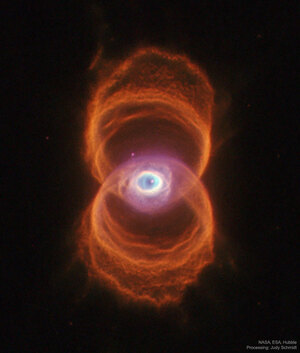
Behold; MyCn18, also known as the Engraved Hourglass Planetary Nebula.

Clearly seen at last, thanks to improved imaging techniques developed since it was first observed in the early decades of the 20th century . But who’s watching who exactly? To wit:

…the sands of time are running out for the central star of this hourglass-shaped planetary nebula. With its nuclear fuel exhausted, this brief, spectacular, closing phase of a Sun-like star’s life occurs as its outer layers are ejected – its core becoming a cooling, fading white dwarf. In 1995, astronomers used the Hubble Space Telescope (HST) to make a series of images of planetary nebulae, including the one featured here. Pictured, delicate rings of colorful glowing gas (nitrogen-red, hydrogen-green, and oxygen-blue) outline the tenuous walls of the hourglass. The unprecedented sharpness of the Hubble images has revealed surprising details of the nebula ejection process that are helping to resolve the outstanding mysteries of the complex shapes and symmetries of planetary nebulas like MyCn 18.

(ImageNASAESAHubble; Processing & LicenseJudy Schmidt)

apod

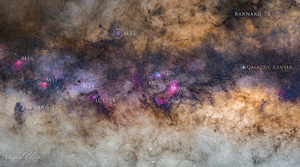
Behold the centre of the Milky Way galaxy – a mere 26,000 light years away (as the photon flies) toward the constellation of Sagittarius. To wit:

Even on a dark night, you can’t really see it though. Gaze in that direction, and your sight-line is quickly obscured by intervening interstellar dust. In fact, dark dust clouds, glowing nebulae, and crowded star fields are packed along the fertile galactic plane and central regions of our galaxy. This annotated view (top pic), a mosaic of dark sky images, highlights some favourites, particularly for small telescope or binocular equipped sky-gazers. The cropped version (second pic) puts the direction to the galactic centre on the far right. It identifies well-known Messier objects like the Lagoon nebula (M8), the Trifid (M20), star cloud M24, and some of E.E. Barnard’s dark markings on the sky. A full version extends the view to the right toward the constellation Scorpius, in all covering over 20 degrees across the centre of the Milky Way.

Huge view here.

(ImageMiguel Claro (TWANDark Sky Alqueva)

apod

Behold: the sunlit crescent of da Vinci glow caused by earthshine (light reflected from a bright planet Earth) on the moon. To wit:

..a description of earthshine in terms of sunlight reflected by Earth’s oceans illuminating the Moon’s dark surface was written over 500 years ago by Leonardo da Vinci. One lunar month ago [this] da Vinci glow was captured in stacked exposures from the Badain Jilin Desert of Inner Mongolia, China. This year marks the 500th anniversary of Leonardo da Vinci’s death.

(ImageLikai Lin)

apod

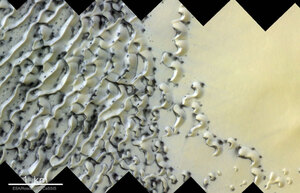
Behold: sand dunes defrosting near the north pole of Mars last May, pictured by the ESA’s ExoMars Trace Gas Orbiter. To wit:

The carbon dioxide and water ice actually sublime in the thin atmosphere directly to gas. Thinner regions of ice typically defrost first revealing sand whose darkness soaks in sunlight and accelerates the thaw. The process might even involve sandy jets exploding through the thinning ice. By Summer, spots will expand to encompass the entire dunes. The Martian North Pole is ringed by many similar fields of barchan sand dunes, whose strange, smooth arcs are shaped by persistent Martian winds.

(ImageESARoscosmosCaSSIS)

apod