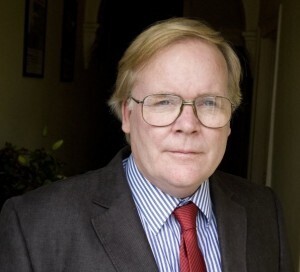
From top: Economist David McWilliams at the banking inquiry, 2015; Michael Taft
Economist David McWilliams argues in his recent article for the Irish Times that:
‘Governments can’t ‘create’ jobs, so why do they keep pontificating about it?’.
I disagree.
Governments, states and public agencies are deeply, deeply involved in job creation, both directly and indirectly. It is hard to imagine a modern market economy without the job-creating role of the state.
* The state directly employs nearly 340,000 in a range of areas: health, education, public safety, local authorities, administration, etc. These make up 18 percent of all employees.
* The state provides subsidies to private for-profit and non-profit enterprises with the express purpose of creating employment. Subsidies to early years’ education providers employ 10,600.
* There are 13,000 Section 39 health sector employees – grant-aided by the public sector. These jobs are additional to the traditional public sector employee count.
* There are 42,000 employed by public enterprises – wholly-owned state corporations.
* The state employs – directly, through subsidies or through corporations – over 400,000 employees. However, it does not end there.
* Through its capital investment programme the state creates employment. The Government estimates that for every €1 billion of investment 9,500 construction-related jobs are created directly and indirectly. These are, of course, temporary (once a bridge is built, the employment ends). However, this doesn’t factor in the long-term productivity-enhancing employment benefits from investment projects.
* The state spends €8.5 billion annually on sourcing goods and services from the private sector to produce public services. In addition, private companies (early years, Section 39, etc.) also purchase goods and services with their state subsidies. And public enterprises have considerable procurement contracts. Billions of Euros of private sector activity – and, so, employment – are based on doing business with public agencies.
Another job creation and job retention feature of the state’s role in the economy are the grant aids and supports for market businesses: IDA, Enterprise Ireland, Údarás na Gaeltachta, Local Enterprise Offices, etc.
These help direct jobs here from abroad (multi-nationals), create jobs for domestic enterprises breaking into export markets, and support employment in local areas.
And let’s not forget the jobs in the private sector that are dependent on the huge demand created by the states’ direct and indirect job creation activities. Billions of Euro are spent by the men and women whose employment is in some way dependent – whether wholly or partially – on the state.
And this money is spent in businesses up and down the country. How many jobs are created from this considerable purchasing power? Lots and lots.
The state also plays key roles in promoting a modern economic base. Take education for example: it is agreed by all across the ideological divide that education is one of the best investments that can be made.
A state that invests in education – from early years to post-third-level on to adult – is a state investing in its future innovative and entrepreneurial capacity. However, Ireland is a laggard in educational investment. It would have to increase such investment by over 20 percent, or nearly €2 billion, to reach our EU peer group average.
R&D is another state investment in an entrepreneurial future. And, again, Ireland is a laggard, needing a 90 percent increase (or nearly €1 billion) to reach our EU peer group average.
To assess the state’s full role in entrepreneurial-creation we have to go beyond just employment and budgetary numbers. Marianna Mazucatto has popularised the theory of the entrepreneurial state
‘How many people know that the algorithm that led to Google’s success was funded by a public sector National Science Foundation grant? Or that molecular antibodies, which provided the foundation for biotechnology before venture capital moved into the sector, were discovered in public Medical Research Council (MRC) labs in the UK?
Or that many of the most innovative young companies in the USA were funded not by private venture capital but by public venture capital such as through the Small Business Innovation Research (SBIR) programme?
Mazucatto goes on:
‘Not only has government funded the riskiest research, whether applied or basic, but it has indeed often been the source of the most radical, path-breaking types of innovation. To this extent it has actively created markets not just fixed them . . . from the development of aviation, nuclear energy, computers, the internet, the biotechnology revolution, nanotechnology and even now in green technology, it is, and has been, the state not the private sector that has kick-started and developed the engine of growth, because of its willingness to take risk in areas where the private sector has been too risk-averse.’
Sean O’Riain makes a similar argument in the Irish context, noting that in the 1990s the key investor in high-tech indigenous sectors was the state:
‘The ‘Celtic Tiger’ is not a product of heroic entrepreneurs but is a (partial) success made possible by the embeddedness of entrepreneurs and workers in dense social institutions. There is a significant collective contribution to the success of those who have benefited (professional classes, entrepreneurs) which rests heavily on collective social and state institutions.’
This doesn’t deny the concept of entrepreneurs. They are essential to bringing goods and services to market. However, the above shows that drawing a line between the public and private sector is a highly misleading characterisation of a modern, complex market economy.
The goal is to create a new dynamism arising out of the obvious inter-dependency between the public and the private.
But even when discussing ‘entrepreneurs’ we have to avoid clichés.
Entrepreneurship is not only a social phenomenon, where new products and services arise out of collective effort; it is – or should be – a democratic phenomenon.
The role of labour is rarely referred to in this context but the evidence is substantial: greater employee participation in the decision-making process of the firm or enterprise equals greater productivity, innovation and firm performance. The same holds for collective bargaining, as employees bring their experience, knowledge and ideas to problem-solving.
Cyrine Ben-Hafaïedh notes that the hunt for the single, heroic entrepreneur was like ‘hunting the Heffalump’:
‘ . . . even when it was proven that this quest was vain, entrepreneurship scholars continued to embody entrepreneurship in a single person, a lone and heroic entrepreneur. But . . . the ‘entrepreneur’ in entrepreneurship is more likely to be plural, rather than singular’.
Entrepreneurship should be a collective, democratic process. In this respect, everyone is an entrepreneur. The problem is that not everyone is allowed. This is a profound question of workplace democracy.
The Covid-19 crisis has shown us the degree to which private sector activity is dependent on public resources. There are other grave challenges, notably climate justice and the fourth industrial revolution involving automation, robotics and AI.
We will need an organising agency (the state); we will need greater public intervention in the market economy (public capital); and we will need a more democratic entrepreneurial practice (workplace democracy). Simplistic notions of public and private sector, of the individual ‘heroic’ entrepreneur, will not help us meet these challenges.
We need an ‘all-of-society’ approach.
We need to let a hundred entrepreneurial flowers bloom.
In short, we need an all-encompassing democracy – from the workplace floor to the boardrooms and beyond.
Michael Taft is a researcher for SIPTU and author of the political economy blog, Notes on the Front. His column appears here every Tuesday.
Rollingnews