Slightly Bemused writes:
As I write, today is February 1. And every year the arguments start over when is the first day of Spring.
February first here is celebrated as St Brigid’s Day, patron saint of Kildare. The church in which I was wed is named in part for her (St Patrick and St Brigid). As a child I was taught the seasons were:
Spring – February, March, April; Summer – May, June, July; Autumn – August, September, October; and Winter – November, December, January.
Under traditional Celtic ways, this is the start of Spring, and was known as Imbolc. The Celtic seasons were around agriculture, and February is traditionally the coldest month.. It was the time that the soil was turned so the frost would kill the weeds and the bugs.
The full moon is known as the Snow Moon, symbolising the cold. So a cold ploughing in February, followed by the harrow in March when, under the Worm Moon, the little wriggly beasties that do so much to aerate the soil and make it fertile start coming out of hibernation.
The final plough was in April, so the rains would water the soil and make it fruitful. And the first planting would begin, usually early potatoes, so simple ploughing was not enough but the rills had to be raised. Potatoes do not do well in wet ground, and the rills helped drain them. The full moon is called the Pink Moon, and I am not certain why. However this is the time when a plant called phlox grows and first spreads its pink petals, so maybe it is that.
Then comes Bealtaine, or the fire of Baal, with May warming up the soil and helping the seeds sprout new life and promise for another year’s harvest. It falls between the equinox and the solstice, and traditionally is celebrated on May 1.
This marked the time to drive the cattle to their summer pastures, celebrated in poem by Pádraic Colum in The Drover. I learned this in school, but only recall the opening line: “To Meath of the pastures from wet hills by the sea”. The full moon is the Flower Moon, signifying the sprouting and blossoming of the wild flowers, and the first sprouts of the cereal crops.
June continues the rise of heat, but also the ripening of many of the berries. and currants planted. The soft fruits ripen during the month, giving the full moon the name of the Strawberry Moon. Given how clever crows are, I often wonder how they protected the berries before the invention of tunnel netting. Although I must admit to witnessing several crows acting together, with two tugging up the side, and one crawling in and plucking their bounty, to be shared. Crows are very clever birds. This time was also the start of canning – turning the fruits to jam and sealing it to last the winter.
June is also the month of Midsummer’s Day, with the Eve dedicated traditionally to bonfires and dancing at the crossroads. Usually happening at the summer solstice, it marks the longest day of the year, and the shortest night. It marked the celebration of the burgeoning crops in the field, and the turning point of the year towards the harvest.
It also is the time for harvesting the early potatoes and planting the next crop, usually a different variety that will last better through the winter. Many is the time I spent on the back of some machine or other sorting the spuds, and later sitting on the tail seat with mud to my knees feeding the new ones across for even planting.
July marks the ripenening of the crops, and where I live a crop producing rape-seed oil lends a beautiful yellow glow to the fields as you take the bus to Dublin. Interspersed are the cereal crops, usually barley, giving the full moon the name of the Buck Moon in Ireland. The Irish celebrated the rutting of the deer whose antlers had grown and the bucks fought for the right to leave their own genetic line behind.
The end of Summer is Lúnasa, named for the god Lúgh, also known as Lúgh Lámh Fhada (Lugh of the long hand). This marked the beginning of the harvest period. When I was a wee one, the Irish for August was Fómhar, meaning harvest, with Lúnasa just the festival. But somewhere along the way, Lúnasa has become the Irish for August. Celebrations would be had over the first harvests, particularly of the cereals. So the moon here is the Barley Moon. Other countries have other names, reflecting which crop is ripening, but the principle is the same. Most popular is Harvest Moon.
The end of Autumn, is usually a quiet affair, as many farmers work to get their crops in. This marked the beginning of the the harvest. The full moon that month is known as the harvest moon for this reason, largely I think because of that dreadful song. The Harvest Moon covers September (Mean Fómhar, or mid harvest) and October but September’s own moon is the Corn Moon, symbolising the ripening of all cereal crops. A corn officially is the name for the seed that comes from a cereal crop, but in recent years has come to mean maize only.
October (Deireadh Fómhar, or end of harvest), and marked the final reaping, the gathering of the straw and hay for the animals for the winter, and the final means of preserving food. From such times come ham and bacon, corned beef, sausages, black and white puddings, and so on. Nothing was wasted. Hides were cured for leather and suede, and certain parts rendered for glue and other necessities. As little was wasted as possible. The full moon was the Hunter’s Moon, as the people sought to supplement their stores. With the breeding season over, hunting of the stags for their skins and meat to tide over the winter could start. Traditionally, only those unsuccessful stags were taken, leaving the leaders to mind the hinds and the fawns.
The end of Summer and beginning of Winter, is the Celtic celebration of Samhain (pronounced Sowan) which is marked these days by Hallowe’en, a festival overtaken by American movies and new traditions. I was once asked by Little Slightly when she was young if we had Hallowe’en in Ireland. I was polite and merely chuckled. But I was adamant to her mother that she should never, ever, be dressed up as a leprechaun. She complied, but got her own back when one of her later sons sprouted a red beard and green outfit (at 8 years old).
The traditional name, Samhain (pronounced Sam hain in the first dreadful Halloween film) is the tail end of Imbolc, and the Irish for November, and marks the time of descent into the darker days of winter. With the full moon known in Ireland as the Oak Moon, it marked the Celtic New Year.
An industrious month, seasoned wood or turf was stacked and prepared for the fires. Chimneys cleaned, and carpets and blankets beaten once more when it did not rain to remove the dust, and the mites. In older homes, the mattresseses had the straw replaced, and all made ready for the coming two cold months.
December, or Nollaig, usually marks the preparations for Christmas. Advent, presents, preparing the feast, and all the trimmings. There are discussions as to the name of the full moon, with some liking Cold Moon, and others Yule Moon. I prefer the latter.
Of course, December also marks the Winter Solstice, and a national lottery to see who gets to get to see the sunrise in Newgrange, or more likely the slight brightening of the sky through the clouds. Midwinter’s Day, halfway between Samhain and Imbolc, reinforces the old Irish seasonal calendar.
Finally back to January, or Eanáir, which is basically a Gaelicisation of the Latin for January. Traditionally a lean month as stocks run low, it also marked the time to start cutting turf and felling trees. Not for use now, but for seasoning over the year for the next winter, this was tough, cold work. And in the past, done to the howling of the wolves as they prepared for their own breeding season. As a result, a January full moon is a Wolf Moon. And preparations were made to celebrate Imbolc, and the start of new growth once more.
This is out of kilter with the astronomical seasons, which change at the solstices and equinoxes, and the meteorological calendar which looks at average temperatures. For the former, March 21 is the start of Spring, and the latter is March 1. I recall once having an argument where my colleague got very heated and stated categorically that the start of Spring was March 21. I eventually calmed her down by saying I was explaining the old traditional seasons.
Officially, Ireland follows the meteorological calendar. In this they choose the month based on average temperature, and so February, being traditionally the coldest month, is still Winter, with March 1 being the start of spring. You would think that it should be easy to standardise these things, but then I remember all the electrical adapters I have had to tote around so all the ‘standard’ plugs could fit.
In so many places I worked it was much easier. You had two seasons: rainy season and dry season. And they were pretty self explanatory.
Useful to know if you end up in a trivia competition.
Slightly Bemused‘s column appears here every Wednesday.
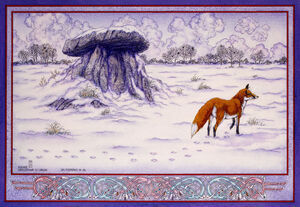
Celtic Winter scene by Jim Fitzpatrick