



This morning.
Kilmacurragh, County Wicklow
Britain’s Prince of Wales visited the National Botanic Gardens where he planted a tree and encountered Fine Gael TD Andrew Doyle (above centre) and Independent Alliance TD Kevin ‘Boxer’ Moran (above right) on the second day of his visit to Ireland.
Earlier: Ask A Broadsheet Reader
Gerry Mooney/DFA Pool

It Takes A Village Festival tweetz:
Important announcement about #ITAV20..
It Takes A Village is coming back next year
Dates being announced at 7pm this evening
Tickets going on sale next week
It’s going to be even better again!…Stay tuned…
Next year’s It Takes A Village Festival will be its third outing at Trabolgan Holiday Village in East Cork.
Registered
at


Working on in-depth piece for @thetimesIE on cancer of match-fixing in Irish football. More I hear, the more sinister it gets. Also spoke to LOI coach who talked about packing in the game as a result. I’d welcome anything that may help at jwardvb@gmail.com (historic or recent).
— Johnny Ward (@Ui_Maine) May 21, 2019
Where to now?
Camogie?
Crown bowls?
Children’s rounders?
.
Wannabe
at
Guard power.
This morning.
Croke Park, Dublin
Garda Inspector Tony Gallgaher and life-size images of The Spice Girls at a press conference ahead of the Posh-less reunited band’s concert in the stadium on Friday.
Leon Farrell/Photocall Ireland
Last night: Rig-A-Rig-Ah


From top: Local Election posters in Phisborough, Dublin; Michael Taft
It is hard to know what the main issues in the local government election are but they seem to revolve around two themes: commitments to spend more money and commitments to lessen/reduce/depress local property tax (has the property tax replaced the USC as the most ‘hated tax’?). Spend more, tax less and the let devil take the fiscal hindmost.
All this is being discussed without reference to a very serious context; namely, that the budgetary heart of local government has been ripped out during the austerity years.
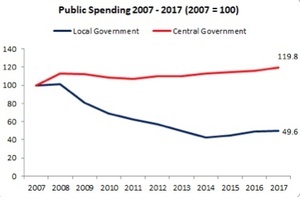
In the decade leading up to 2017, local government spending fell by 50 percent. The biggest casualty is investment: local authority investment (primarily housing and economic infrastructure such as transport) fell from €6.2 billion in 2007 to €1.2 billion in 2017.
This collapse in local authority spending can also be seen in the fall in local authority employment.

Proportionately, local authority employment carried the burden of public sector employment cuts during the recession/austerity years and is still nearly 20 percent below 2008 levels.
Irish local government was never very strong to begin with. Today, it is even weaker.

Ireland has the weakest local government, as measured by spending levels, in the EU bar Malta, Greece and Cyprus. It is even weaker than Luxembourg which is essentially a one-city state.
So whatever about the party manifestos and candidate slogans, there is a lot less money to spend than 10 years ago and a lot less people to produce the services.
It is unfortunate the campaign ‘More Power to You’ – sponsored by Connect, Forsa and SIPTU – didn’t feature more prominently in the local election debate.
Do we really want a local government that actually governs? Do we want a strong local government system with revenue-raising powers or guaranteed funding from central government; employment levels capable of providing a wide range of services; elected councillors with real democratic powers as opposed to the managerialist regime that currently dominates.
This paper by Dr. Mary Murphy (commissioned by the campaign) details the issues regarding an enhanced local government.
Admittedly, a debate over a radical decentralisation of powers to local levels is hard to kick-start during an election campaign; especially one that is more focused on which party will get more votes and what it might mean for a general election.
Hopefully, this debate can be continued past polling day.
For progressives it provides an opportunity to promote more resources for public services which would be, through a strong local government system, closer and more accountable to people. This would be key to vindicating a strong public service state.
Michael Taft is a researcher for SIPTU and author of the political economy blog, Notes on the Front. His column appears here every Tuesday.
Earlier: Derek Mooney: Mayor Culpa
Envahi
at


Journalist Ken Foxe, former Minister for Justice Frances Fitzgerald and PR advisor Terry Prone, of the Communications Clinic
Journalist, lecturer, founder of investigative news site Noteworthy and Right To Know Ken Foxe has given his latest update on his attempts to obtain correspondence between the former Minister for Justice and current MEP candidate Frances Fitzgerald and PR advisor with the Communications Clinic Terry Prone between May 8, 2014 and March 11, 2017.
Mr Foxe was originally told by the Department of Justice that no such records existed – even though it was already on public record that Ms Fitzgerald paid the Communications Clinic, via a special secretarial allowance, more than €11,000 between the date she became minister [May 8, 2014] and the end of 2016.
The claim also contradicted evidence put before the Disclosures Tribunal last year of written/email communications between Ms Prone and Ms Fitzgerald during the relevant time of Mr Foxe’s request.
Mr Foxe appealed the decision of the Department of Justice and the Office of the Information Commissioner went on to discover 68 such records of correspondence between May 8, 2014 and March 11, 2017.
Separately, Mr Foxe has also had a frustrating time securing correspondence between Ms Prone and the former Garda Commissioner Nóirín O’Sullivan – whom Ms Prone was also advising between 2014 and 2017.
The Disclosures Tribunal saw how statements or draft speeches were written with the help of Ms Prone by Ms O’Sullivan for Ms Fitzgerald concerning issues about Ms O’Sullivan.
Mr Justice Peter Charleton described this sequence of events worthy of Myles na Gopaleen’s satire.
In his latest update, Mr Foxe explains that the Information Commissioner Peter Tyndall has since told him that the department has told him it has checked mobile devices for phone messages or emails which may have fallen within his FOI request and that the only individuals who may have had such contact with Ms Prone or the Communications Clinic via said phones was Ms Fitzgerald and a “named special adviser”.
Mr Tyndall told Mr Foxe:
“The department stated that its ICT division confirmed that the special adviser’s phone was reset, wiped of data and recirculated to another person in 2017.”
Mr Foxe was also told this is “standard practice when a staff member who has use of an ‘official’ phone leaves the department”.
And he was further informed:
“The department said that a phone that had been used at that time by the former minister was returned to her for checking and that she subsequently advised that no additional records covered by the request were identified on that device.”
Finally, Mr Tyndall told Mr Foxe that he has accepted the department’s account of how it went about securing any records and “its position that no further records were found”.
It added:
“I have no reason to dispute the assurances of those involved that they do not hold further records. I accept that the original searches in response to the applicant’s [Mr Foxe] request of 11 March 2017 did not, for reasons explained by the Department, find records that subsequently came to light in its further searches. However, this, of itself, does not entitle me to find that all reasonable steps have not been taken to ascertain the whereabouts of records falling within the scope of the request.”
Mr Foxe writes about his latest update in more detail below…
Previously: “What Is It About Emails Between Terry Prone And Very Important Public Officials?”
Meanwhile…
As reported in last weekend’s Sunday Times...

A job advertisement for the role of “Head of Transparency” at the Department of Justice on publicjobs.ie.
