





More to follow.



More to follow.

A tuneful Bad Lip Reading of all things non lunar. To wit:
Grand Moff Tarkin shares a musical moment with Princess Leia aboard the Death Star…
Previously: SEAGULLS! (Stop It Now): A Bad Lip Reading Of The Empire Strikes Back

A public lecture tomorrow at 6pm in Lecture Theatre 4079 hosted by the Department of Law at the Dublin Institute of Technology, Aungier Street, Dublin 2.
In 2012, Colorado together with Washington State became the first jurisdictions in the world to regulate cannabis for recreational use, having earlier regulated for medicinal use in 2000 and 1998 respectively.
The lecture will analyse key economic data from Colorado such as tax revenue, pricing, and job creation and “evaluate the opportunity cost to the Irish economy plus the continuing and future cost of prohibition in Ireland”.
Roll! Fight!
Thanks Niall


From top: The Dublin Tenants Association; Dr Rory Hearne
Private renters have been amongst Ireland’s forgotten and ignored households. But politicians can no longer downplay their importance and the difficult situation many live in the sector.
Over 800,000 people in this country now live in the private rented sector – that’s almost 20%, or a fifth of all households. This is double the number of households in the sector over a decade ago. And in the cities and towns it is even higher.
In Dublin, it is estimated a quarter, one in four households, are in the private rental sector. However, up to this point the voice of the private tenant has been largely absent within debates on the housing crisis, with the voices of landlords and other interests much more dominant.
We also know that the new global investor landlords like Kennedy Wilson and Real Estate Investment Trusts have the ear of the government.
So how can private renters make their voice heard in the public and political debate?
Tonight there is an important public meeting taking place in Dublin City Centre (details here) to try and do just that. If you are a tenant in the private rental sector you should try and get there.
It is being organised by the Dublin Tenants Association (DTA). DTA is a “private rented sector tenant-led support group, who believe that decent affordable and secure housing is a right for everyone” and that tenants are “primary stakeholders in the private rented sector” and, therefore, should be an important concern for housing policy.
The meeting tonight is discussing the issue of tenant security – how poor it is in Ireland, where tenants cannot get long-term leases and can be evicted relatively easily by landlords.
There will also be advice for tenants on their existing entitlements and discussion on improvements to security of tenure that could ensure tenants are not forced to go from short-lease to another short-lease and so they can actually get long term security, create a home in a community, and do not live in fear of eviction.
Charities and NGOs like Threshold, Focus, Simon and Inner City Helping Homeless, have been doing a really important job raising issues of rising homelessness resulting from unaffordable rents and evictions and poor conditions in the private rental sector.
However, they are not explicitly set up to represent and mobilise tenants in the private rental sector as a group.
There is a need, therefore, along with these important services and charities, for the growth of strong private sector tenant’s organisations, such as Dublin Tenants Association, that can organise and represent private tenants, just like trade unions do for workers or the IFA does for farmers.
Given that households renting in the private rental sector are now such a large and growing proportion of the population, and many of these households are families with children they require greater political attention and a voice of their own.
Particularly as they often face living in substandard conditions, unaffordable rents, and the lack of security of home and, therefore, an inability to set down roots and be part of a community –which is a major problem for families with children who need a secure base. They are constantly facing possibility of being moved.
Part of the reason why private tenants have been treated like second class citizens in housing and politics is that it has been reviewed as a temporary or transitory form of housing, with home ownership seen as the ideal or where people are going to. But that is no longer the case.
A majority of households aged 35 and under are now renting their home. Back in 1991, a majority of households over the age of 26 were renting their home. So now we have added a decade of renting to people’s lives.
This is ‘generation rent’. But given the lack of affordable housing many in ‘generation rent’ could be in rental accommodation for their life. Policy has to recognise this and change to reflect this new reality. It has to improve tenant’s rights to ensure they have a secure and affordable home.
The other reason why private tenants have been ignored is because they are viewed as a profit-making investment for people with money and wealth. Government and banks have promoted the private rental sector as a key investment – for people’s pensions, for the wealthy, and for global property investors like Kennedy Wilson. The buy-to-let sector has been a key area for investment.
But we have seen the failure of this approach with a high level of buy-to-lets in mortgage arrears. These are a significant proportion of the mortgages in arrears being sold off by PTSB and other banks which means the tenants in these properties are facing losing their homes also.
The government has done little because they have viewed rising rents as a key way to attract in investors and vulture funds to buy up these ‘non-performing loans’ off the banks and get them back to profitability, irrespective of the impact on those living in these properties as their home.
Government took the view that introducing greater tenants’ protections and rights would lessen their investment attractiveness and therefore refused to intervene and allowed rents rise – and homelessness rise- and left tenants be evicted.
Of course it is no coincidence either that one in five TDs and Ministers are landlords. Fine Gael and Fianna Fail have the highest number of landlords amongst their TDs, with key government Ministers such as former Minister for Environment and Housing and now Tanaiste and Foreign Affairs Minister Simon Coveney, Junior Ministers Paul Kehoe and John Paul Phelan and Dublin Bay South Fine Gael TD Kate O Connell all landlords and owners of investment properties.
This has to be a major issue of conflict of interest. It is landlords making decisions to benefit landlords. The elite in Ireland protecting the investments of the elite.
The Fine-Gael Labour Government introduced the tax break for big global investors in rental property –through the Real Estate Investment Trust tax incentive in 2013. This, added to many other tax loop-holes available for investors in Ireland, has seen investors now buying more homes than first-time buyers.
For example, just recently global property investors just bought Ireland’s tallest residential tower – the Elysian in Cork City Centre according to the Examiner. The Elysian has 211 apartments and a rent roll close to €5 million per annum. Kennedy Wilson now owns 2100 residential units in Ireland, and aims to expand to 5,000 units over the coming years.
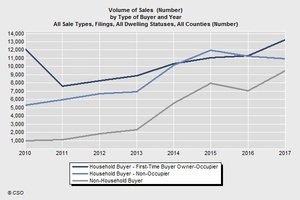
In 2010 First-Time buyers bought 12,000, or 42% of homes for sale, while investors (named in the graph below as Household Buyer-non-occupier and Non-Household Buyer) bought half that number, just 6,254, or 21% of homes for sale.
But by 2017, the proportion of First time buyers had fallen substantially as they bought just 21% of all homes for sale, while investors now bought almost twice the amount of first time buyers and increased their proportion – now buying a third of all homes (33%, 20,000 properties) for sale.
Currently private tenants are not seen as a political force in Ireland and politicians pay little attention to their concerns. But this is likely to change as private rental tenants are stuck and are increasingly frustrated and angered by an inability to buy affordable housing and unable to make a home in private rental housing.
It will also change if private tenants raise their voice – get organised and take public action – like these public meetings, the actions against landlord evictions being taken by Dublin Central Housing Action, and get involved in wider housing crisis protests such as that being held on April 7th by the National Homeless and Housing Coalition.
They need to increase their media profile and mobilise tenants to define and highlight their key policy ‘asks’ or ‘demands’. There are real political opportunities coming up in the next 18 months between local elections next year and a likely general election. These are key points where private tenants could intervene – by engaging in a voter registration drive among tenants, producing a set of policy demands and highlighting which parties support (or not) these.
The political reality is that we are in a volatile time – no political party can take for granted voter support or allegiance as was the case in the past. And none of the big parties are likely to get an overall majority in the coming election so they are reliant on others for support, and this makes governments politically weaker and more open to public opinion at times. Voters are also much more influenced by a variety of factors and are increasingly making their decisions during elections.
This means groups such as Dublin Tenants Association and other civil society and campaigning groups can have an influence, in influencing policy of government but also in the run up to and during elections if they are organised to highlight their issues at this time.
Particularly in places like Dublin, Galway, Waterford, Cork and Limerick, if private renters got organised and took action they could be a substantial political force.
Dr Rory Hearne is a policy analyst, academic, social justice campaigner. He writes here in a personal capacity. Follow Rory on Twitter: @roryhearne

This afternoon.
Chancery Street, Dublin 7.
Liamknutj writes:
Should we be worried that they seem to be climbing? No sign of radioactive spiders.

Wear your shorts at the airport, recommends The Guardian, and socks with sandals
Ah here.
Graeme Kelly writes:
Is this an early April Fool’s?
Menswear picks: get off to a flying start with your holiday wardrobe – in pictures (The Guardian)


Last night.
TV3’s 5.30pm news broadcast an interview between TV3 journalist Paul Byrne and Richard Satchwell.
Mr Satchwell’s wife Tina, 45, has been missing for a year from their home in Youghal, Co Cork.
A search is currently under way in Mitchell’s Wood in Castlemartyr, Co Cork.
Further to this…
From last night’s interview…
Paul Byrne: “Six months ago, I asked you were you willing to take a lie detector test. You said you would. How do you feel about it today?”
Richard Satchwell: “At this point, I, myself, don’t feel up to it.”
Byrne: “But people will say that you’ve got something to hide if you don’t take the lie detector test, today or tomorrow.”
Satchwell: “I’ll take a lie detector test when I feel that I’m right. I’ve got nothing to hide, I’m not sleeping too well and I don’t suppose I’ll sleep much at all until the search in Mitchell’s Wood is finished. And when the time, when I feel right, I’ll contact yourself and I’ll take a lie detector test then.”
Byrne: “You’re now putting that on record, people will expect you to take that test.”
Satchwell: “I will put on record that, in the future, not today, not tomorrow, but when I feel right, I’ll contact you and I’ll sit down, I’ll take a lie detector test.”
Watch the interview back in full here

On First Dates Ireland…
Gareth Naughton, of RTE, writes:
Tonight on RTÉ2 First Dates Ireland welcomes a well-known dater as former Head 2 Toe presenter Pat O’Mahony enters the restaurant in search of love.
Pat is matched with Gemma, who will be familiar to First Dates Ireland fans from series one when she came to the restaurant only to find she had been matched with a man she had already been on a date with….
First Dates Ireland on RTE Two at 9.30pm.

From top: The Cover of Fine Gael MEP discussion paper on Ireland’s defence/security policies; Derek Mooney
As I am out of the country for a few days I missed last night’s RTÉ One Claire Byrne Live discussion on Irish Defence policy.
Based on the social media commentary it seems the talk was as much, if not more, about neutrality, or the myriad different interpretations of neutrality, than it was about policy.
Regrettably, most attempts to try to have a sensible discussion on national security and the threats that face us flounder on tired, ill-informed and hyper charged arguments on neutrality.
Neutrality is not unimportant, but arguing continually over its definition and who is more neutral than who means we miss the core issue – how do we develop and maintain the capability to protect ourselves and to contribute to increasing global security?
So, let us get the definitions out of the way. Ireland is militarily neutral. This means more than simply not being part of a military alliance.
It means that we decide for ourselves how much we spend on defence, what strength defence force we want and how we deploy them.
It also means that we support multilateralism, via the United Nations. It has long been Ireland’s position that one of most tangible contributions we can make to global peace and stability is to deploy our troops on Chapter 6 and 7 multilateral peace enforcement operations, mandated by the United Nations.
It is why we sent approx 1,600 troops per year to do precisely that in the decade leading up to 2009.
Whether a mission has been NATO led, EU led or whatever, has not been an issue, once it has been mandated by the United Nations – a sensible position for a small nation that believes in international law.
Now back to policy: this latest attempt to start a debate appears to have been provoked by the short discussion document entitled: Ireland and the EU: Defending our common European home from Fine Gael’s group of MEPs.
Provoked being the key word. The document so outraged the good folk in Sinn Féin that one of their number was moved to thunder on about how the FG MEPs were set “…to tear up Ireland’s military neutrality and expose[s] their extremist and dangerous far-right position on European security”.
While the Fine Gael four do indeed urge us (wrongly in my view) to “redefine the concept of Irish neutrality” and to “Amend Ireland’s Triple Lock system”, it is a gross over reaction wrong to call their document extremist or far-right.
In my opinion; its biggest problem is that it is light-weight.
It’s not there aren’t some other decent ideas in the document, there are, but a paper, even a discussion paper, making 10 recommendations “for a progressive future Irish security and defence policy” should stretch to a bit more than just seven A4 pages of text in a 16-page pamphlet?
National Defence and security are big issues. There is a serious debate to be had, so if you are going to kick start one then offer something more closely argued and researched than a poor reheating of bits of Gay Mitchell’s 2003 Beyond Neutrality policy document.
Though, to be fair, this time Fine Gael does manage not to call our military neutrality a “sham” or dismiss the triple-lock as an “abdication of national sovereignty”
Still, fifteen years later and no one in Fine Gael can make a better case against the Triple-Lock than citing a lone 2003 EU peacekeeping mission to FYR Macedonia?
If this is the only reason Fine Gael can come up with to get rid of the Triple-Lock, then advocates, like me, of the Triple-Lock have no case to answer.
Even Fine Gael’s discussion of the origins of the Triple Lock misses the point.
Read the FG paper and you would think it dates to the 1990s.
Wrong. The Triple Lock mechanism itself goes back to the 1954 and 1960 Defence Acts. It essentially states that a Triple Lock of UN mandate, government and Dáil approval is required to send contingent of more than 12 armed troops overseas.
It is worth noting here that Fine Gael frets that we would not be able to assist in a humanitarian crisis or natural disaster, but misses the point that the UN mandate part only applies when sending armed contingents of more than 12, there is no restriction on unarmed contingents assisting with natural disasters.
Though they do not make it this time, the other charge levied against the Triple Lock is that it is slow.
Yet in 2007/8 when Ireland took part in and commanded the EUFor mission in Chad we were among the first on the ground and were waiting for other non-triple lock countries to catch up.
It was during the preparations for this EU led mission that I had the pleasure of hearing the then UK Defence Secretary Dr John Reid sum up (using the words of George Robertson) the approach of so many interminable EU ministerial gatherings, saying:
“Everything that needs to be said has been said, but it hasn’t yet been said by everybody.”
This slight segue allows me to a chance to acknowledge some of the MEPs’ more positive suggestions before I return to my other major complaint.
The MEPs rightly focus on the need to establish a “cohesive National Cyber Security Strategy”.
This is an issue that Fianna Fáil’s James Lawless TD. raised yesterday when he urged the government to prioritise the National Cyber Security Centre following reports that the Russian intelligence services are taking an unhealthy interest in the Irish technology and scientific sectors.
The MEPs also call for the creation of a both a Central Intelligence Unit and a National Security Council. These are two proposals that should have been considered years back, but as with many things in Defence, they have not been a priority for almost a decade now.
Which neatly brings me back to where this document collapses in on itself.
While the Fine Gael MEPs deserve credit for bringing defence to the fore, albeit via a flimsy vehicle, their calls for increase defence spending on capabilities, research and personnel, they ignore the fact that it has been their own party leaders, who have both served as Defence Minister as well as Taoiseach since 2016, who have not just failed to act, they have looked the other way.
Since 2011 one single Minister of State has effectively run the show – and although he is a well-intentioned guy who is happy to travel overseas as to visit troops and take the salute at reviews, he has never had the political clout to make defence an issue at the cabinet table.
I am not laying all the blame for all the cuts at Fine Gael’s door. I was there when we cut the Defence Force strength from 10,500 to 9,500 on foot of the Bórd Snip Nua report in 2008/09. But that was intended as a temporary measure.
Yet, a decade later, the Government struggles to even keep it at 9,500. At the same time, the numbers serving on overseas operations has over halved, with a hefty consequent effect on soldiers pay, and that’s on top of other unaddressed issues from the Lansdowne Road Agreement.
The major progress made in modernising and improving the Defence Forces in terms of training, equipment and conditions on foot of the 2000 Defence White Paper, the first of its kind, has been all but lost.
We need now to commit to getting back to where we were in 2006/7 in terms of equipment, pay and capabilities.
A major step in that direction would be to appoint a Defence Minister at Cabinet level, for whom the role is not part time and mandate them to bring Óglaigh na hÉireann back up to 10,500. They will find that there will be no shortage of suitable and willing recruits ready and waiting to join.
Derek Mooney is a communications and public affairs consultant. He previously served as a Ministerial Adviser to the Fianna Fáil-led government 2004 – 2010. His column appears here every Tuesday Follow Derek on Twitter: @dsmooney
Earlier: Luke Flanagan on PESCO
