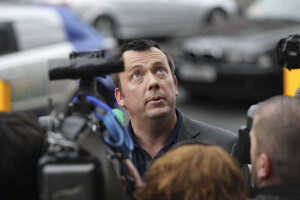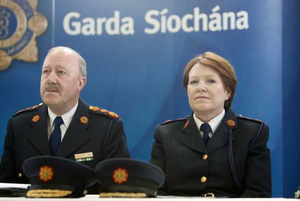
Former Garda Commissioner Martin Callinan and Garda Commissioner Nóirín O’Sullivan
Commissioner O’Sullivan was not aware of any private meeting between former Commissioner Callinan and Deputy McGuinness as outlined by Deputy McGuinness in the Dáil.
In relation to whistleblowers, Commissioner O’Sullivan has consistently stated that dissent is not disloyalty and as a service we are determined to learn from our experiences. An Garda Síochána agrees that whistleblowers are part of the solution to the problems facing the service.
The Commissioner has recently appointed a Protected Disclosures Manager and an appropriately trained dedicated team will be established to oversee all matters related to whistleblowers.
Transparency Ireland has agreed to work with An Garda Síochána to help ensure protected disclosures and people making them are welcomed and protected in An Garda Síochána.
Garda Commissioner Nóirín O’Sullivan in a statement released this evening.
Meanwhile…
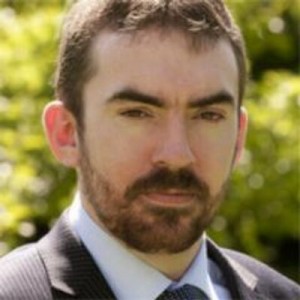
Lorcan Roche Kelly
You may recall the murder of Sylvia Roche Kelly.
The mother of two, from Sixmilebridge, Co Clare, was murdered by Gerry McGrath, from Knockavilla, Co. Tipperary, at The Clarion Hotel in Limerick on December 8, 2007.
McGrath was out on bail – for attempting to abduct a child, on October 9, 2007 – when he killed Sylvia.
He was also out on bail for assaulting taxi driver Mary Lynch in Virginia, Cavan on April 30, 2007.
Further to this…
Sylvia’s husband and journalist Lorcan Roche Kelly spoke to Seán O’Rourke this morning about An Garda Síochána and his trust in the same.
Lorcan Roche Kelly: “I think the problem with Noirin O’Sullivan – this is nothing personal against Noirin at all, I’m sure she’s a perfectly good Garda – is that she is a commissioner that was appointed internally. She came up through the system that exists within the gardaí for the last however many years and it’s that system that has been the problem. So, to get that system reformed, I don’t think Noirin O’Sullivan should have the public’s confidence in being able to reform it because she is of that system. Like I think if you look over the border, what we saw in 2001 with the Royal Ulster Constabulary being completely transformed into the Police Service of Northern Ireland, it’s, I’m not saying we need to change the name of the Gardaí but it’s that level of reform that the Gardaí now need because they have resisted reform for so long that the reform, I suppose, the actions needed have built up to such an extent that we’re nearly at a root and branch level of reform.”
Seán O’Rourke: “Yeah but again that is very central to her whole approach and that’s what’s being seen now by the new Policing Authority. Was it not a good starting point in itself? I suppose it’s precious little consolation to people like yourself and the [Shane] O’Farrell family, for instance. The Commissioner did say, ‘we are sorry the victims did not get the service they were entitled to’.”
Roche Kelly: “Isn’t that the most mealy-mouthed apology. It’s like: I’m sorry your coffee wasn’t as hot as you wanted it to be. Like this is much more serious..”
O’Rourke: “Ah is it not a bit, and I accept now that nobody knows apart from you and your family the grief that you’ve had to endure but would you not give her a bit more credit it than that?”
Roche Kelly: “To be honest, after nine years and after the, I suppose, the stonewalling we’ve received over the years, it’s very hard for me to look at a guard and say, ‘ok, I trust your bona fides in this’. Like this apology came after the O’Higgins Commission, the apology, when the writing was so clearly on the wall that then, ok, now, an apology was necessary. So rather than making a fulsome apology, the apology was made as a press release, that I didn’t receive, I’d to go on Twitter and ask, ‘does any journalist have this press release so at least I can see it’.”
O’Rourke: “Have you had any direct personal apology yourself, from the gardaí?”
Roche Kelly: “Last week I had a meeting with some gardaí in Dublin with the idea of them outlining the reforms they’re bringing in. So it was, the idea of the meeting was to show what reforms they’re bringing in to show this won’t happen again, I think is where we are.”
O’Rourke:“And they clearly would have been senior. How senior gardaí were they? Was there an assistant commissioner or deputy commissioner among them?”
Roche Kelly: “No.”
O’Rourke: “And were you persuaded by what you heard?”
Roche Kelly: “Again, I’m probably the least persuadable person when it comes to Gardaií reform but no it was..no, I think it’s as simple as that, to be fair.”
O’Rourke: “And what would persuade you, Lorcan?”
Roche Kelly: “I think, in order for a reformed process to have credibility, the first thing you need to say is, ‘ok, the people that need to be reformed shouldn’t be the people that do the reforming’. Like, again, nothing personal against Noirin O’Sullivan, I’m sure she’s a fantastic person and she’s a very good guard, but in order to reform an organisation, you need to bring in an outsider. Like, say, in the corporate world, if you want to change a company, you appoint a new CEO from outside because you can’t appoint an internal appointment because, you’ll say, well that’s just going to be more of the same in the Gardaí. So the Gardaí, as an organisation, have to be beyond reproach and we have spent, I have spent nine years, the Irish media have spent the last month and a half reproaching the Gardaí, saying, ‘look this is where the problems are, what are you going to do to address these problems?’, ‘how are you going to address these problems?’. It’s a constant drumbeat of a question that is landing at the Gardaí’s desk and, in order to address those problems, they need to have an outsider come in. And again, to look at what we saw what was done over the border 15 years ago, so it is not an impossible task but there has to be willingness to do it.”
O’Rourke: “To what extant, Lorcan, are your views informed by that experience, that nine years as you say, in the course of which you took a legal action which, I think, you knew would fail, seeking to get fuller information. And then you had the dealings with GSOC and you’re still not satisfied that there is sufficient accountability there clearly.”
Roche Kelly: “When I was doing the research, one of the interesting statistics from GSOC that I found out and you mentioned this yourself with the exoneration of the gardaí in Cavan-Monaghan at a previous report in 2011 was that the way GSOC works is that they can make recommendations for disciplinary action against a guard but they have no power themselves to implement disciplinary commission, that goes to a senior guard. And in 2012, the year my complaint came up, there was 5,600 complaints against gardaí. Over 1,000, I think it was 1,017 of them were put forward for disciplinary action. Of those 1,017, 69 resulted in some disciplinary action. So, if you’re a garda and a complaint is made against you there is a less than 1% chance of you facing any disciplinary action at all. Which, some people could say a lot of the complaints against gardaí may be spurious but I doubt 99% of them are. It’s the culture, and that needs to be highlighted, because it’s a cultural problem, rather than admit there are problems, let’s ignore the problem and move on as an organisation and to move on within the gardaí seems to me to mean, ‘let’s pretend none of this happened’.”
Later
Roche Kelly: “When my wife was murdered, our daughter was in junior infants in primary school, she’s now in first year in secondary school. So her entire primary school life has been based on: where is the answer to these questions? And I haven’t found them. And the only reason that I haven’t found the answers to these questions is because I have been stonewalled by the gardaí. This entire, my entire thing could have been sorted out with two phone calls and a letter eight years ago.”
O’Rourke: “Did you get the answers in the O’Higgins report?”
Roche Kelly: “I got the answers, the factual play that I had known all along. It was, why had the gardaí not admitted that they had made a mistake here; why have they not come out and said, ‘ok, if we had done our job right, Sylvia would still be alive’ and here’s what we’ve done to address it. And like the O’Higgins report, again, ended with a kind of a thing that happens a lot in Ireland where there are systematic problems where many things failed, therefore no one should be individually held responsible. And if that’s the response of the O’Higgins commission, then the book for that has to go to the top of the organisation. And again, I’m not saying Noirin O’Sullivan is anyway incompetent or had any hand, act or part in this but if the organisation is fundamentally rotten or, I won’t say corrupt, but is damaged then it needs to be changed from the top down.”
O’Rourke: “And what about the fact that there was an open, international competition for the Commissioner appointment, after Martin Callinan resigned or was retired, whatever way you want to phrase it, and she came through that competition?”
Roche Kelly: “Again, I don’t think it’s the fact that the competition existed, I would understand that wanted a challenging position would look at the garda, the job of the head of the garda, and say that might be a bridge too far for me, to reform an organisation like that. But if there is an open competition then have an external candidate so internal candidates cannot apply for it because it is a situation where you need an external candidate.”
Listen back in full here
Commissioner ‘not aware’ of Callinan’s car park meeting (Today FM)
Previously: Better Late Than Never