

McGregor asserts he’s quite tough,
And repeats this claim often enough,
But some muscly Yank,
Who calls himself Frank,
Has asked for a peek at his muff.
John Moynes
USA Today



McGregor asserts he’s quite tough,
And repeats this claim often enough,
But some muscly Yank,
Who calls himself Frank,
Has asked for a peek at his muff.
John Moynes
USA Today





MOAR: Innocent Cats (Eatliver)






MORE to folly.

Pro Choice supporter in Dublin in 2012
According to the whichcandidate.ie election site, of the 44 elected Fianna Fáil TDs, only two – Lisa Chambers and Jim O’Callaghan – favour expanding access to abortion; of 50 Fine Gael TDs, only Kate O’Connell and Paschal Donohoe favour more liberal laws.
To put those figures in context: while 87% of the general population favour expanding access to abortion, only 4.5% of Fianna Fáil TDs and 4% of Fine Gael TDs do.
… I agree that the campaign to Repeal the Eighth Amendment isn’t going to lie down under a conservative coalition. I too believe that we can put a referendum on this government’s agenda.
But if our referendum is begrudged to us by overwhelmingly anti-choice politicians, are these really the people we want to preside over it?
Leo Varadkar, minister for health under the outgoing government, regarded by many as a future Fine Gael leader, has publicly stated that while the current legislation may be too restrictive, he wants to keep a “pro-life” amendment in the constitution.
After all our work, can Ireland’s feminist movement risk letting Fine Fáil scheme to replace the eighth with another constitutional amendment? To offer – masquerading as middle ground – not the opportunity to repeal the eighth but to amend it?
Laura Hutton/Rollingnews

Did you see them?
Garsehole writes:
I know you don’t normally do this, but….you have a good way of promoting Irish creatives/stuff even when created abroad. So here’s a new series on E4, written by London-based Fintan Ryan, from Blackrock (the place, not the school), which went out yesterday and has been well received.

From top: Begging on the Ha’penny Bridge, Dublin; Dr Rory Hearne
The rich are getting richer and the vultures are circling.
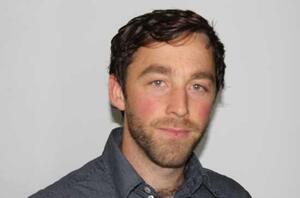
Dr Rory Hearne writes:
“The test of our progress is not whether we add more to the abundance of those who have much; it is whether we provide enough for those who have too little.”
Very true words spoken by former US president, Franklin D. Roosevelt. Unfortunately if we apply them to Ireland we can see that we are certainly making plenty of ‘progress’ in adding to the abundance of ‘those who have much’, according to a report released last week by property agent Knight Frank.
Their Wealth Report 2016 showed that the number of ultra-wealthy individuals in Ireland increased by 18% between 2005 and 2015, and that number is set to increase by 28% over the coming decade. This follows on from the recent Sunday Independent Rich List which showed that the top 300 wealthiest Irish people doubled their wealth since 2010.
This increase in wealth at the top of society while we have growing numbers of homelessness and child poverty at the bottom is morally wrong and socially unjust. It is shameful and unethical.
Look at the stark contrast between this rising wealth for those at the top of Irish society and the reduction in wealth and income for those in the middle and at the bottom.
For example, in terms of deprivation, in the same period of time as covered by this increase in wealth, the number of children aged 0-6 suffering from deprivation in Ireland doubled from 55,000 in 2007 to 105,000 in 2014.
How is this right? How is it allowed to continue?
These ‘ultra high net worth’ (UNHW) individuals in Knight Frank’s Wealth Report 2016 are individuals who have a net worth of at least US$30 million (after accounting for shares in public and private companies, residential and passion investments such as art, planes and real estate). That is a massive holding of wealth.
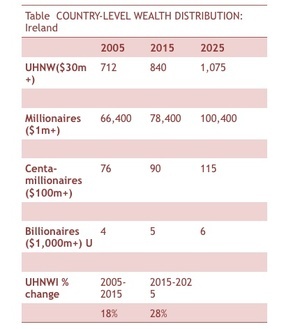
The Wealth Report (you can read it here) also finds that the number of millionaires in Ireland is projected to increase from 66,000 in 2005 to reach 100,400 by 2025 (see Table above).
The Knight Frank Wealth Report also needs to be looked at in the context of our worsening housing crisis.
The Report highlights that property (residential housing and commercial real estate property) is a key aspect of wealth accumulation by the wealthy. The report explains how “super-normal returns” from residential property “helps underpin the net worth of the ultra-wealthy”.
Knight Frank, of course, benefit from this themselves as they are a global ‘property agent’ and property advisor, handling sales of very large properties. Clearly, promoting the role of property in wealth accumulation for UHNW individuals is an important aspect of their business model.
Their Report shows that housing property (primary residence and second homes) accounts for a quarter of UHNW’s investable wealth, while commercial property investments make up 11%. Thus, total property investment makes up almost 40% of the wealth of the UHNWs while financial investments (equities, bonds, etc) makes up a smaller proportion (28%).
And the importance of property as an asset has increased in recent years. The reason for the increasing importance of purchasing property was its role as an ‘investment to sell in the future’ and a ‘safe haven for funds’.
This is in contrast to how most of us see housing as a home rather than an investment asset.
The investment in property by the wealthy is playing a role in recent property price increases in ‘prime’ markets (like Dublin). The report highlights that “it has been the weight of money from wealthy investors looking to secure assets in leading world economic hubs that has propelled markets to record levels”.
I have shown here before the role of global wealth funds in worsening the housing affordability crisis in Ireland by driving up rents through the sale of property and land by NAMA to vulture funds.
So the vulture and wealth funds, the wealthy and banks increase their wealth by dispossessing the poorest of their homes and extracting ‘super profit’s from speculative sales of land and property, along with what they get from rental income.
This wealth isn’t ‘created’ from thin air – it is being paid for by the Irish taxpayer through the bank bailouts, austerity and NAMA, mortgage distress, homelessness and escalating rents and house prices.
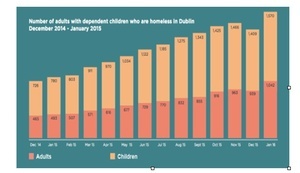
The result of this is most visible in our housing crisis –from the 37,000 still in mortgage arrears to the 1,570 children and their families who are now homeless in Dublin.
Source: Department of Environment
It is interesting to read in the Report that even the wealthy are realising that the growing concentration of wealth, particularly within the advanced economies, is a major problem.
There is a specific Chapter in the Report entitled ‘Wealth Inequality takes Centre Stage’ which highlights the ‘growing sense of disenfranchisement” that “is changing the political landscape globally”. They explain:
“wealth inequality has continued to climb the political agenda and is now one of the biggest issues facing politicians as they try to address those who feel disenfranchised”.
There is an increasing desire from ordinary people to see a stop to rising inequalities and for policies that will make society more fair.
One proposal that could make a fairer society is a wealth tax. Interestingly we had a wealth tax before in Ireland – it was introduced by a Fine Gael Labour government in 1975.
It was levied at 1 per cent of the value of assets in excess of £100,000, with family homes, bloodstock, livestock and pension rights exempt. But after the 1977 election Fianna Fáil abolished it.
It is time to look again at the merits of a wealth tax. A 1% wealth tax that would apply only to the top 1% of households (and would exclude homes, farm land and pension savings) in Ireland could raise up to €500 million.
That is a very large amount of money (but insignificant to the ultra wealthy) that could build housing for the homeless, fund our health service and provide school meals to address child poverty. Isn’t it time for a wealth tax?
Dr Rory Hearne is a policy analyst, academic & social justice campaigner. His column appears here every Wednesday. Rory is an independent candidate for the Seanad NUI Colleges Panel. He writes here in a personal capacity. Follow Rory on Twitter: @roryhearne

The red hand of a united Ireland.
CX writes:
A unique opportunity has arisen in our online shilling department…


