
refugeesJulien Mercille hi res

From top: Refugees cross the border from Serbia into Hungary yesterday; Dr Julien Mercille

The refugees crossing Europe should be welcomed as they are fleeing chaos of the west’s creation.

Dr Julien Mercille writes:

We have heard a lot about the hundreds of thousands of refugees flocking to Europe, but much less about Europe’s responsibility for this state of affairs. Indeed, most refugees are fleeing countries in the Middle East that have recently been invaded or attacked by Western forces or seriously affected by the consequences. In short, this is “blowback” from Europe’s own militaristic actions.

It is a no-brainer that a rich continent should help people leaving poor countries out of desperation. And because Europe also bears a direct responsibility for the chaos, it has an even larger moral obligation to do everything possible to fix the problem.

However, media coverage has highlighted personal tragedies and stories such as that of the little boy (Aylan Kurdi) drowned on a beach. Those stories show the human costs of the crisis. However, Europeans could look at thousands of images of drowned children without ever knowing that their governments played a large role in creating the problem through war.

Military interventions for regime change in the wake of 9-11 in Afghanistan, Iraq and Libya have involved the United States, Germany, Britain, France, Italy and Spain. The no-fly zone to remove Muammar Gaddafi from Libya was led by the UK and France, with assistance from Norway, Denmark, Belgium and Canada, among others.

The large majority of refugees come from exactly those places, like Syria, Afghanistan and Iraq.

Ireland played an important role as well by allowing US military flights through Shannon airport on the way to and back from those wars. This is still going on, as the group Shannon Watch reported last week:

“Right now, armed US troops and military planes move through Shannon Airport on a daily basis. We contribute to the NATO-led operations in Afhganistan, a country that has been brought to its knees by the US/NATO invasion, and we supported the equally devastating NATO invasion of Libya. And we provide tax breaks and other supports to companies that develop and manufacture components used in the lethal weapons systems that kill innocent people throughout the Middle East”.

In Syria, the atrocities were triggered partially by the spillovers of the Iraq war. Groups like ISIS and the Al-Nusra Front which are terrorising large areas of the Middle East emerged out of the invasion of Iraq, evolving from al-Qaeda’s activities there.

This is well described by the journalist Patrick Cockburn in his book The Jihadis Return. For example, many of the leaders of the Islamic State movement were incarcerated in an American prison in Iraq called Camp Bucca for a few years during the occupation.

As the Washington Post reported, “Camp Bucca provided a unique setting for both prisoner radicalization and inmate collaboration—and was formative in the development of today’s most potent jihadist force”, ISIS. The radicals’ time in prison “deepened their extremism and gave them opportunities to broaden their following” so that “the prisons became virtual terrorist universities”.

Therefore, as James A. Paul, the former executive director of the Global Policy Forum (based on New York), said, to use the term “regime change refugees” would go a long way to change the media discourse and popular understanding of the situation.

Also, while Europe is procrastinating and dragging its feet to welcome hundreds of thousands of refugees, countries like Jordan, Lebanon and Turkey have already received 3.5 million of them from Syria, and they haven’t invaded Iraq or Afghanistan.

A Sunday Business Post investigation revealed Ireland’s shameful record. During 2008-2014, the total number of people given refugee status in Ireland was only a third of the average across the EU’s 28 member states (relative to population size of European countries). Whereas Ireland accepted only 46 asylum seekers per 100,000 population, the EU average was 148. Ireland has thus the second-highest rejection rate of asylum seekers in the EU, after Greece. Those figures completely undermine our government’s recent claims that it has provided a “very large response” to the crisis.

But hope has come, once again, from ordinary people. There have been numerous actions across Europe supporting the refugees. We will have to pressurise our governments if any sense of morality is to influence the response to the ongoing tragedy.

Julien Mercille is a lecturer at UCD. He is the author of Cruel Harvest: US Intervention in the Afghan Drug Trade (Pluto). Twitter: @JulienMercille

gaa-kilkenny-all-ireland-final-liam-mccarthy-cup_3347277

Kilkenny, winners of the 2015 Liam McCarthy Cup, in Croke Park yesterday

The hurlers who came from the west,
Dropped the ball in the ultimate test,
Now there won’t be any,
Cats milked in Kilkenny,
Today, as they’re once more the best.

John Moynes

Pic: SkySports

Screen Shot 2015-09-07 at 09.41.23 Screen Shot 2015-09-07 at 09.42.05 Screen Shot 2015-09-07 at 09.42.30

A letter sent from the Central Statistics Office to Eurostat on July 25, 2015

Ken Foxe, in yesterday’s Sunday Times, reported:

“A reference to plans for the future privatisation of Irish Water was removed from a Eurostat letter explaining its classification of the water utility following a request from the Central Statistics Office (CSO). The reference, which could have proved highly embarrassing to the government, was in a preliminary letter sent by the European statistics agency to the CSO last July.”

“Eurostat had, in its original letter, said the “privatisation of Irish Water is ultimately envisaged” although ownership of the infrastructure could only be changed by referendum. However, the CSO asked that the reference to privatisation be removed, according to correspondence obtained by The Sunday Times following a document request to Eurostat.”

Meanwhile, Senan Molony, in today’s Irish Daily Mail [not online], reports:

“Irish Water has declined to say how many households have cancelled their direct debits since the firm admitted fewer than half had paid the first round of bills in summer. Instead the utility is insisting new direct debits are being taken out all the time.”

“Anti-water charges activists, however, claim their sources in the company are maintaining that up to one fifth of direct debt mandates originally set up by householders are no longer functioning in relation to the second billing period.”

“Asked about a suggestion that possibly 19 per cent of direct debit mandates have been cancelled, Irish Water acknowledged customers could ‘change their minds’ but would not confirm how many cancellations have been made.”

Related: Irish Water silence on cancelled water payments (Fiachra Ó Cionnaith, Irish Examiner)

beasts_of_no_nation

What you may need to know:

1. In a war-torn West African country, a young boy (Abraham Attah) is forced into the life of a child soldier when his father is killed by mercenaries.

2.
Netflix’s first foray into original movies is written and directed by True Detective’s Cary Fukunaga.

3. Netflix also passed on Top Gear. Well played. On the other hand, they have financed FOUR Adam Sandler movies. So it’s a one-all draw.

4. Idris Elba and Tom Hardy are the current names attached to take over as Bond when Daniel Craig steps down.

5. Although we would be happy to see Elba playing DCI John Luther in perpetuity.

6. Broadsheet prognosis: My little Kony.

Release Date:
October 16.

(Mark blogs about film, TV and other stuff at WhyBother.ie)

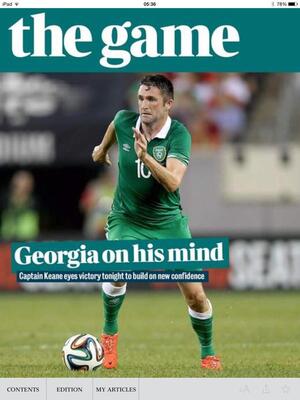
The TimesCORjA7OWcAAfqhG

This morning.

The controversial new Irish edition of The Times, a new digital daily part of a 7-day subscription package (link below) with The Sunday Times.

Its ‘welcome’ editorial says:

Welcome to the Irish edition of The Times and thank you for subscribing. This new newspaper is part of a seven-day digital package, which includes the Irish edition of The Sunday Times. The Times has been in existence since 1785. The Sunday Times was founded in 1821 and has had an Irish print edition for over 20 years. Both newspapers have a long and distinguished tradition of quality journalism. The Sunday Times is an established and popular newspaper in the Irish market and we intend for the Irish edition of The Times to be as strong a competitor among its daily rivals.

The newspaper industry has undergone significant change in recent years. It has been challenging but it has created new opportunities. We continue to print the UK and other editions of The Times — and will do so for some time yet — but we have also developed a world-leading digital offering, using the full array of platforms — tablet, smartphone and web — now available to us.

We have embraced the possibilities that technology provides and we are determined to stay ahead of our rivals. We still tell stories, we still break news, but we are now able to do so with more style and flair, allowing our readers to enjoy a far more interactive experience. In Ireland we have chosen to concentrate on a digital-only product for the Irish edition of The Times. We believe this will give us the opportunity to seize the potential of the medium in a way that has not been achieved in the Irish market to date.

The changes in our industry have also enhanced the relationship we have with you, our subscribers. We believe in the importance and power of quality journalism; we believe in hiring professional journalists to produce it; and we believe we must charge a modest amount for their efforts.

By supporting our journalism you are far more than a reader: you are a member of The Times. We want to hear from you and our technology allows you to get in touch more conveniently. You can also share our journalism more easily and, in doing so, help us to learn what you are interested in and where best to focus our efforts.

If we are asking our members to pay, we must offer more. This is why News UK and Ireland, our parent company, has invested in exclusive content such as our sports highlights packages for exciting competitions including GAA league and championship games in addition to British Premier League matches.

Being an Irish edition of a world-renowned newspaper puts us in a great starting position. In addition to the 30 journalists we have in Ireland, we have 350 in London and 36 around the world. Ireland is a vibrant country with a strong sense of its place in the world. We think readers of the Irish edition will be keen to know about domestic affairs, often in great detail, but we also think you will want to know more about what is going on outside this country.

A newspaper with a different perspective in the Irish market is a positive development. The more competition the better. We believe we will distinguish ourselves by providing quality and insightful Irish news but, crucially, we also intend to pursue an outward-looking agenda. As a newspaper we have a global reach that no other offering in Ireland can match. We believe that this will allow us to deliver exciting, informative and entertaining journalism and we look forward to sharing it with you, seven days a week.

FIGHT/Was it for this?

TheTimes.ie/join

Broadsheet.ie