

The Bed Linen Warehouse Finglas
(Thanks Holden MaGroin)



The Bed Linen Warehouse Finglas
(Thanks Holden MaGroin)
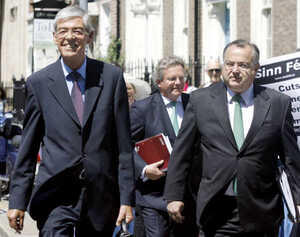
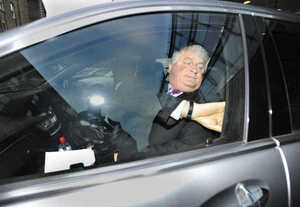

From top: Former IBRC chairmen Alan Dukes (left) and CEO Mike Aynsley in 2010, Denis O’Brien and Siteserv logo
You may recall how Kildare North Independent TD Catherine Murphy has been asking questions of Finance Minister Michael Noonan about the sale of Siteserv to Denis O’Brien’s company Millington.
Well. She’s received another reply.
But, first, to recap…
Siteserv – of water meter fame – was founded in 2004 by chief executive, Brian Harvey, with backing from Niall McFadden of Boundary Capital.
In October 2009, McFadden – who at that point owned 6.7% of Siteserv – quit Boundary, as he battled to repay loans to Anglo Irish Bank.
In March 2012, Denis O’Brien, who owed hundreds of millions of euro to Anglo, bought Siteserv for €45.4million from IBRC, formerly known as Anglo Irish Bank, while Siteserv owed Anglo €150million.
Arthur Cox represented both sides of the sale.
The sale involved IBRC writing off €100million of Siteserv’s debt, and the distribution of €5million to Siteserv’s shareholders, including Harvey, Chris Neate and John Neal, with Harvey remaining in the business.
At the time of the sale, the Sunday Business Post reported that Australian hedge fund Anchorage Capital had offered a higher price for the company.
It reported:
“Sources said that Australian hedge fund Anchorage Capital had put more money on the table, but elements of the offer were considered less attractive then the O’Brien bid. O’Brien was chosen as the preferred bidder, with Anchorage in second place. Some ten companies were involved in the initial bidding process. Sources said that some of the underbidders were unhappy with the sale process, although this is not uncommon. However, more than half of the shareholders have already voted in favour of the deal, which would suggest that it is a fait accompli. It is understood that the higher offer was made at a late stage in the sale process, which was handled by Davy Corporate Finance.
“As part of the deal with O’Brien, shareholders will get about €5million, but the rest will be used to satisfy debt owed to the Irish Bank Resolution Corporation, which was formerly Anglo Irish Bank. IBRC will have to take a hit of more than €100 million, as the bank had advanced more than €150 million in loans to the company. However, the deal needed to garner the support of shareholders, which is why there was a sweetener in the deal for investors.”
Also around that time, it was reported that French company Altrad claimed it was denied the opportunity to make an offer for Siteserv – saying it had been prepared to offer €60 million for the firm but that it was ‘effectively denied the opportunity because its representative was told the Irish group was not for sale’.
Ray Neilson, a senior manager with Altrad, told the Irish Times that he had emailed Harvey four times before the deal was agreed with O’Brien but that he was told the firm was not for sale – a claim Siteserv rejected.
Indeed, just a few weeks ago – following questions from Murphy – Siteserv released a statement saying:
“In terms of media comment concerning a competitor, Altrad Group, Sitserv PLC (in liquidation) said at the time of the transaction, that neither its board or its advisors ever received any formal approach or offer from Altrad prior to accepting the Millington offer and that any claims regarding a proposed formal or executable offer for Siteserv PLC were spurious and vexatious.”
Readers may wish to recall how, at an EGM of Siteserv – after its sale to Denis O’Brien and during which Altrad claimed it had offered €60million for Siteserv – Donal Donovan, of the Irish Independent reported:
“[Ray] Neilson claimed his firm should have been allowed to table an offer to buy Siteserv before bids for the company closed last month. The Altrad representative said his firm made an initial approach to Sitserv chief Brian Harvey back in September, but only learned of the planned sale of the company once the process ended in March. He questioned whether the board was aware of the French interest and claimed Altrad’s offer could be worth 33pc more than the bid accepted by the board.”
“CEO [Brian] Harvey confirmed he had received a number of approaches from Altrad executives in the run-up to the sale, but that they had been informal and vague. No offer to buy the business had been put to him. Mr Cooney said an approach from Altrad had only been made on Tuesday, after the EGM to vote on the sale of Sitserv had been called. He said the Altrad approach was non-binding and indicative.”
A few weeks ago, in another reply to Murphy, Noonan revealed that there were concerns raised about the Siteserv deal.
He said:
“Through this review, Department of Finance officials were made aware of certain aspects of the transaction which raised concerns with the quality of some of the decisions taken in respect of this transaction, including, among others, that legal advisors to the company referred to in the question had also acted for the purchaser, that a payment had been paid to the shareholders of the company referred to in the question, that some of those shareholders were members of the Board of the company referred to in the question and that a significant proportion of those shareholders appeared to be clients of the financial advisor on the transaction to the company referred to in the question.”
Further to this, Ms Murphy asked the Minister for Finance for specific details surrounding the bidding that led up to the sale of Siteserv – to essentially find out why Millington won the bid.
Mr Noonan said that, following a meeting about the sale in May 2012, and a further review of the sale in June 2012, another meeting was held on July 25, 2012, between him, his officials, IBRC’s chairman, former Fine Gael leader Alan Dukes, and IBRC’s CEO, Mike Aynsley.
In the meeting, Noonan’s officials raised a number of concerns with IBRC. Their concerns included:
“…the decision to allow the sale process to be held by advisors of Siteserv, the bidding process, entering into exclusivity with one of the bidders and the decision to exclude trade buyers.”
Mr Noonan also revealed that yet another meeting was held in August 2012 between the former secretary general of the department of finance, John Moran, and Aynsley, at which point, “the transaction had been concluded and no further action could have been taken”.
You may recall that last December, Mr Noonan stated that IBRC acted “at an arm’s length to the State” and that “commercial decisions in relation to IBRC were solely a decision for the bank.”
This was Ms Murphy’s latest question:
“To ask the Minister for Finance in respect of the departmental review of the sale of Siteserv to Millington by the Irish Bank Resolution Corporation, the process that resulted in him being convinced that the sale amounted to the best outcome for the State; if he and his officials looked at both rounds of bids; if so, the number and name of the companies that made bids in the first round; the place in the hierarchy Millington fell; the number of those bids that went forward to the second round; the criteria for moving to the second round; the place Millington, the winning bid, fell in the hierarchy in terms of the amounts bid; if the tender process was uniform for all bidders; if not, the reason for same; if not, the way the bids were ranked; and if he will make a statement on the matter.”
Michael Noonan’s responded yesterday:
“I am advised that, on foot of a meeting between officials from my department and senior management of IBRC held on 31 May 2012, it was agreed that my department would review this transaction to better understand the decisions taken by IBRC.
This review took place by way of a meeting between officials from my department and senior management of IBRC, on 11 June, 2012. At this meeting, IBRC officials explained how the sale process was conducted, from the selection of the original 50 candidates through to the 8 bids ultimately submitted and the selection of the winning bidder [Denis O’Brien’s Isle of Man vehicle Millington].”
“Following this review, a further meeting was held on 25 July 2012, which I attended along with officials from my department and the chairman [former Fine Gael lead Alan Dukes] and CEO [Mike Aynsley] of IBRC.
At this meeting, the transaction referred to in the question was discussed further, along with a number of other topics. I can confirm that at this meeting, it was put to senior management of IBRC that officials in my department had concerns with a number of decisions taken by IBRC in relation to the sale of Siteserv, including the decision to allow the sale process to be held by advisors of Siteserv, the bidding process, entering into exclusivity with one of the bidders and the decision to exclude trade buyers.
It was at this meeting that senior management of IBRC confirmed to me that the transaction involving the sale of Siteserv was thoroughly assessed by the board of IBRC prior to them approving it and that the transaction was managed in the best manner possible to achieve the best result for the State.
A further meeting between the former secretary general of the department of finance, John Moran, and the then CEO [Mike Aynsley] of IBRC took place in August 2012 at which this matter was also further discussed. A that point, the transaction had been concluded and no further action could have been taken”
“Notwithstanding the fact that a new Relationship Framework had been put in place, it was decided (following the meeting with John Moran and the then CEO of IBRC [Aynsley] in August 2012) that a senior department of finance official would be seconded to IBRC to explore opportunities for deleveraging with a view to maximising the recovery for the taxpayer.
This had the additional benefit of providing greater oversight while supporting the management team. The secondment of Neil Ryan to IBRC commenced shortly after.’
There you go now.
Previously: ‘The Best Deal For The State’
Denis O’Brien, Fine Gael And The Water Meter Deal
(Photocall Ireland)
Thanks Catherine Murphy

https://www.youtube.com/watch?v=eGGtTawl33k
Of this sponsored celebration of gluttonous nostalgia, Claire Buckley writes:
Ahead of the chocfest that will be this weekend, Saorview took to the streets of Dublin to ask the public some hard hitting questions about Easter – here’s what they found out!
Other digital television providers are available.

Sulkiness at Crumlin, Dublin, yesterday.
(Thanks Sarah Barry)


MORE to folly
Thanks Enda Bolger (The Irish Sun); Brian Oliver (The Irish Times); Nick Sutton (UK covers); Kevin Cramer (The Irish Examiner); Meliosa Fitzgibbon (The Irish Daily Mail)
Covers to broadsheet@broadsheet.ie
 David Bowie in The Man Who Fell To Earth
Bowie!
Walsh!
Aliens!
The ‘New York Times’ writes:
“Four decades after his star turn as an alcoholic alien in the film “The Man Who Fell to Earth,” David Bowie is now co-writing a new stage work based on the same story.”
“Off Broadway’s New York Theater Workshop said on Thursday that Mr. Bowie would collaborate with Enda Walsh, the Irish playwright who won a Tony Award for “Once,” in writing the new piece, entitled “Lazarus.” The play will feature new songs by Mr. Bowie, as well as new arrangements of older songs, and will focus on the story of Thomas Newton, the alien-turned-inventor portrayed by Mr. Bowie in the 1976 film.”
Musical? Play? All That’s Sure Is David Bowie Is Involved (New York Times)
(RCA)
 This afternoon.
Dunnes Stores, Newbridge, Co Kildare.
Some decent parking, in fairness.
Earlier: Holding The Line Always Better Value
(Eamonn Farrell/Photocall Ireland)
Update:  None shall pass.
The picket outside the Dunnes Newbridge car park.
(Eamonn Farrell/Photocall Ireland)
Meanwhile…  Veterans of the Dunnes apartheid strike, from left: Liz Deasy, Mary Manning and Sandra Griffen on Henry Street, Dublin this afternoon.
 Mary Manning and passerby outside Dunnes Stores, Henry Street, Dublin in July, 1984.
(Eamonn Farrell/Photocall Ireland)
 Gulp.
Via wine app Vivinio:
The wine present would have had to pair well with traditional Seder fare, which includes: maror or chazeret, a type of bitter herb; charoset, a sweet, brown, pebbly paste of fruits and nuts; karpas, a vegetable (usually parsley or celery) that is dipped into salt water before eating; zeroa, a roasted lamb shank bone or chicken wing; and beitzah, a hard-boiled egg.
Searching for the Wine from the Last Supper (Vivinio)
Thanks Holden McGroin

Sunday Independent columnist and author Gene Kerrigan
Grab a large tay.
Because David Manning, of media monitoring website MediaBite, has carried out a lengthy interview with Gene Kerrigan.
From the interview:
Gene Kerrigan: “Generally the media – not always or directly – reflects society. We live in a fairly conservative society where people see politics through a narrow lens. You vote every four years, elect a government which then looks after the running of the country. When something happens, such as the water tax protests, media people are interested, but it’s not something they’re comfortable with. Then someone throws a brick, it confirms media people in their discomfort. They’re more comfortable posing the story as real politics versus throwing bricks. I think that mindset applies to everyone, citizens and journalists alike. I wish it wasn’t that way – I’d rather a broader interpretation of debate and political interaction but I think it is a very conservative country.”
David Manning: In terms of that idea of reflecting a conservative society, it seems like a contradiction in the sense that there is this movement that has grown organically, it didn’t come from the universities, it didn’t come from the established political parties, it came from ordinary people who can’t afford to pay. On the other hand the press appears to be representing another public, a more conservative public. What public do you think the press represents?
Kerrigan: There’s something I find amusing – the total absence of the right wing in Irish politics. For instance, Clare Daly would be described as a left wing TD, and she would have no problem with that. But the media never describes Willie O’Dea as a right wing TD, or Leo Varadkar, Brendan Howlin or Eamon Gilmore. Gilmore was Tanaiste in a government that implemented very right wing, Merkel-style politics. And yet he would be portrayed as left of centre by most media, simply because of the Labour label. Similarly, in journalism. People would describe myself and some others as left wing, and we’d have no problem with that. But no one ever describes the political correspondents as right wing journalists – even though they clearly report, approvingly, almost entirely within the consensus of the right wing parties. So there’s an invisible right wing, that is so much part of life that we don’t even have a name for it, it’s just seen as the norm. Anything on the left is identified as being somehow from ‘the other’. It’s from the outside. I don’t think the media even recognises that what is seen as the centre is way over to the right.”
Read the interview in full here
H/T: Miriam Cotton
Pic: Politics.ie
