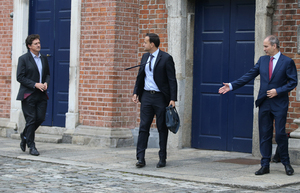
Tanaiste Leo Varadkar arriving at Dublin Castle for a cabinet meeting this morning; Róisín Shortall on the plinth at Leinster House this afternoon

This afternoon.

Social Democrats co-leader Róisín Shortall has asked the Tánaiste Leo Varadkar to “immediately clarify remarks” he made in which he said he worked at the national maternity hospital and that “some people” were failing to acknowledge that Holles Street is a “Catholic-ethos hospital”.

Deputy Shorthall said:

“There is a very simple reason that people are not acknowledging this. Mr Varadkar is wrong. Holles Street was never a Catholic-run, or owned, hospital.

“The national maternity hospital in Holles Street was set up by Royal Charter in 1903. That Charter makes no reference to Catholic ethos. This is why services contrary to Catholic ethos – like sterilisation and IVF – are performed.

“Contrary to this, St Vincent’s is most definitely a Catholic-ethos hospital and declines to provide women a full range of medical services – like sterilisation or even contraception – for that reason.”

Earlier….

RollingNews

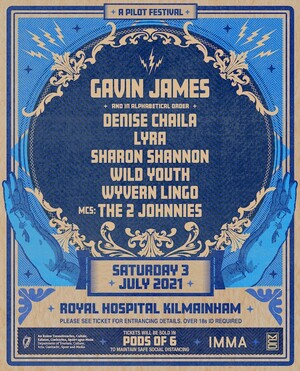
This Saturday.

Pods of six.

Enough to mosh?

Only you can demonstrate.

UPDATE:

They’ve changed the date.

Must be something going around.

Meanwhile…

Kill the Foo with FIRE.

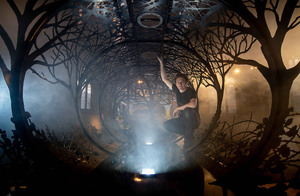
A new work by British artist Dan Rawlings currently housed inside a 19th-century church in Scunthorpe, Lincolnshire: a canopy of foliage plasma-cut into the steel shell of a reclaimed oil tanker. To wit:

Future Returns invites us to examine our own part in commercialization and the resulting changes to our natural environment. Rawlings believes it is easy to demonize industry but we must acknowledge that it has allowed life as we know it to bloom. It is our ability to design, create and produce that has put towns like Scunthorpe on the global map. He also believes oil companies have much to answer for, from the state of our environment to mistrust of science.

In fairness.

colossal

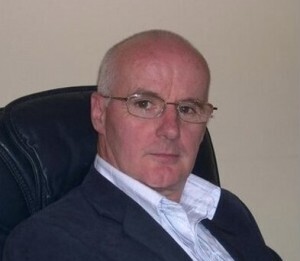
From top: Taoiseach Micheál Martin and Tánaiste Leo Varadkar; Eamonn Kelly

Michael Portillo’s investigation into the origins of the Northern Ireland conflict (“Partition” RTE 1.) led to a jaw-dropping moment in Gerry Adam’s office when Portillo realised, and to his credit, could no longer deny, (due to his own research and Adams’ input), that the conditions for the conflict had been set and inflamed by his own party, the Tories, in the years preceding the foundation of the Northern Irish state.

Yes, Partition and conflict came to you from the same people who brought you Brexit. It was a denouement as surprising and shocking as the ending of The Sixth Sense.

A couple of days later, Leo Varadkar, clutching at straws in the aftermath of a sobering poll drop, with abysmal political timing (given the panic and volatility of unionism), “envisioned” a united Ireland in his lifetime.

This apparently in a naked attempt to appropriate what he must have perceived as a Sinn Féin populist idea, apparently not realizing himself the irony that he is Ireland’s very own Tory, more at home with the privileges and ideologies of Johnson and Cameron than the largely socialist intent of Ireland’s founding fathers.

Stat Fiddling

Later in the week, at the Fine Gael Ard Fheis, the Tánaiste said that Ireland’s home ownership is 65%. He then set what appeared to be an ambitious goal for 70% ownership, to be achieved by building 40,000 private homes a year until the target is met.

But that 65% stat is a fiction, apparently deliberately under-estimated so that the target of 70% can be more easily achieved.

According to the Trading Economics Survey, Ireland’s home ownership is closer to 70% most of the time. It is currently 68.7%, which is considered low relative to the highs of 81% during the boom, before re-possession became a reality and everyone realized that when push comes to shove the banks own most of the homes anyway.

Rounding that 68.7% up to the nearest unit, home ownership in Ireland, according to the Trading Economics Survey for 2020, stands at just under 69%, just 1% short of Varadkar’s target of 70%, which is the norm for home ownership across Europe.

But what’s 1% among those who can so casually drop 4% to suit a rigged argument? In other words, the Varadkar goal of 70% has already been more or less achieved, and will be achieved with or without FG input.

The Tánaiste is basically pulling a salesman’s tactic, leaving himself room for certain success. Ultimately, it doesn’t matter who’s in government, the stats will still deliver a home ownership level of in and around 70% anyway.

Cultural DNA

To sell the idea of private home ownership versus social housing, the Tánaiste insisted that private home ownership is in the Irish DNA. This again is pure sales patter. This angle he’s working is no more than an exploitation of fear of homelessness, which may well be part of the Irish post-colonial DNA, due to hard lessons learned in the 19th century: lessons of eviction, condemnation, exclusion and starvation that still rightly spook the ancestral memory.

What we are perhaps looking at here is the cynical exploitation by an elite, of native post-colonial distress. Cynical because the exploiters are privileged and educated, in a system where education costs are also pricey, leaving the same elite with an almost exclusive hold on knowledge too.

They are not ignorant. They know well what they are doing when they deliberately mislead people with fake arguments and stats, in an attempt to sell over-priced private houses, by undermining the concept of social housing through the cynical manipulation of psychological anxieties embedded in the culture.

At a general election a number of years back the curtain slipped when a Fine Gael handler told a reporter that they’d “frighten the shite out of them” (the electorate) in the run up to polling day. They are capable of this level of cynicism.

The real idea behind this type of sales pitch is to divide people, in order to exploit prejudice between those who own and those who rent, in much the same way as the Tánaiste sought to divide low-paid workers from unemployed workers with the welfare cheats campaign, when the reality was that they were all basically the same people, just in different current relationships to jobs.

Here he seeks to divide property owners and non-property owners, with his mean-minded naming of social housing as “free”, the attempt being to saddle a target group with the label of parasite, while many would be more inclined to view the tax-dodging billionaires and the vulture landlords as the real parasites, if we must resort to labelling people like that.

The very group the Tánaiste is serving by trying to sell this idea that home ownership is in our DNA, like as if we’re wild fowl programmed to fly South in winter, and simply can’t help ourselves.

The whole 65% thing is a distraction from Fine Gael ideological opposition to the concept of social housing.

Even those boasts you occasionally hear about Ireland having the highest home ownership in the EU and so on, are just small statistical gradations of point zero percentage points. The reality is that home ownership across the entire EU averages in and around 70%, fluctuating by one or two percent here and there on an ongoing basis, with occasional outlier anomalies.

Same As It Ever Was

One of the shocking images you often see in films about World War II are the dead bodies on the streets of the Warsaw ghetto. Yet we have a housing system that often produces similar results, and many people apparently believe this to be “normal”, if not “deserved”.

How is homelessness, low wages, evictions, rack-rents and the condescension of the privileged any different from the 19th century exploitation the founding proclamation was designed to free us from? It’s a fair question.

This is the climate of social Darwinism Varadkar in particular has been cultivating since he arrived on the scene. A climate of moral bankruptcy, exacerbated, as Fintan O’Toole recently discussed, by the collapse of Church authority.

And what do you actually have to do to own a house in Ireland’s rigged system? Well, mostly, given the miserable wages and the outlandish house prices, you have to agree to be exploited by that rigged system for your entire life; while being in hock to a bank which will, as we have seen, at the first sign of a downturn in fortune, ditch you out onto the side of the road to be condemned by many of your countrymen as a ”loser”.

The neo-liberal plan is quite simple: Fib, Fog, Divide and Privatise. The pity is that a lot of Irish people, even after Trump, are still quite partial to that bitter, mean-minded diet.

You can hardly blame people, though. Who in their right mind would want to be at the bottom of Varadkar’s social heap? If someone has to be there, so the logic goes, let it not be me.

Eamonn Kelly is a freelance Writer and Playwright.

Previously: Eamonn Kelly on Broadsheet

RollingNews

River Shannon at Athlone, county Westmeath

This morning/afternoon.

A Covid-19 outbreak in Athlone has been identified as “probably” the Delta variant, the Director of Public Health, HSE Midlands has said.

Via RTÉ:

Dr Una Fallon said it became apparent over the weekend that there was a cluster of cases associated with socialising by the River Shannon on Friday 11 June.

Speaking on RTÉ’s Morning Ireland, Dr Fallon said this was not necessarily unusual, but that public health experts had been investigating a travel related incident and were screening for the Delta variant.

As a result, some of the cases belonging to the 11 June gathering were sent for Delta screening as well.

Dr Fallon said there are 14 primary cases and that each of these cases has further links in the community – such as home and work places.

Seems plausible.

Athlone Covid cluster linked to socialising is ‘probably’ Delta variant (RTÉ)

Pic: Athlone.ie

Meanwhile…

Fight!

This morning.

Women’s Aid, the national domestic violence organisation, released its Annual Impact Report for 2020 detailing the 29,717 contacts made with Women’s Aid frontline services.

During these contacts, 24,893 disclosures of domestic abuse against women including coercive control were made. Support workers also heard 5,948 disclosures of abuse against children (30,841 disclosures in total).

Sarah Benson, CEO of Women’s Aid, says:

“These statistics are shocking. The 43% increase in the numbers of women reaching out to Women’s Aid for support during the most difficult of years, is staggering. However, these figures are only the tip of the iceberg of the numbers of people who are suffering at the hands of those closest to them and who need protection and support.

“One in four women in Ireland are targeted during their lifetime by current or former partners, a shocking one in five will have been abused by the time they are just 25 years old – many for the first time as teenagers in their earliest intimate relationships.”

A live webinar on the report  is currently taking place can be viewed here until 1pm.

Women’s Aid

Taoiseach Micheal Martin and Tanaiste Leo Varadkar arriving at Dublin Castle for Cabinet this morning

This morning.

Ireland ‘Still On Track’ To End Travel Restrictions on July 5 (Newstalk)

Sasko Lazarov/RollingNews


An anti fur farming protest in Dublin in 2005

This morning.

Further to reports Ireland will finally ban fur farming in 2022…

“Animal rights campaigners welcome this long-awaited decision which was hard fought by compassionate people for years who rolled up their sleeves, exposed the suffering on fur farms and brought the country around to why it’s never fair nor right to kill animals for their skins.

“Ireland has truly become a more progressive nation for animals’ rights and we now urge authorities to work towards banning fur sales nationwide whilst considering moves to end the trade in leather and wool too.”

Animal rights activist John Carmody, who helped to lead the national campaign by the Animal Rights Action Network to ban fur farming dating back to the mid-1990s.

Memo on prohibition of fur farming set to go before Cabinet (RTÉ)

RollingNews

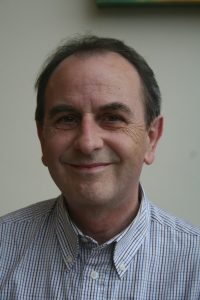
From top left to right: Green Party Leader and Minister for the Environment Eamon Ryan, Tanaiste Leo Varadkar and Taoiseach Micheál Martin after the first cabinet meeting of this current government on June 29, 2020; Anthony Sheridan

The political establishment that has [mis]ruled Ireland since independence is on the verge of extinction.

For clarity, here’s a good definition of the term ‘establishment’.

”The ruling class or authority group in a society; especially, an entrenched authority dedicated to preserving the status quo.”

An establishment’s greatest resource is the people over whom it exercises power. Its success depends on the people’s willingness to tolerate its behaviour.

When an establishment betrays the people’s trust one of two things will happen. The ruling elite will attempt to preserve its power by becoming ever more oppressive, even to the point of violence, or the people will bring it down and replace it with a new establishment that will return the balance between rulers and the ruled.

For example, abuse of power and an abject failure to respond to the needs of ordinary people triggered the French revolution in 1789. The revolution marked the beginning of the end of the divine right of kings to rule and the eventual emergence of the middle class political establishment we see in France today.

In addition to getting rid of corrupt regimes revolutions also serve to enlighten citizens to the fact that it is they, and not the ruling elite, who are the rightful owners of political power. They become aware that power flows from the bottom up, that those at the top exercise power solely on sufferance from the people. This sense of people power is as strong in France today as it was in 1789.

Unfortunately, the opposite is the case in Ireland. This is because there has never been a political revolution in our country and as a consequence there has never been a change in the mindset that sees power as belonging to the powerful.

We had a rebellion in 1916 that ultimately persuaded the British establishment, who were distracted by the brutality of WWI, that a degree of independence for Ireland within the Commonwealth was better than more war and rising criticism from the international community.

This resulted in the relatively smooth replacement of an oppressive, self-serving colonial establishment with an equally oppressive, self-serving home-grown version.

This home-grown establishment immediately set about creating a political regime that ensured the subservient mindset instilled in the population over centuries of colonialism lived on as a powerful means of political manipulation.

They created a system of gombeen clientelism where crumbs were handed out in payment for votes. Citizens were led to believe that the natural order of power in a democracy was a top down system, where the ruling establishment knew best.

This is why, unlike functional democracies, Ireland never benefited from the healthy tension between a Left/Right political system. There was never any real political opposition in our parliament. We never witnessed political parties seriously competing with each other to promote and implement their own political ideologies for the greater good of the country.

All we got was a political ruling elite, principally made up of Fianna Fáil and Fine Gael, masquerading as separate political parties. They are, and always have been, one political class with one overriding ambition – to exploit the people and resources of Ireland for their own benefit. The only competition they engaged in over the decades was in the Tweedledee Tweedledum race for government where the opportunities for self-enrichment are most plentiful.

As the political establishment became weaker in recent years smaller parties such as the Progressive Democrats, Labour and, currently the Greens were recruited to support the ruling political class.

The abandonment of most, if not all, of the ideals and policies of these smaller parties was the price demanded and received in exchange for admission to the exclusive ruling elite club.

The British left-wing journalist, Owen Jones, provides the best definition of this particular type of establishment:

”The establishment represents an attempt on behalf of powerful groups to “manage” democracy, to make sure that it does not threaten their own interests.”

But the century-long manipulation of the people and contempt for democracy by this political regime is rapidly coming to an end. Irish citizens are beginning to realise that it is they who are the rightful owners of power and not the ruling political establishment.

It is crystal clear from recent elections and polls that the people are rejecting the old regime and are demanding real change in how the country is governed. That this demand for change is being ignored not just by the political centre but also by mainstream media demonstrates just how out of touch the establishment is with this revolutionary redirection in Irish political history.

The consensus among the ruling regime is that housing, health and the economy are the reasons for their continuing loss of power, that if these problems are fixed they will survive – it is a vain hope.

While these problems are obviously of huge concern to the electorate they take second place to the demand for radical political change. People have come to realise that the old regime must be abolished and replaced with a genuinely democratic system. This change of mindset in the electorate is not a temporary phenomenon, it’s permanent – the old corrupt regime is finished.

The dramatic and historic rise in support for Sinn Féin is the most visible sign of this new emerging political landscape. But that party should take note. If it fails to radically overhaul how the state is governed, if it fails to abolish the old establishment and create a genuinely democratic balance between rulers and the ruled then it too will be rejected by the power of the newly enlightened electorate.

Anthony Sheridan is a freelance journalist and blogs at  Public Enquiry.

RollingNews

Broadsheet.ie