



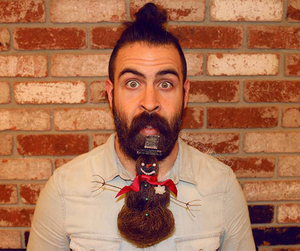



Mr Incredibeard (aka Isaiah Webb) – facial hair sculptor extraordinaire.
He’s been at this since September 2012.
Previously: Beard Of Weird



Mr Incredibeard (aka Isaiah Webb) – facial hair sculptor extraordinaire.
He’s been at this since September 2012.
Previously: Beard Of Weird
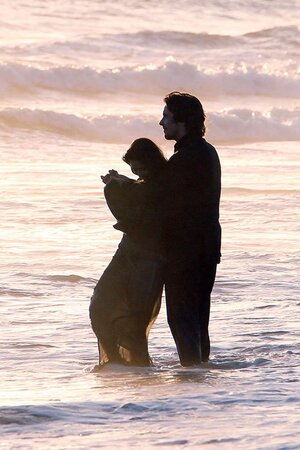
What you may need to know:
1. We do not really know what this movie is about. The ‘official’ line is:
“Once there was a young prince whose father, the king of the East, sent him down into Egypt to find a pearl. But when the prince arrived, the people poured him a cup. Drinking it, he forgot he was the son of a king, forgot about the pearl and fell into a deep sleep. Rick’s father used to read this story to him as a boy. The road to the East stretches out before him. Will he set forth?”
2. What we can gather from the trailer is that it’s about some fella with lots of money and girlfriends and he is unhappy. Poor sod.
3. It is from Terrence Malick. Wild, dreamy and beautiful films are kind of his thing. To some his Tree of Life (2011) was a characterful masterpiece and his The Thin Red Line (1998) was a philosophical wonder. To others they are dull and laboured. We loved them.
4. Cate Blanchett and Christian Bale team up for this alongside a megastar cast. Brian Dennehy for the win!
5. Malick was poised to be one of the great prolific American directors post Badlands (1973) but he took 20 years off instead so fans of his will be happy to see anything.
6. Broadsheet Prognosis: Carte Blanch
Release Date: TBC
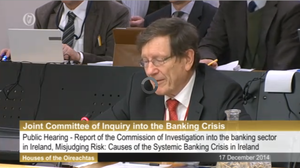
“Real estate-mania in Ireland was not a unique phenomenon”: finance expert Peter Nyberg tells the #BankingInquiry #TV3News
— Brian O’Donovan (@BrianODTV3) December 17, 2014
The Banking Inquiry has got under way in Committee Room 1 in the last half an hour.
Watch here

https://www.youtube.com/watch?v=UNozx2mpXiQ
Animator and science journalist McGregor Campbell explains the highly likely probability of extraterrestrial life.
So nyeh, Dr Brian Cox.
Nyeh.

Maria O’Brien from Professor Georg Duisberg’s research group at the TCD School of Chemistry tweetz:
Did we make the world’s smallest Christmas tree?
It’s arguable.


Independent TD, Clare Daly gave an emotional speech in the Dáil late last night, earning her applause from some of those present.
Ms Daly moved a Private Member’s Bill repealing the eight amendment to the Constitution to allow for abortion to be legalised in Ireland.
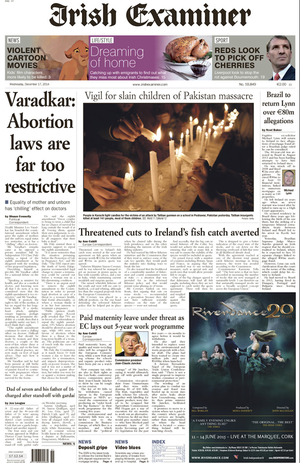
In his response, in which he ruled out a referendum on the matter, Health Minister Leo Varadkar responded by saying, amongst other things:
“The eighth amendment continues to exert a chilling effect on doctors. Difficult decisions that should be made by women and their doctors, a couple or the next-of-kin where there is no capacity, and on the basis of best clinical practice, are now made on foot of legal advice. That isn’t how it should be.”
“Ministers for Health do not just represent their own private views, they are guardians of the nation’s healthcare, and must work to protect and safeguard all of its citizens. But perhaps people may be interested in where I am coming from.
“I consider myself to be pro-life in that I accept that the unborn child is a human life with rights. I cannot, therefore, accept the view that it is a simple matter of choice. There are two lives involved in any pregnancy. For that reason, like most people in the country, I do not support abortion on request or on demand.”
Ms Daly’s speech came a day after Carl O’Brien, in the Irish Times, reported that, in the past 12 months, 26 asylum seeking women went to the Irish Family Planning Association to use its counselling services and indicated that they wanted an abortion. However, they were not allowed to travel to Britain for the procedure. He reported that, of those 26, five went ahead with the pregnancy, against their wishes, while four sought or took medication to self-induce an abortion.
This is what Ms Daly said:
“I’d like to move the Bill and I have to say, I do so with a mixture of a bit of sadness. I feel a bit mad and a little bit glad as well to be here to move the 34th Amendment to the Constitution (Right to Personal Autonomy and Bodily Integrity Bill) which really seeks to repeal the 8th amendment, in order to protect women’s life, health and choices. And I think it is regrettable that we have to do this. We have to acknowledge the background to this and the fact that so many women’s lives have been negatively impacted upon by the State’s decision to take women’s health and reproductive choices out of our hands and put them into the constitution. A decision that has resulted really in a horrendous scenario for Irish women, including a number of unnecessary deaths, casualties – if you like – of a nation’s hypocrisy. I think it’s regrettable that decades down the road, it’s been left to the Opposition to use this twilight slot, at the end of the Dáil term in order to launch a last-minute plea to the Government on this issue. Not that we’re begging, we actually aren’t, we’re demanding that you respect women, that you respect our health and human rights and repeal the 8th amendment.”
“It’s a little bit regrettable that given that the Government announced today that it was going to hold a number of referenda in early May why you couldn’t include this one as well, when it’s such a long, overdue measure and it really is, I think, a particularly, you know, poor reflection on you that you’re not doing it. But, that said, I’m glad to have the opportunity to do it because it is a hugely important issue which, I have to be honest, I’ve been involved in through all of my adult life. It’s an issue that affected 10 women today, 10 women yesterday, 10 women tomorrow, who will be forced to take the journey out of these shores in order to access what is a routine medical treatment in many other countries and I think we do have an important opportunity here to do something positive in this parliament. We’ve a chance to send a signal, that when we said that we were sorry to the women who were banished behind the Magdalene laundries, when we said to those who had their babies taken from them and given up in forced adoptions, or their pelvis was broken in symphysiotomy, when we said that we were sorry about the ways in which we treated crisis pregnancies of the past. If we really meant that, we do something different now by ensuring that it wouldn’t happen again, only this time to be replaced by a Ryanair ticket or a packet of pills, illegally purchased over the internet, with the possibility of a criminal sanction for that action. If we were serious and meant that this was a new era, we’d be developing a society which supported people, instead of passing judgement which was open instead of being stigmatising, and secret behaviour, by respecting women and their choices that they know what’s best for them. And that’s really the opportunity that we have here today, to do something positive at the end of this term, reconsider your attitude and include this as part of the referenda that you’re holding in the new year. And I think when we look at repealing the 8th amendment, we should really look back and see how did we end up with it in the first place.”
“In 1983, abortion in Ireland was already illegal. The penalty for it, Offences Against the Persons Act 1861, penal servitude for life for the woman, anyone who helped her or a doctor or a medical practitioner, pretty much a very serious chilling effect. But obviously, in the background, society was changing. You had the swinging Sixties, the movement in the Seventies, women demanding access to contraception, women being a part of the workforce, demanding to control their reproduction. Meanwhile, in the United States, you had the Roe Vs Wade judgement which certain elements, particularly in the Catholic hierarchy, felt that maybe our abortion ban could, potentially, be undermined in the future through the courts. And they began, in the early Eighties, a highly-funded and organised Pro-Life amendment campaign, a campaign of sustained political pressure so they could, if you like, be sure to be sure that there would be no abortion in Ireland. So that has to be our starting point. What an absolute unmitigated failure that was because, while they did stop abortion in Ireland, they didn’t stop Irish abortion. 160,000 women expelled from this country, in order to access that treatment, every single family in the State affected, whether they know it or not but they were stigmatised, told not talk about it, get out there, an unbroken thread really, from the days when we hid women behind Magdalene laundries. I could call it an Irish solution to an Irish problem but, you know what, it wasn’t. It was more than that, it was an English solution to an Irish problem because let’s be clear about it, if it wasn’t for the proximity of Britain there would be far more women who’ve lost their lives to this reprehensible amendment. If it wasn’t for the proximity of Britain, we would have had a campaign to eliminate this provision many times before now. Because what the 8th Amendment said was that the State acknowledges the right to life of the unborn and, with due regard to the equal right of the mother, guarantees in its laws to respect, and as far as is practical by its laws, to defend and to vindicate that right. I mean how could you even make sense out of that. And the confusion was there at the time. I think it’s a little bit ironic that it was a Fine Gael/Labour government that moved that referendum but used the wording, put forward by Fianna Fáil. And how did they end up in that position? Because the Government, at that time, gave a free vote to all of its deputies, a little bit ironic, makes us think that the democratic revolution, pretended by this one, is obviously a little bit redundant.”
“And I think it’s particularly sickening that much of what’s happened since the passing of that referendum was actually forewarned. You have the legal problems being flagged by the Attorney General at the time, who warned that those who were looking for protection and certainty, that this was going to have the opposite effect. Moving the referendum, they were told it would conflict with the European Convention on Human Rights and it did. But the State pressed on and the referendum was passed with only 53% of voters participating being passed by a 2 to 1 majority. And we’re talking about that being a decision of the Irish people, 30 years on, when most of the people involved in that are probably not around anymore. That’s not the mandate of the Irish people and we have a peculiar scenario where everything is different and yet it stays the same because, legislatively, everything is different but abortion is actually a normal part of everybody’s reproductive life in Ireland. And Ireland’s abortion rate takes place pretty much the same as it does in every other country. And the attitudes of Irish people have fundamentally moved on. And I would put it that that it’s the Government that’s out of touch on these issues and the result is that it’s actually poor women and women of precarious immigrant status who are the ones who can’t exercise their constitutional right to an abortion. Constitutional right, which hypocritically says you can have an abortion, you’ve a Constitutional right to it but you’re not having it here in Ireland, off you go somewhere else. And it’s those who are too sick, who are disabled, who don’t have the money, who haven’t got the status, who pay the price. And because of that, I welcome the statements of John Douglas, from Mandate, and the President of the Irish Congress of Trade Unions who, in welcoming this legislation, made the point today that many of his members are low-paid and the cost of travelling can equate to more than 10% of their annual income, forcing many women into debt and causing serious mental health problems – that’s one of the reasons he says why this is an important trade union issue. The minister I know has seen the very tragic reports, highlighted in the Irish Times yesterday, that in the past 12 months, 26 asylum seekers, or women who have travel restrictions, came to them looking for help to seek an abortion. They faced, what the Irish Family Planning Association said, were insurmountable difficulties and obstacles – five of them had to continue their pregnancies, four of them tried to self-induce an abortion.And that’s the reality of the chilling effect of the legislation that’s still there on our books but there’s no surprise in that because these issues were well flagged by the United Nations’ human rights committee which flagged them and warned us of them last year and, all too tragically, those events, came to pass with the horrific Y case which, you know, whatever about the details, which we obviously won’t discuss here, other than to say, I think it’s particularly horrendous, that that young woman had to go through the court process at the moment, but what is indisputable is that young woman was suicidal, that her life was in danger and that she was a rape victim. The very circumstance of the X case that the Government told us, that their new legislation was going to provide for, that young woman couldn’t access an abortion here. The European Court of Human Rights, which said we had an obligation to provide for women’s legal rights to abortion in those circumstances, wasn’t delivered upon. And, in actual fact, what yesterday’s report highlighted is that in the A and B cases, the court ruled in favour of Ireland because the women were able to travel, in order to other states, to access that. Women now, those 26 women could take a case against the Irish state and win because they haven’t had the right to travel. But the Y case exposed, in the most horrific way, how inadequate our overall legislation is. Dragged and shackled to this 8th amendment, where the words of Nigel Rodley rang true, in that case, where the young woman there was nothing more than a vessel. Her opinions, her rights didn’t count, the constitutional barrier really was, what was at the hear of this and what needed to be tackled and what’s there and the reason that we’re here, is that our State, 30 years ago, put a Chinese wall between the right to defend somebody’s right to life and their health – it’s an impossibility, it can’t be done, it’s completely out of sync with the rest of Europe, 44 out of the 47 states allow for abortion in order to protect a woman’s health. That peculiar cause in our constitution, that we seek to amend here today has resulted in a scenario which I think the former minister for justice and inequality highlighted very well when we moved legislation here previously. And he made the point very clearly: ‘That in the absence of constitutional change, there will continue to be a British solution to this Irish problem. It’s also of course the position that a pregnancy that poses a serious risk to the health, as opposed to the life of that women, even where that health risk could result in permanent incapacity does not provide a basis for effecting a termination.’ And he went on to state that this constitutional provision meant that not all our citizens are equal and that women only have a qualified right to health. So anybody who is in favour of equality for women, in this State, must recognise that the 8th Amendment has to go. I would even say that the Dean of St Patrick at the time, when the referendum was being put forward in the Eighties, made a very valid point, prophetically turned out to be true, when he said that the constitution should steer clear of controversial and moral questions. And he is, of course, absolutely right in that regard.”
“Now, the majority of Irish people have said, in successive opinion polls that they favour a repeal of the 8th Amendment. The United National Human Rights Commission has said that, in order for Ireland to be compliant with human rights laws, we need to revisit our constitution in relation to these matters. A whole number of TDs, from the Government benches, including prominent ministers, have come out and said, ‘we need to repeal the 8th Amendment. However they’ve clarified that and said, ‘but not on our watch’, ‘wait for somebody else to do it’. That’s not good enough for the 10 women who had to leave Ireland today, it’s not good enough for the women who’ve had to risk purchasing abortion pills over the internet and while I recognise the statement you made today minister, that you believe that our abortion legislation will be very different in 20 years’ time, I agree with you, it will be, but I don’t think that’s good enough for somebody who’s a minister for health now. And I think that we need to revisit this issue immediately because, you see, it’s not about whether TDs or individuals here agree with abortion or don’t agree with it, that’s a personal matter, it’s absolutely nothing got to do with that. If you don’t want to have an abortion, or if your partner doesn’t want to have an abortion then I would spend my time defending her right to continue with that pregnancy and not be forced to end it. But, thankfully, that’s not a scenario we have in this State, except for some circumstances whereby economic poverty, in many instances stood over by this Government in attacking single parents and so on, have meant that some people, who would like to have a choice of having a child, can’t choose that because of economic reasons.”
“But the issue here isn’t whether you’re for or against abortion but whether you respect women’s right to make that decision for themselves. Because there’s no mystery about this, the women who have abortions are the women who have children, it’s as simple as that. They’re me, they’re the other female deputies here, they’re your partner, your mother, my daughter. In women’s reproductive lives, which span from the early teens, sometimes into their early 50s, choices will be made. We, as a society, expect women to manager our fertility, to manage when we have our family and our children and so on, it’s a valid expectation in a modern society. And there will be many instances in the 30 to 40 years of sexual activity and possible reproduction, that women will be faced with having to make this decision. None of those decisions are ever easy or taken lightly and all of them are valid because they are the decision of the woman themselves and it vindicates and international position that means that 1 in 3 women will, on a global scale, have an abortion in their lifetime and it’s not a big deal. In most instances, it’s like a miscarriage, that’s all it is, a bit of cramping, a bit of bleeding, it can be done relatively simply. Now minister [for Health, Leo Varadkar], in previous debates, you made the point, that human experience is not black and white. You made the point that you’ll never get perfect legislation to remove all of life’s tragedies and I totally agree with you in that statement. You’re absolutely right. Regret and tragedy are actually part and parcel of life but the least we can do is ensure that when people experience a crisis, they’re supported and helped and not stigmatised and cast out. That the role of the State in these instances is to ease the burden of people, not to add to it. Of course the rape victim, who becomes pregnant has been violated and her life has been irretrievably altered but are we going to make it worse by saying that she has to carry that pregnancy to full term, against her will. Of course the family, of a much-wanted pregnancy, who discover that the foetus has a fatal abnormality, incompatible with life, wouldn’t they wish for anything else, other than have to terminate that pregnancy, of course they would. But the least we can do is free them from the cruel and degrading treatment of carrying that pregnancy to full term, of having people congratulate them, of being expelled out of this country, away from their family and support. Isn’t that what a civilised society would do? And isn’t it the case for somebody who may be facing permanent incapacity, and has to make the choice to have a termination, should not be criminalised by that. And that’s all that this bill seeks to do. That’s all that we want to do. Nobody of a present reproductive age has had a chance to vote on this matter, that’s absolutely ridiculous, even from a basic democratic standpoint, people who can get pregnant now, should have a right to a say on this and that’s all we’re asking for. The only response you’ve said to this issue, when we’ve discussed it previously, minister, is that if we were to remove the 8th Amendment that we would remove all protections for women. Now I have to say, I think that’s bizarre, as if suddenly like, women were going to be the victims of some rampaging murderers or whatever. In actual fact, we’ll only be put in the same position as men where are issues will be, and our body integrity, will be protected in that regard because the reality is that our constitution doesn’t protect women. In actual fact it has been interpreted to mean that women’s constitutional right have been successively subordinated to the right of a foetus to be born. And instead really, what we seek to do here, is to replace the present provision with an explicit commitment to bodily integrity of born persons. And I think you would be doing everybody a hugely great service if you were to announce today that you would include this referendum with all of the others that are scheduled for May. It would be an incredible step forward, ridiculous that we have to say it in this day and age, but an incredible step forward for human rights in this State, for women’s health and for women’s choice and for the rights of pregnant people both to make decisions about their bodies, whether to have children or indeed not to have them. And I end on the point that this isn’t about whether you agree with abortion, or you don’t agree with abortion, that’s absolutely irrelevant, everybody is entitled, very much to their own personal opinions. But this is a private matter, it should be a matter that’s decided between a woman and her doctor, with full support, with full back-up, so that decision is the best decision for her. If it’s to end the pregnancy or if it’s to continue with it, that she gets that support and that back-up and this is an opportunity to bring us in to the modern era, to make us human rights compliant and to protect women’s health and I would urge you to reconsider and agree.”
Varadkar rules out referendum on legalising abortion (Irish Times)
Video via Clare Daly
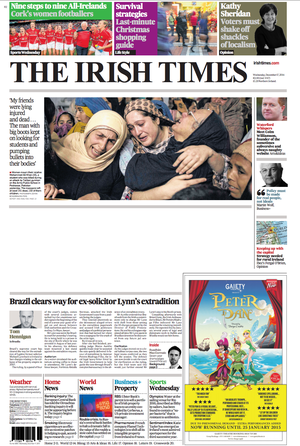




MORE to folly.
Covers to broadsheet@broadsheet.ie
Thanks Brian Oliver (Irish Times); Dermot Ahern (Irish Examiner); Meliosa Fitzgibbon (Irish Daily Mail); Paul Murphy (Irish Sun); Colm Heaney (Irish Mirror); Patrick Conboy (Longford Leader); Nick Sutton (UK papers)
Solicitor Michael Lynn is to be extradited from Brazil, via @rtenews http://t.co/Zbp5c6gV0x
— RTÉ (@rte) December 16, 2014
Lots of business news tonight. Michael Lynn to be extradited, Rouble collapses and bank inquiry about to kick off http://t.co/IQCJm1vcNc
— David Murphy (@davidmurphyRTE) December 16, 2014

