



Surreal pencil drawings by Swiss illustrator Christo Dagorov.

German Shepherd ‘Ger ‘
“sup?
In return he’ll keep you company.
Win win.
Dogs Trust writes:
Ger is a beautiful 9 year old German Shepherd. Poor Ger was found straying; cold, hungry and completely emaciated, he was in terrible condition and massively underweight. Our amazing vet staff and carers at Dogs Trust have helped nurse him back to health and he’s looking and feeling so much better.
Ger’s story, unfortunately doesn’t end there. Ger became quite ill recently and we discovered a problem deep in his abdominal cavity and we’re unsure just how long Ger will remain symptom free. All we can do now is keep Ger as comfortable as possible and closely monitor his welfare. Despite this, Ger is full of positivity and the sweetest, most loving and affectionate fella you could ever meet! He’s hugely popular here with both the staff and the other dogs!
We would love to give Ger the opportunity to live out the rest of his days in a home, a home he should have had from the very start. He would understandably need a quiet home to help him through this difficult time and he’s great with other dogs, so as long as they’re not too bouncy and playful, he’d happily live with a fellow canine companion. please call our rehoming centre on 01 8791000 or email reception@dogstrust.ie
Thanks Annie Whittier

https://www.youtube.com/watch?v=Yyk6hLK8WxQ
Staying in tonight?
Part one of a two-part ‘exposé’ of expenses claims made by MLAs [Northern Ireland Assemby members] by BBC Spotlight goes out on BBC One at 10:35pm.
Sinn Féin can’t catch a break these days.
*shakes printer cartridge*

What you may need to know:
1. Peanuts is getting a full CGI 3-D feature. Their first one ever. This trailer is all about Snoopy.
2. The official statement from Fox says “Did you hear? Snoopy leaked THE PEANUTS MOVIE trailer“. The trailer was not meant to appear until Thanksgiving, which coincidentally is the same day that the new Jurassic World trailer is dropping. Cowards.
3. This teaser is not giving much away but is a good indication of what the film will look and sound like. Seems good so far. Snoopy is not voiced by Adam Sandler nor is Charlie Brown wearing a Nike jacket and listening to an iPod.
4. Charles Schulz’ son Craig has written the script and is producing.
5. Paul Feig of the brilliant Bridesmaids (2012) is in charge of this one.
6. Next year will be the comic’s 65th anniversary. That’s Don Jonson vintage.
7. Broadsheet Prognosis: Great grief
Release Date: December 2015.
(Delboy remains a fugitive from the residents of the house of love. Dylan is Broadsheet writer, Tom ‘Farmer Tom’ Dillon)

Pull up a crying chair.
James Beggan writes:
‘We’re Not Leaving’ are delighted to have [Homeless activist] Fr. Peter McVerry at our photo exhibit tonight and to launch our policy recommendations to tackle the housing crisis. After researching the housing situation in Ireland and alternatives in place elsewhere, well, there may be rent controls..Read our executive summary here
FIGHT!
Migrant Rights Centre,, 37 Dame Street, Dublin @ 7pm

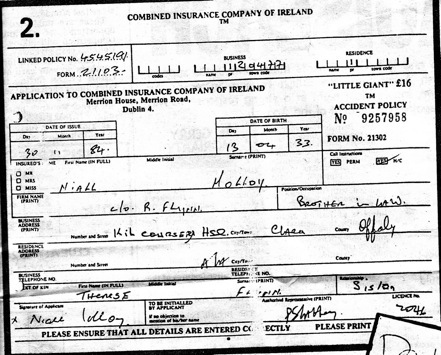
From top: Fr Niall Molloy in the Irish College in Rome with relatives and friends in the 1960s and a false insurance claim on Fr Molloy’s life
Justice Minister Frances Fitzgerald is considering a report that aims to explain some of the mystery surrounding the death of Fr Niall Molloy ending a three decade wait by his family.
Ahead of this we have prepared a brief timeline of events around the case since the killing in Roscommon in 1985.
1985: On July 5th, Niall Molloy, Parish Priest of Castlecoote, County Roscommon and a Flynn family friend, attends an after-party at Kilcoursey House, County Offaly following Maureen Flynn’s wedding to Ralph Parkes of Limerick. The guests include the late Brian Lenihan Sr and reportedly “at least one other senior Fianna Fáil member”.
At 3.15 a.m., James Duignan, parish priest of Clara, arrives at Kilbeggan Garda Station and informs Sergeant Kevin Ford that Fr Molloy has been killed at Kilcoursey House. Maureen Flynn’s mother Therese, a childhood friend of Fr Molloy, has already been sedated and taken to hospital.
Richard Flynn, Maureen Flynn’s father, makes a statement to the Gardai in which he states that he hit Fr Molloy several times with his fists in his bedroom following an unprovoked attack by the priest and Therese Flynn in the course of an argument over drink.
1986: Richard Flynn is tried in Offaly Circuit Court for manslaughter. The presiding judge, Frank Roe, writes to the Director of Public Prosecutions, Eamon Barnes disclosing prior knowledge of the Flynn family and Fr Molloy.
At the trial, Judge Roe directs that the jury acquit following an admission by Dr John Harbison, state pathologist, that heart failure could not be ruled out as a contributory cause of death, telling them “it’s a little bit unusual but not improper of me to say that no one intended any injury to be caused.”
A subsequent inquest finds that Fr Molloy died of acute brain hemorrhage consistent with an injury to the head. Speaking to RTE News after the inquest, Richard Flynn’s son David states:- “It’s very difficult, maybe, when one knows certain answers and isn’t in a position to comment. It makes it very difficult to live with.”
1987: Theft of the Niall Molloy file by criminal Martin Cahill.
1992: Niall Molloy file returned to the Gardai in a deal struck with Cahill and his criminal associate John Traynor, in return for charges being dropped against Traynor. Subsequently Sunday Independent crime reporter Veronica Guerin is made aware of certain contents of the Molloy file, including Judge Roe’s correspondence with the D.P.P. Guerin was working on the Molloy story at the time of her murder in 1996.
2003: Death of Judge Roe. His obituary in the Irish Times states:- “[h]e came from a staunch Fine Gael family and his political sympathies were always well known. He was described as ‘strong Fine Gael’ this week by those who knew him, and he was active in Fine Gael politics for most of his legal career.”
2010-2012: Irish Independent reporter Gemma O’Doherty carries out an investigation into Fr Molloy’s death. The results of this investigation, based on information supplied by Fr Molloy’s nephew Bill Maher (who has spearheaded the family’s campaign for justice for three decades) and the statements of a number of individuals, including that of a Kilkenny surgeon, now deceased, details the presence of political figures in the house on the night of Fr Molloy’s death, and concludes that the blows causing death occurred downstairs, in the presence of a number of people, and that he took several hours to die.
As a result of Ms O’Doherty’s work, the Gardai Serious Crime Review Team (SCRT) is appointed by Garda Commissioner Fachtna Murphy to re-examine the case.
Following concerns regarding the conduct of the Gardai in the initial investigation, including the failure to investigate a fraudulent insurance claim on a life policy taken out in the name of Fr Molloy naming Therese Flynn as beneficiary, Roscommon Labour Senator John Kelly demands his party uphold its pre-election pledge to establish an independent inquiry.
2013: Garda SCRT Report into the Fr Molloy death delivered to Commissioner Martin Callinan. The DPP states that the Gardai investigation has uncovered insufficient evidence to press charges.
Minister for Justice Alan Shatter appoints prosecution counsel Dominic McGinn SC to conduct a review of the contents of the Garda SCRT report and in light of that review to (i) prepare a report on any issues of public interest that may arise so as to facilitate the reviewer’s report being put into the public domain as well as (ii) to identify any matters of significant public interest or concern which would warrant examination by a further inquiry, which would have a reasonable prospect of establishing the truth.
2014: McGinn Report delivered to Minister for Justice Frances Fitzgerald. The Molloy family is not informed and finds out about this online.
Yesterday: The Report Is In
Pics via Bill Maher at Justice for Fr Niall Molloy
Staff Bonus
at

The Business
at
Omar Sarhan writes:
Small serviced office available to rent in Rathmines.
Meanwhile, in New York: The Plan to Turn NYC’s Old Payphones Into Free Gigabit Wi-Fi Hot Spots (Gizmodo)
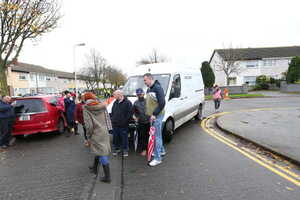
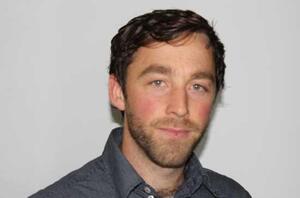
Protesters in Donaghmede, Dublin yesterday (top) Dr Rory Hearne, a lecturer in political and economic geography at National University of Ireland, Maynooth
Dr Rory Hearne spoke to Keelin Shanley on Today With Sean O’Rourke this morning about the protests that have taken place since the Fine Gael and Labour coalition were elected into Government in February 2011.
Keelin Shanley: “Rory, how do you explain the way in which the protests have grown and, you know, the apparent lack of understanding from the Government and the establishment of what’s driving them?”
Dr Rory Hearne: “Well, I think that the protesters have emerged as a result of a cumulative impact of austerity. And, you know, we can’t get away from this and, you know, Enda Kenny is right when he says, they’re [the protests] not about water. To a certain extent, they’re not because people are saying, you can hear there in the interviews with people who are protesting, they can’t take anymore. And I think it’s, the narrative that came out, when the Troika left was, ‘well, we’re now in recovery’ and, for the majority of people, they’re not seeing any recovery. And if we look at, you know, there’s structural problems within the Irish economy – things like low wages, housing crisis, mortgage arrears, child poverty, these have not gone away, they’re still there and they’re going to, the likelihood is they will get worse.
And, essentially, and I’ve been analysing this for a number of years now, there was this idea that the Irish people didn’t protest during the crisis and it’s not actually true. There was a number of protests that emerged after the Labour/Fine Gael government was elected in and that is significant. I think that was a significant moment. When Labour and Fine Gael were elected, on the promise of a democratic revolution and this idea that they were going to radically reform the State, that bondholders would be burned, that the recovery, and you know that it was the end of the way that politics was done, there was a sense that this was a new republic but they absolutely failed to do that.
And so people, in response to that started protesting. We’d a small group in Cork, called the Ballyhea Says No, who were protesting about the bondholder bailouts and the Anglo debt. There was the groups that protested against the sell-off of the forests who were actually successful in that, there was a lot of community groups and disadvantaged areas who have been, where their communities have been disproportionately affected by cuts. And there was a number of protests that were growing, and then of course we had the household charge campaign and we must remember that 50%, half the population, refused to pay that charge initially, that was a significant protest. And, obviously, that was defeated, when the Revenue Commissioners came in and I think it’s also interesting that when people comment about when, you know, what happened in Ireland during the austerity, why wasn’t there, you know, protests, and Lenihan went over to Europe and ministers in Europe were asking, ‘how are you doing all these adjustments and people aren’t protesting?’
And similarly, Enda Kenny was on the front of Time magazine, saying ‘I’ve got us through all this austerity, we’ve made vast adjustments and there hasn’t been protests’. And to a certain extent, I think people were holding back. They were holding back on the basis of shock, of collective guilt and a fear, and a sense of powerlessness and now that’s all changed. People feel now that they have a power to stop these water charges, that they can actually do it. And they also see that they’ve been through the worst, they can’t get any worse for most of these people. And there’s also an injustice, there is an injustice that’s lingering about the bailout of the banks and the role in which Ireland played in bailing out the European financial system and the fact that we were left with the highest cost, €64billion, of any other European country. And while the government tries to say that, ‘well that’s not significant’, well, it is for people. They feel the pain of it everyday and I think what’s happening is that you could describe this as a fracturing of the social contract of the Republic. The Republic was, since independence, was based on the idea of, you know, we’re all in it together, that there’s no real divisions – whereas that’s completely…”
Shanley: “That’s been broken at this point…”
Hearne: “That is broken and I think that we’re seeing the emergence of a new type of politics, of people feeling that they can’t rely on the political system, they have to take action themselves and with the water charges protests, you can see that they’re right – they’ve achieved more with these protests than electing a government.”
Listen back in full here
Earlier: Are You In The Sinister Fringe
(Sasko Lazarov/Photocall Ireland)