



Have you seen this bell?
Last week, during a discussion about the derelict Magdalene Laundry site in Donnybrook, Dublin 4, Dr Laura McAtackney, an historical archeologist, shared images (above) of a make-shift bell used by the nuns at the institution.
Laura sadly added that the bell went missing between visits to the site.
Breeda Murphy writes:
It is not of any monetary value but in terms of what it conveys – we can speculate as to the purpose; calling the girls to work; to pray – recite the Angelus perhaps; to eat or that it was time to load the van with fresh laundered linens etc – who knows? but it’s significant as a piece that reminds us of absence. The absence of the women who rang the bell and those for whom the bell tolled whose footprints are erased from such sites.
Anyone?
Last week: An Archeology Of Containment
In Bloom
at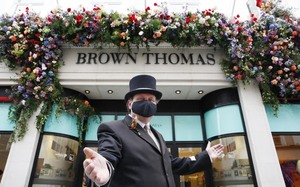





This morning.
Grafton Street, Dublin 2.
Earlier: Assembly Required
Meanwhile…
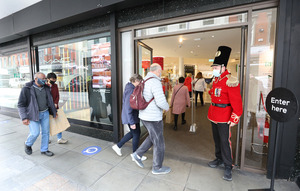
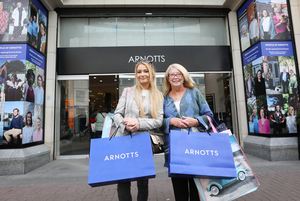
This morning.
Arnott’s, Henry Street, Dublin 1.

 From top: Amazon CEO Jeff Bezos; Heber Rowan
‘…$13,000,000,000. If all those 000s are making your eyes go funny, I’ll spell it out: thirteen billion. That’s how much Jeff Bezos added to his net worth in one day last July after the pandemic caused Amazon’s stock price to surge….According to a report by Oxfam, the combined wealth of the world’s 10 richest men increased by $540bn since March 2020…
The world’s 10 richest people made $540bn in a year – we need a greed tax (Arwa Mahdawi, The Guardian)
About now we are facing the idea of some people entering the ‘four commas’ club, ie. Trillionaires. More wealth than we can imagine, more than Standard Oil of its day or Amazon today.
A question is raised from this: do the mega rich have a moral or societal obligation to grant their wealth away in philanthropy? Or should countries tax them personally to ensure that their accumulation of wealth manages to decrease wealth inequalities?
The Gini Coefficient as an indicator of international inequality paints a harrowing picture. While most wealth is in shares owned within companies beyond personal taxation, we have to look at the effectiveness of taxation as it stands and how often the super wealthy enter into philanthropy as a means of keeping their social standing.
Indeed with the massive profits some firms have gained from the COVID-19 pandemic the UK and Ireland have considered imposing extra ‘pandemic profits’ taxes along with the IMF. It begs the question: what is fair profit? Namely, how rich can people get without a significant onus to redistribute that wealth either through taxes or through philanthropy.
Yes, extraordinary crisis (like pandemics) create opportunities to generate extraordinary profits, though at what point do we determine it to be too much, unfair or wrong? Amazon saw a 37% increase in its profits or for the new blue chip company Zoom, over 4,000%.
Indeed there have been many great philanthropic efforts and initiatives in the past. Dublin city owes a lot of its social housing to the Iveagh Trust of the Guinness family and the Carnegie Trust in the UK. The efficacy of philanthropy boils down to this, can you trust the effectiveness of government to deliver social impacts or do you trust those who have been fortune or innovative enough to generate profit?
Given the systems and controls in place with government expenditure, it is in part, perceived that philanthropy can be more effective than government. There is considerable debate about the issue given the tax breaks that charitable donations give. Though there is the argument that it is a manifestation of the politics of others with means.
The question of innovation
Some have a lot, others don’t. It is that simple.
Whatever you want to say about a Pareto principle in place or the structural inequalities of an economic system, we could politically deem what are ‘ok levels of wealth’ or too much.
Generally speaking most politicians are only too happy to have jobs from billionaires investing in their areas to complain, they need such a power base. As the mega rich also know that at the end of the day, they can rely on the threat of capital flight from a country to prevent a single nation state from getting ambitions of ‘a maximum wage’ or higher taxes on investments.
The OECD has been working for over a decade on anti avoidance measures in tax harmonisation but have been bogged down by continued opposition and the difficulties of a global system unable to make dramatic changes. While indeed a lot has been done through the BEPs anti-avoidance measures, we as a planet don’t act as a single unit too often. That’s not great.
Especially when we come out of a once in a century crisis of a pandemic that inevitably causes deep changes in society. Something’s gotta give.
The larger companies and the billionaires might argue that they are permitting innovation due to their purchasing power. Indeed, some visual examples of innovation in this decade amaze and horrify us deeply such as the Boston Dynamics robots having a dance. Though a considerable amount of innovation is stymied from the need to get immediate results for investment, sometimes known as the ‘Last Mile’ problem.
McKinsey reckons that most innovation this past year has been with the pharmaceutical companies, no surprise there, the issue is how can innovation still happen sustainably if so many people are getting insanely wealthy.
So when we have billionaires potentially becoming Trillionaries, we need to stop and ask ourselves, can we get more done by working cooperatively via governments not competitively in free markets.
Let’s ask another question; how long will it be before we stop enjoying the innovations of the companies of the super wealthy, like the latest smartphones, before philanthropy will be deemed to be not enough?
Heber Rowan is a Sligo native with a passion for politics. He works in public affairs and enjoys listening to and narrating audiobooks. He can be found on Twitter and occasionally blogs on Medium.com.
Getty
Hot Wheels
at



Behold: the Automobili Estrema Fulminea – an electric hypercar currently in development and due for release (in a limited run of 61 vehicles) in 2023.
The Fulminea’s pioneering hybrid battery setup combines ultra-capacitors and solid-state cells in four electric motors to generate 2,040bhp, 0-100km/h in 2 seconds and a terrifying 0-320km/h in 10 seconds.
Estrema claims the car will power up to 80% in 15 minutes and go for 520km between charges.
Your Call
at
This morning.
What’s your poison?
Via RTÉ News:
Strict conditions on the use of the Johnson & Johnson and AstraZeneca vaccines in people aged between 40 and 49 will mean people will have a choice to accept them, or wait for an mRNA vaccine, like Pfizer or Moderna…
…..The J&J and AstraZeneca vaccines will only be permitted to be used if an mRNA vaccine is not available at the time of vaccination.
People must be given a choice at that time on what vaccine to accept, with fully-informed consent…
….It expects to start vaccinations for this group of people later this month.
People aged 40-49 can decide to accept J&J or AZ jabs (RTÉ)
Meanwhile…

More metallic vax shenanigans.
Or sleight of arm?
Only you can decide.
Previously: Opposites Distract


This morning.
IKEA, Ballymun, Dublin 11.
Non-essential shops begin to reopen today.
We’re flat pack, baby.

This morning.
An interview by Fintan Dunne with Cindy Connolly (top right) who was transferred from mandatory hotel quarantine to hospital on Friday night suffering chest pains due to stress.
Ms Connolly travelled to Dublin from the UK to care for her 79-year-old father James (top left) who was released from hospital earlier this week after suffering an adverse reaction to Pfizer’s Covid 19 vaccine.
She was tested negative for Covid-19 by the NHS but was told on arrival at Dublin Airport she needed a PCR test and was escorted by members of the Defence Forces and detained at the Croke Park Hotel.

Thousands gather to celebrate the Yes result in the Marriage Equality Referendum in Dublin Castle Courtyard on May 23, 2015
Kevin writes:
My poem in response to yesterday evening’s episode of [RTÉ One’s] Reeling In The Years, which covered 2015. I wrote the poem below in the immediate aftermath of the (overwhelming) passing of the Marriage Equality referendum in that year.
A Day of Just Yes
Word is:
the system of storms
building mid-Atlantic has now
obligingly cancelled itself out;
all remaining car accidents
have been put off until tomorrow;
no further bankruptcy notices
will come into existence
until at least Monday,
as there’s no one home
to open the envelopes;
the shadow on your mother’s
right lung will not be detectable
on an x-ray until next Wednesday
week at the earliest;
elected representatives
are permitted, for one day only,
to walk the streets openly
shaking peoples’ hands
without anyone wanting
to lock them in the boot
of an ancient Ford Escort
to think about what they’ve done
and what they’ve failed to do;
commentators from across
the ideological spectrum agree,
even Auntie Bridie’s sciatica
is better than it was
this time last week;
the other side’s slogans are,
this morning, flags
madly cheering
your victory;
the roof top crows for once
maintain a dignified silence
and appear to be enjoying
this sunshine,
which the old lady in the paper shop
says is promised
to last.
Kevin Higgins
23-5-15