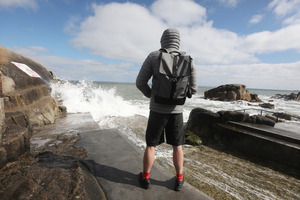
From top: Sibu a 42-year-old male Orangutan listens to violinist Larissa O’Grady; Barry O’Halpin on guitar and Malachy Robinson on double bass play to the Elephants at Dublin Zoo

‘sup?

This morning.

Phoenix Park, Dublin.

Members of Crash Ensemble play to the animals at an empty Dublin Zoo to mark the announcement of the programme for MusicTown 2021 .

MuiscTown celebrates ‘community, durability, and adaptability’ and includes rooftop lullabies performed across the City, choral performances, celebrating DJ culture, and ‘an exploration of sexual identities in Irish music…’

Crash Ensemble will premiere nine, 5-minute new works as part of MusicTown which runs from 15-25 April. These works are reactions to 2020, written by composers ‘outside of the contemporary music field’.

Any excuse.

MusicTown 2021

Leon Farrell/Photocall Ireland


From top: the statue on the cover of Midnight in The Garden of Good and Evil originally located in Bonaventure Cemetery, Savannah, Georgia; David Langwallner

It is Easter time, and one is reminded of the resurrection of good and evil.

The Southern Gothic tradition of such diverse figures as Faulkner, Cormac McCarthy and, above all else, Flannery O’Connor is a potpourri of hysteria, a crucible of awfulness. The dominant themes are race, class divisions, murder and insanity all inter linked and relevant to our age of extremes.

A later Southern Gothic crime novel is John Berendt’s Midnight in the Garden of Good and Evil (1994), also turned into a film, about murder most foul, or was it?

I had given a paper at an Innocence Project conference in Atlanta in 2010 and then, following an act of god, the volcano erupted in Iceland, we were stranded.

Atlanta is a dangerous city, even walking from our 5-star bland hotel to Martin Luther King’s birthplace and museum, a short ten-minute walk from our hotel, was to see much urban degeneration. Thus, after said visit, we hopscotched across the state of Georgia to Savannah with flights delayed. The conference had concluded on the 14th of April after Easter, or what Americans call Spring Break which is a decidedly different ritual.

Savannah, Georgia is an utterly eerie place. It contains some of the oldest courtly buildings in America and some of the best bookshops, including one where, except for financial impediment, I would have picked up, for next to nothing, a first edition with dust wrapper of The Great Gatsby. Funds were drying up.

These early colonial buildings included the mansion of a man put on trial for murder. Jim Williams was a successful art and antiques dealer. A wonderful tour of his mansion, Mercer House, from a man who knew and liked him well and saw him die was most informative. Antique dealers or art dealers who I have represented historically are the most ambiguously loved and hated people. Like Marmite. He thus seemed a loveable scapegrace. But said people have enemies in a local and closed community where people talk. Like Ireland, a valley of the peeping windows.

The book on its cover has a stunning example of Southern Gothic sculpture (above). It is the centrepiece of a museum displaced from its utterly macabre setting in the Bonaventure cemetery.

Oliver St John Gogarty, the Irish writer, surgeon, and dissolute, was sued for libel in his famous book As I Was Going Down Sackville Street (1937) for making a remark of antique dealers from the Dublin Liberties that:

‘They were in fact more interested in new mistresses than old masters.’

A typical callous Irish comment but, in substance, right, and I have also represented the same. Samuel Beckett who gave evidence in the subsequent libel case arising from Gogarty’s book, and obviously despised by the judge, was gloriously entertaining about this when I met him in 1981.

Jim Williams was put on trial four times and eventually acquitted for murdering his boyfriend. The argument was self-defence and, in effect, proportionate force as, he claimed, that after a tiff he had been attacked with a gun and merely responded.

All juries were hung until the final one when the trial was moved out of Savannah. Many wanted to hang him; many were fond of him. Either way, the strain of it all killed him. Local communities and small towns are riveted by blood feuds and animosities built up over time. It is always best not to become too prominent with a hint of unconventional notoriety in a local community.

Williams had friends. He was a conservationist and restored many historic buildings, but he made a lot of money and lived opulently and in a manner, which may have caused puritan eyebrows to be raised.

The title refers to the witching hour near midnight where folk magic is replaced by evil magic and the film features voodoo incantations that Williams be acquitted. Of course, a thought that has occurred to me often is that advocacy is like voodoo and sorcery. It is certainly a nonlinear dark art. It is not an entirely rational exercise and over rational formalistic predentary in advocacy has huge dangers in being effective.

The trial of Williams, at one level, was a form of the criminalisation and demonisation of someone for a lifestyle, perceived by some, as transgressive. Savannah is a most odd place with much old wealth of puritan stock and Mr Williams, with his parvenu, unconventional lifestyle and love of voodoo and alchemy, was a target.

The film and the sculpture are most unsettling, like the town itself ,with its interrelationship between high and low. Voodoo probably helped him not be convicted on balance. The film is also unsettling about prosecutorial zeal. They wanted him convicted. They were gunning for him.

But Williams you see, from a certain mindset, was a sinner.

But such statist absurdity is a feature of our age. Prior to the Catalan trial, for the simple civic act of hosting a referendum, a minister in the Spanish government Donna Luzon referred to the soon-to-be tried as the convicted. The lowering of criminal processes to hybrid civil processes to guilt by accusation and preventive detention is an awful feature of our age. The targeting of Julian Assange, which I have recently commented on (also see below) , is an act of state vengeance masking over their own criminality. The age of state authoritarianism not Aquarius.

I could afford some cheap books – not The Great Gatsby – for the journey home. A very courtly old lady with impeccable pearls and a blue rinse – when I asked for directions to Jim William’s mansion – said with a barely concealed flash of anger and a crimson blush, ‘He had it coming to him. He was known to the town’.

The volcano has now erupted worldwide and with the lowering of proof processes and an age of internment compulsory or otherwise and debates about vaccinations and viruses to come, the targeting of whistle-blowers and human rights lawyers, and a state of permanent coronavirus panopticon, we are all in Midnight on the Garden of Good and Evil and god only knows what is coming to whom? Or who is coming for whom or for what reason?

The question thus is fundamentally raised worldwide at all sorts of levels at Easter time as to what innocence is and who is truly evil.

David Langwallner is a barrister specialising in public law, immigration, housing and criminal defence including miscarriages of justice. He is emeritus director of the Irish Innocence Project and was Irish Lawyer of the Year at the 2015 Irish Law Awards. His column appears here every Tuesday and Friday. Follow David on Twitter @DLangwallner

Meanwhile…

Last night.

RT.

David discusses legal efforts to prevent Wikileaks founder Julian Assange’s extradition to the United States.

A pleasing short by Daihei Shibata – and a gentle poke in the eye for binary thinkers – In which a series of hard colours and shapes transition gradually from one form to another. Daihei sez of it:

When we gradate the boundaries between two polarized things, the two become smoothly connected. By blurring the various boundaries, we can find complexity, diversity, and richness of information.

kottke

Apella – Buried You

What’s another year?

Dublin pop sensations Apella – Dara Quilty on drums and Ronan Nolan on guitar (top) have released a limited edition vinyl and CD version of their hit album 1963, which has raked up half a million streams and counting.

The video for the new single Buried You comes courtesy of Ray Keogh.

Dara writes:

“We’ll be donating 100% of all the physical sales proceeds directly to The Marie Keating Foundation. Up against COVID-19 and BREXIT, I am delighted that production is complete and we can finally release our beautiful Vinyl and CDs! I am eternally grateful to everyone who has pre-ordered and we’ll continue to donate sales after the release date!”

The donations go specifically to help fund the outstanding support services the foundation provides to women affected by breast cancer.

Nick says: A good year.

Apella

The Magazine Fort.

Harry Warren writes:

On a fine Spring day, I was strolling along near the Magazine Fort in the Phoenix Park. Some children playing football kicked their ball near me and with a quick instep kick I tapped the ball back. It brought to mind a historic raid on the Fort that involved of all things a game of football but more of that anon.

Dating back to the 18th century the Duke of Dorset directed that a powder magazine be provided for Dublin.  The Phoenix Lodge built in 1611, standing on top of St. Thomas Hill (The Phoenix Park took its name from the lodge) was demolished so that the Magazine Fort with its five feet thick walls and surrounding dry moat could be built on the same spot.

The new fort was designed by the architect John Corneille and it was constructed in 1734 to 1736 for storing munitions for the Crown in Ireland. The Fort was never properly utilised for this purpose and early on, was seen as a symbol of British occupation. In 1737 Jonathan Swift (author of Gulliver’s Travels) satirised the fort suggesting that there was nothing worthwhile to defend in an impoverished Dublin at that time anyway so why waste time building it?

He wrote:  “Now’s here’s a proof of Irish sense, here Irish wit is seen, when nothing’s left that’s worth defending, we build a Magazine!”

In 1801, a barracks was added to the fort to accommodate troops. And in 1830, an older and larger earthwork fort that stood nearby was demolished.

The Magazine fort was a British garrison until 1922 until it was handed over to the National Army (1922-1924) after the Anglo-Irish Treaty. The Irish Army (1924 -) continued to operate the site as an ammunition store until it was demilitarised during the late 1980’s and it is now in the care of the Office of Public Works.

Unsurprisingly the fort was raided on two occasions in its history. Now about that football I mentioned earlier. On Easter Monday 1916 the IRA raided the fort, with one recalling:

“We arrived at the outside of the Fort, pretending to be a Football Team, and by passing the ball from one to the other got near enough to the outside sentry to rush and disarm him, while the remainder of the unit doubled into the Fort with pistols and revolvers drawn. The Guard Room was rushed, the soldiers there were covered and their rifles, which were stacked, were collected.”

An attempt was made to explode the fort by the laying of mines but the IRA discovered that it did not contain any high explosives that could have demolished the building. The fort had a store of only a small supply of firearms and ammunition. After the mines detonated, modest explosive damage was done to the fort and a blaze broke out. Later the fire brigade subsequently succeeded in extinguishing the fire and the fort was restored to service.

Years later on the 23rd of December 1939, a daring raid was made by the IRA on the fort, now in the control of the Irish Army. The “Christmas Raid” as it became known, resulted in the successful seizure of a huge quantity of weapons and ammunition. The reason for the raid was, that although the IRA had copious amounts of Thompson submachine guns, the .45 calibre rounds used in the guns were difficult to come by. By coincidence the Irish Army also used the Thompson and the same ammo.  So, a raid was planned and soon took place.

At 8:30pm on the 23rd of December 1939, a civilian called to the fort saying he had a parcel to deliver to the officer-in-charge. At his court martial, a military policeman then on guard duty at the entrance gate, said he bent down to unbolt the gate to take the parcel and when he stood up there was a muzzle of a revolver pointed in his face. He was told to open the gate and put his hands up. At this point the IRA members appeared from both inside and outside the fort and with the rest of the soldiers caught unawares they were taken captive.

The raid resulted in the huge theft of 1.2 million rounds of ammunition and cases of Thompsons arms being taken away in thirteen lorries with no casualties inflicted on either side. Though the raid was initially successful the majority of the ammunition and arms were recovered in the next two weeks turning it into a major PR disaster for the IRA. The day after the raid the Irish Minister for Justice, Gerald Boland, introduced the Emergency Powers bill to reinstate internment, Military Tribunal, and executions for IRA members.

Today the Magazine Fort stands somewhat dilapidated but it is being renovated and when the pandemic restrictions are eased it will open reopen as an important military historic site on view to the public. It is part of our history as a nation and well worth a visit.

All pics by Harry Warren

Harry’s Dublin appears here regularly, often on a Friday.

From top: Jason Corbett and Molly Martens on their wedding day in 2011; Grace Garvey

Reading the reaction to the news that Molly Martens and her father, Tom, have had their convictions for the murder of Jason Corbett overturned and are now considering a plea bargain, I was reminded of a heated discussion I once had.

It was 1988 and I was in London for the summer, working in Harrods, a shop so labyrinthine I sometimes got lost on the way to the loo. It was the tail end of an era when the odd old Etonian would choose Trinity College Dublin as an alternative to Oxbridge, which is how I ended up in Soho one evening having dinner with a college friend and his Tory dad. The father was chatty and, somehow, conversation turned to the Birmingham Six. At that point, the six Irish men were 13 years into a life sentence for the IRA Birmingham pub bombings of 1974. I had read enough about the case to be persuaded of their innocence and didn’t mind saying so.

The father was appalled, and railed against the cost of keeping the six at Her Majesty’s pleasure. The gallows was too good for them, he fumed. He was entrenched in his position and no amount of reasoning on my part could move him. He couldn’t countenance the fact that their convictions were unsound; in hindsight, they were simply too ‘other’ and he couldn’t relate. Coming from a place where the anomalies of the case were dispassionately discussed, this was an eye-opener for me.

Similar intransigence surrounds the Martens case, it seems. For those unfamiliar with it, Limerick man, Jason Corbett, was found beaten to death in his home in North Carolina in 2015. His American wife, Molly Martens, and her father, ex-FBI agent Tom Martens, were convicted of his murder two years later.

In February 2020, their convictions were quashed and a retrial ordered, partly because evidence that Jason may have abused Molly, which would have bolstered their self-defence claim, was excluded from the trial. The state appealed, but three weeks ago, the North Carolina Supreme Court upheld the judgment. A retrial was expected to take place sometime next year, but having since been offered a manslaughter plea bargain, this might not go ahead.

Judging by comments on social media, this case has created a dichotomy of us and them. Largely, the Irish contingent feels the Martens should rot in jail, while the Americans are open to the idea that justice has not been done.

The general public first heard of the case when Marian Finucane interviewed Jason’s brother, John, two weeks after the killing. He spoke of getting the awful call at work and the battle for custody of Jason’s children that ensued. Jason’s first wife had died of an asthma attack and Molly had cared for them since 2008, first as an au pair in Limerick and subsequently as their stepmother in the US. John surmised that Molly, a suspect by then, wanted custody of the children to gain control over Jason’s estate. He gave a glimpse of the horror that had engulfed his family, and listeners responded with sympathy, wishing the children a safe return home.

In February 2020, the North Carolina Court of Appeals found that both Martens had grounds for a new trial. The ruling said:

‘All of the evidence supports that Jason was the initial aggressor in the affray, and the first person who used deadly force.’

Mike Earnest, Molly’s uncle, said the result came as a surprise only to those who read news reports in Ireland. He claimed many Irish media organisations had published ‘fiction’ about the case, which is why so many were surprised at the appeal’ success.

One such bone of contention was the widely reported fact that Jason was planning to leave Molly to return to Ireland with the children for good. According to Jason’s sister, Tracey Corbett Lynch – who got custody of the children – this was the crux of the dispute.

The Martens family contend this is not true. According to Mike Earnest, no evidence was presented at trial to support this. He said:

“The sheriff and district attorney issued subpoenas and search warrants to try to find any email, text, internet search, anything that would have corroborated this – and they came up empty-handed.”

At the very least, he believes Jason would have been discussing such a move with his employer, but no such evidence was found.  he added:

“This is yet another example of fiction being presented as fact in an effort to paint Tom and Molly with a conspiratorial brush.”

In August 2017, Tom Martens’ sister, Mona Earnest, set up a crowd funding campaign to pay for the appeals. She received ‘an unbelievable amount’ of hate mail from Ireland but got several donations too. One of these came from a journalist who said she believed the pair had acted in self-defence, noting what she described as a tendency in the Irish media to take the side of men who abuse their wives. ‘We have had several murder-suicides in this country and the newspapers focused on “what drove nice, respectable pillar-of-the-community so-and-so to do it?” rather than on the fact that it should not have happened,’ she wrote. ‘Irish editors are biased in favour of the Corbett family,’ she added.

The problem with claims of domestic abuse is that abusers tend to be shape shifters and notoriously difficult to pin down. Tom Martens claims Jason dictated what his wife would wear and what she could buy; he would text her repeatedly, demand to see her phone and look at her computer history, all signs of coercive control if true. The Corbetts point to Molly’s loose relationship with the truth and her secret recording devices stashed about the house. Jason had packed up his life and moved to the US at Molly’s behest. Was that her way of isolating him from family and friends?

Although Molly had been de facto mother to the children for most of their lives and wished to adopt them, Jason wouldn’t agree to it. Was he trying to maintain the upper hand, or had he genuine concerns? Molly had invented a younger sister who had died, a fabrication that would give most people pause for thought. In a recent interview with Elle magazine, she says she hasn’t necessarily lied more than the average person, but that everything she’s ever said and done has come to light.

Jason’s children, then aged 8 and 10, were interviewed by social services in the days following his death and both described incidents of domestic abuse – punching, hitting and hair-pulling ­– in the home. Jack later recanted his statement, saying he had been coached by Molly to lie. For this reason, their evidence was not presented at the trial, but the Martens maintain the later statement given in Limerick, where the children now live with their aunt, was given ‘under coercive circumstances without any of the safeguards to ensure trustworthiness or reliability’.

One thing that can’t be denied is that deadly force was used that fateful night. Jason suffered at least a dozen blows to the head. Mike Earnest believes Tom Martens did what he was trained to do to eliminate the threat to his daughter’s life. But despite the alleged struggle, neither Tom nor Molly sustained a single mark.

At the heart of these tragic events are two families whose lives have been torn apart. Both insist on the integrity of their stance. If the Martens accept the plea bargain on offer, they’re likely to be released on bail before returning to prison to serve whatever remaining time is agreed. If they opt for retrial, the Corbetts will be forced to relive the trauma of Jason’s death.

While we might sympathise with one side or the other, tribalism has no place in due process. Everyone is entitled to a fair trial. Real cases are messy, and more nuanced than can ever be conveyed in a courtroom drama. All we can hope for is that justice is served.

Grace Garvey is a Communications and Content Marketing Strategist. Grace can be reached at ggarvey2021@gmail.com. 

Broadsheet.ie