90312876Are you based in North America/Canada and like your R ‘n’ B at full pelt?

You may like this.

Jenny McGovern writes:

The Strypes have announced some tour dates in America and Canada, they will be playing the following dates, if any US/Canada based based broadsheeters are interested in going…

January 2014
20 – Toronto, ON – Lee’s Palace
22 – New York, NY – The Studio @ Webster Hall
24 – San Francisco, CA – Brick & Mortar
28 – Los Angeles CA – Troubadour

Hope some of ye enjoy!

Also here‘s the latest video from the band for their cover of “You Can’t Judge A book” filmed in a warehouse in Cavan last month by Finn Keenan.


Previously:The Strypes on Broadsheet

(Sasko Lazarov/Photocall Ireland)

WomenLondon

Then you may like to see this documentary Breaking Ground.

Michelle Deignan writes:

“Throughout the 80’s Irish women arrived in London in their droves and towards the end of the decade they made up 10% of the capital’s female population. Many of these women were not simply economic migrants but women in search of an alternative life, away from the repressive predominately Catholic culture of Ireland. Their optimism for a new life was tempered by the reality of life in London. Irish women were among the most disadvantaged ethnic and gender groups in terms of housing and employment. What the London Irish Women’s Centre did was tackle inequalities and difficulties for Irish women in London by both actively agitating for change and providing practical services to support Irish women to live daily lives. The documentary film charts the context within which the organisation began in 1983 and it’s work over the next 29 years up until it’s closure in 2012. There are 18 interviewees in the film all representing different times, situations and perspectives on the centre.”

Breaking Ground will be screened at Cork Film Festival on Monday, November 11, at 5pm, The Gate Cinema.

More about the documentary here.

H/T: Women’s Museum of Ireland

original

Youtuber SafetyHammer (animators Doug Bayne, Ben Baker and Trudy Cooper) sez:

The Elegant Gentleman’s guide to Knife Fighting is an Australian sketch show- they came to me and said “you love Terry Gilliam, right?”
Yes. Yes I do. I made them a bunch of animated bumpers, these are some of my favourites.

gizmodo

(H/T: Rachel Wynne)

Colm(President Higgins appointing Colm MacEochaidh as Judge of the High Court last year)

You may recall the Iranian asylum seeker whose gayness was questioned by a member of the Refugee Appeals Tribunal.

Another Iranian man, who came to Ireland on December 19, 2009, applied for refugee protection out of fear he would be persecuted due to his political opinions and email campaigning.

He told the Irish authorities he was arrested in June 2009 at a ‘Green Movement’ demonstration and that he was tortured for 12 days. He said he was almost arrested on a second occasion, at another political demonstration, but that he escaped.

His application was turned down in July 2012, with the Refugee Applications Commissioner claiming his application lacked credibility. This decision was later upheld by the Refugee Appeals Tribunal.

In upholding the decision to reject the Iranian man’s application, a Tribunal member wrote how copies of emails that were given to the Tribunal didn’t bolster the man’s claims. The Tribunal member also wrote about short video clips which, the Tribunal member claimed, actually contradicted the man’s evidence in his application.

The Tribunal member wrote:

“They [the copy emails] do not bolster his claim in any material sense. The Tribunal is fortified in this view by viewing the short video clips (recorded on a phone) of his purported attendance at various demonstrations in Iran provided by the appellant in support of his claim. Again, it is difficult to ascertain by viewing them whether the appellant was even present or whether they were obtained elsewhere (to note in this regard is that the appellant stated that they were stored on a removable flash memory card rather than on the RAM of the phone itself). However, even if one were to untainted by the visible presence of police or army officers.

Indeed, the participants themselves appeared fairly relaxed and unconcerned about the presence of even undercover agents, which seems incongruous with the earlier contention made by the appellant that he and other participants had been acutely aware of the dangers of undercover agents and the resultant necessity to conduct all their activities furtively.

But.

The Iranian man never submitted any such video clips as part of his application.

In reviewing the case, Judge Colm Mac Eochaidh found:

“The pleading and averment about the video clip are not met by the respondent with evidence to the contrary. The statement of opposition is in the barest of terms, applicant did not tender a video clip in evidence to the Refugee Appeals Tribunal. No explanation has been offered by Counsel for the Tribunal why the decision maker said that a video clip had been submitted by the applicant. I do not need to speculate on how this happened. The respondents’ silence speaks for itself. I have no doubt but that the complaint made in respect of this matter by the applicant must be upheld.”

Counsel for the Tribunal urges me to allow the decision to stand by excising the passage quoted above dealing with the video clip. This is an invitation I refuse. Numerous decisions of the High Court warn against deconstructing credibility findings in decisions of the RAT. As Cooke J. notes in I.R. v. Minister for Justice, Equality and Law Reform [2009] IEHC 353 “When subjected to judicial review, a decision on credibility must be read as a whole and the Court should be wary of attempts to deconstruct an overall conclusion by subjecting its individual parts to isolated examination in disregard of the cumulative impression made upon the decision-maker. ………” That cuts both ways and applies to respondents too.

In this case, I cannot overlook the stark fact that the Tribunal Member considered evidence which he mistakenly believed the applicant had submitted. Neither can I disregard the fact that the Tribunal Member analysed the content of that material and concluded that it contradicted claims made by the applicant. Though it is not possible to say to what extent this contributed to the rejection of credibility, its negative effect cannot have been small. However one might categorise or describe what happened, my view is that the episode infuses the decision with illegality and it must therefore be set aside.

Judge Mac Eochaidh has granted the man leave to seek judicial review and ordered the man’s case to be heard again but by a different Tribunal member.

Read Justice Mac Eochaidh’s decision in full here.

Previously: Rescuing The Gay Refugee

Pic: President.ie

Thanks Mark Malone

maths

“Mathematics, rightly viewed, possesses not only truth, but supreme beauty — a beauty cold and austere, without the gorgeous trappings of painting or music.” —Bertrand Russell

A rather fetching triptych video by Yann Pinneill and Nicolas Lefraucheux of Parisian video production agency Parachutes showing the mathematical principles underlying everyday events: equations to the left, mathematical models to center and videos of the phenomena to the right.

A full screener, this one.

colossal

90162543This week in place of Paul Krugman, who is away brooding…

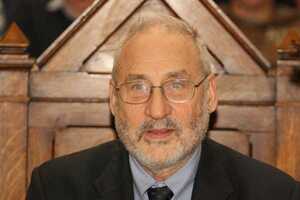
Nobel Memorial Prize winning economist Joseph Stiglitz went on RTE R1’s Morning Ireland earlier to tell co-host Gavin Jennings about our lost decade(s) ahead.

Gavin Jennings: “As we leave the bail-out, in your view, do we have reason to celebrate?”

Professor Stiglitz: “Well, it’s better than not leaving. You have reason to celebrate for not being under the thumb of the Troika, but I don’t think that anybody thinks that you’re back to robust recovery, nobody thinks that Europe is really doing well.”

Jennings:
“Do you think we deserve any credit for what we’ve done?”

Professor Stiglitz:
“I think there was some foolishness in assuming for instance that on the public backs – the burdens of the debts of the banks – that’s going to saddle you for years to come. I think some really serious mistakes [have been made] – that having being said, you’ve managed reasonably well – given the demands that were put upon you.”

Jennings:
“You said, not long after the bail-out that it was a noose around the country’s neck that would strangle it, and that Ireland has done all the wrong things. In your view, who got it wrong, who is to blame?”

Professor Stiglitz: “I think that obviously a good share of the blame has to go to the ECB – The European Commission for not re-structuring the debts – for not saying, you know – you have private banks that made bad decisions, the shareholders, the bondholders of those banks have to bear the costs – not the taxpayers. And to bail out the banks’ bondholders was a deep mistake. Obviously, it was also a problem with The Government to accept those burdens which will saddle future generations. Given that Ireland has benefited so much from being part of the Euro – there wasn’t much after that, once you’d made those bad decisions that you could do. That is to say, in the context of where you were – limited ability to finance – hard to have a non-austerity package without some money.”

Jennings: “Whatever about how we got into this mess, was there an alternative for how we got out of it?”

Professor Stiglitz: “I think once you have accepted the burdens of the debt, once you made the decision – it probably was the right decision, to stay in Europe – the room for manoeuvre was greatly restricted. And I’ve been very impressed at the way that the Irish people have accepted, you might call the pain.”

Jennings:
“Impressed, or astonished?”

Professor Stiglitz: “Astonished maybe, astonished – without protest, you know, it was a loss of democracy. There is a democratic deficit, here in Europe – I would have thought that the citizens of the country should at least express disappointment, severe disappointment with the way things have been working out.”

Jennings:
“So, if taxpayers ended up paying for these mistakes and in your view, wrongly – the cause of these mistakes, or those who should bear the blame for those mistakes are somebody else, and you said the ECB. How could they, or how should they have paid for those mistakes?”

Professor Stiglitz: “How should the ECB have paid for those mistakes? Basically – who should have paid? The first mistake was making the citizens pay for it. First of all, the bondholders under conventional bankruptcy – if you are owner of a firm, if you lend money to a firm and the firm goes bankrupt – you suffer. You get the upside in capitalism, but you have to take the downside. That’s why you get returns that are often quite high. So that was where the burden should have laid. It should have laid with the bondholders and the shareholders. And I think what was really going on was that the ECB and others in Europe wanted to save the banks and the other investors in Europe who had put their money into these bonds. So it was really a trade-off between banks all over Europe and Irish citizens. Irish citizens are not so much bailing out the Irish economy – they’re bailing out foreign bondholders.”

Jennings: “In your view, how long do you think it’s going to take us to recover, are we looking at three years, ten years, thirty years – can we ever recover along the road we’re going down now?”

Professor Stiglitz:
“Well, the word recover has two different meanings. Will you get back to the growth path that you were on? Almost surely no! Will you get back to where you were – with maybe a lost decade, a lost two decades – yes! I think you will get back to where you were, but it will be a lost decade, at least. And I think that’s the reality that Europe needs to wake up to. What I find so upsetting is most of this is totally unnecessary. You know – the mistakes that were made before 2008 were totally unnecessary, but the mistakes that were made in 2008 and afterwards are even more unnecessary. Because we know, we knew then that austerity would not work.

Listen here

(James Horan/Photocall Ireland)

miriam


Let us have respect and hail women for whom breaking a glass ceiling is not a priority. Women who are content in their jobs but who value the time they have left for their families too.
Hey sisters we can’t have it all – the high flying career, the perfect family and perfect life. We have to make choices. But that doesn’t mean we are not making a valuable contribution. Let’s stop the whingeing and just get on with it.

I broke through glass ceiling – then changed my mind (Miriam Donohoe, Independent.ie)

Alternatively…


Broadsheet.ie