

LockoutINdo

For the day that’s in it.

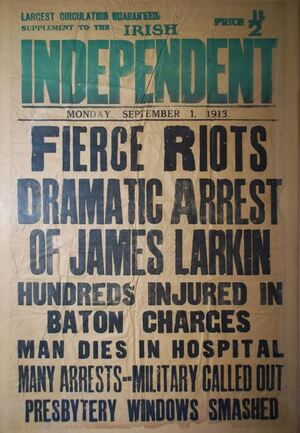
Social historian and author of Lockout: Dublin 1913, Padraig Yeates discussed the implications of the 1913 Lockout to The Irish Story in 2010.

This is what he said:

“My contention would be that the events of the Lockout and the peaks that took place during the Lockout were the nearest thing we had to an actual discussion or contest over what modern Ireland, 20th century Ireland, would be like in social and economic terms. The 1916 Rising produced the Proclamation (of Independence) and you had the Democratic Programme in the first Dáil but these were sort of handed down from on high. Similarly, if you look at the Treaty debate, that unfortunately revolved around the oath of allegiance to King George the 5th.

There’s very little in it about what sort of society they wanted. So the nearest thing you had to that was the Lockout where you had, if you like, reformist elements, like the suffragette movement, and socialists and trade union leaders generally arguing for a more secular, more pluralist and more equitable society, on one side and you had employers and the Catholic Church on the other side, arguing very much for the sort of society we ended up with for the most of the 20th century. So it was a very important event. Its main importance is the unspoken importance.

It was this sort of conventional myth created of a heroic sort of workers fighting British Imperialism, in all its manifestations including British capitalism, but being defeated in the end. There was a subliminal message there that really socialism and those sorts of ideas don’t really work. At the end of the day, the employers were right. They were a bit more hard-headed and bit more ruthless than they needed to be but they knew how the world worked. So there was a sort of comfortable myth there then that gave something to everybody. But I think the real story is the story of people like Dora Montefiore.

It’s a story of people, suffragettes, socialists, trade unionists who were trying to create a modern, secular, pluralist society in this country and were ground into dust. I think its importance is it set the agenda for post-independence Ireland. It was seen simply as a curtain raiser for 1916 and everything that followed. But, in real terms, it actually set the agenda for the independent Irish state that followed 1916. So far from being a curtain raiser it really was a curtain raiser and a curtain fall on the whole process. It pre-determined, to a large extent, the type of Ireland we were going to have in the 20th century.”

Listen here.

Pic: IFALPA

Market FV1

FV2

Following reports that the Victorian fruit and vegetable market on Mary’s Lane in north inner city Dublin will be redeveloped, leaving wholesalers sharing the space with retailers and café owners, this letter was written to the Irish Times:

FVletterGeometry, eh?

Dublin’s Victorian fruit market to be redeveloped (Irish Times)

Market plan could bear fruit (Irish Times letters)

Pic: William Murphy

90298041

.From Checkout.ie:

In addition, Budweiser retains its position as Ireland’s Number One off-trade alcohol brand, Blossom Hill is Ireland’s leading wine brand, Smirnoff is Ireland’s top spirit, and Silk Cut holds on to its position as Ireland’s leading tobacco brand.
“Another interesting one is single serve premium cat food, a category that is growing by 20% year on year, while overall cat food is declining. Consumers might be buying private label for themselves, but still buying luxury single serve cat food for their pets.”


Proper order.

The top ten grocery brands in Ireland.

1. Coca Cola
2. Avonmore
3. Brennan’s Bread.
4. Lucozade
5. Cadbury Dairy Milk
6. Tayto
7. 7Up
8. Jacobs
9. Walkers
10. Danone

Coca-Cola Still Ireland’s Biggest Selling Brand, Checkout Top 100 Brands Report Reveals (Michael Wynne Jones, Checkout)

(Leon Farrell/Photocall Ireland)

902895171

Martin McAleese presenting his report into the Magdalene Laundries in February

It’s not washing.

From Saturday’s Irish Examiner:

Questions surround a section of the McAleese Report which states it asked the Ryan Commission to contact seven women mentioned in the Ryan Report who were in Magdalene Laundries.
Chapter 19 of the McAleese Report outlines how it asked the Ryan Commission to write to the women it spoke to and inform them of the McAleese committee and its work.
This was done as it was not possible for the Ryan Commission (CICA) to clarify to the McAleese committee what sections of the chapter referred to Magdalene Laundries, rather than other institutions because of legal issues.
However, minutes of a meeting of the McAleese Committee on June 26, 2012, obtained under Freedom of Information, which deal directly with its interaction with the Ryan Commission, completely contradict this claim.
In the minutes, it is stated that it was agreed with the Ryan Commission that it would not contact any of the women.

…The McAleese report ultimately concluded that it could not determine if any of the women’s experiences cited in the Ryan Report actually related to the 10 Magdalene Laundries within its scope.


Lest we forget.

Questions over section of McAleese Report (Conall Ó Fátharta, Irish Examiner)

Previously:

The McAleese Report: ‘Incomplete And Not Independent’

Omission To Prey

Lost In The Wash

McAleese Report: A Conclusion

 (Sasko Lazarov/Photocall Ireland)

Broadsheet.ie