Woh.

You’re going to Barbados.

Ralph Hosford writes:

I am an Irish guy living and working in Barbados. The company I work for is part owned by an Irish person so thought this may be of interest.

The Barbados Fertility Centre are looking for an IVF nurse coordinator to come to Barbados to join our team. We have 365 days of sunshine, friendly people and beautiful turquoise seas!

There is also a few Irish staff here already so we are looking to expand the team. Interested? Know someone who would be?

Anyone?

Barbados Fertility Centre

From top George Gibney in 1988 (left) and in 2019 (right); Irvin Muchnick

Though I have sharply criticised the thoroughness, as well as the lowest-common-denominator quality, of the BBC/Second Captains podcast Where Is George Gibney?, there is no question that this Mark Horgan series succeeded in one significant respect. It has created a space in which other major media outlets can choose, at last, to step up and reexamine the Gibney story, either comprehensively or from the several important angles Horgan consciously ducked.

The biggest breakthrough so far, on the American side, was last month’s coverage in The New York Times (which I reviewed here).

Ed O’Loughlin, a Dublin-based New York Times reporter, became the first mainstream journalist since Bob Egelko of the San Francisco Chronicle in 2016 to tackle the global aspect of the protection of Gibney from accountability for more instances of child sexual assault than we’ll ever know.

The New York Times did so by quoting the strong words of federal judge Charles Breyer during my Freedom of Information Act case against the Department of Homeland Security for background material from Gibney’s immigration records.

They whiffed, however, on Judge Breyer’s supportive comment about my hypothesis regarding the role of the American Swimming Coaches Association (ASCA) in engineering the coaching job offer letter for Gibney that enabled his relocation here on a diversity lottery visa. This came shortly after a nepotism-tinged Irish Supreme Court, in 1994, quashed his indictment on 27 counts of illicit carnal knowledge of minors.

Today there is behind-the-scenes drama at ASCA, which is now on its third executive director in 13 months following the retirement of John Leonard, who is perhaps the most pernicious figure in the swimming world’s decades of cover-ups of abusive coaches. Stay tuned for more shortly on the ASCA drama.

Before and after the New York Times story, I have been importuning editors of the Orlando Sentinel to take Gibney coverage to another level. At age 72, Gibney lives in Altamonte Springs, Florida, north of Orlando. And as we know, all politics is local.

In 2010 the Sentinel published fleeting mention of a controversy among Gibney’s neighbours in Orlando, where he then lived and soon lost his home (the reason is not known, but it may well have been part of the universal home mortgage collapses of that period).

The same year – probably not coincidentally – Gibney, holder of permanent resident alien status for a decade and a half at that point – applied unsuccessfully for U.S. citizenship.

He moved into a house in nearby Altamonte Springs with “Brother Pedro” (possibly one of the local Knights of Columbus chapter players who are propping up the elderly Gibney with housing and a job at a hospice).

In 2014 George Diaz, a Sentinel columnist, wrote about the campaign to deny Chuck Wielgus, then the long-time chief executive of the U.S. Olympic Committee’s national sport governing body USA Swimming, induction into the International Swimming Hall of Fame.

Over a period of years, I pressed Diaz, who advocated for foster children, to write something additionally about the campaign to bring to justice the swimming coach monster in his midst. Diaz never came through before the Sentinel laid him off in 2018.

Most recently, following the conclusion of the podcast series, I pitched Sentinel editor-in-chief Julie Anderson and managing editor Roger Simmons. Anderson and Simmons directed it to Jeff Weiner, whose title is “justice & safety editor.” Weiner expressed interest, but he and his bosses all have fallen silent for more than a month.

What are they waiting for? So many local details from the Horgan podcast and the Times article remain unexplored. Among them: Peter Banks, the Tampa-based swimming coach, formerly a Gibney assistant in Ireland, all but admitted to Horgan that he was the person who brokered the American coaching job offer letter that was attached to Gibney’s original visa – and Banks was, at the time, an ASCA official.

Also: The state attorney’s office in Hillsborough County has told me that the statute of limitations does not bar prosecution of Gibney today for his 1991 rape of a 17-year-old Irish swimmer during a Florida training trip — and this overlays and supplements the question of extraditing Gibney for previous crimes in his native country.

Two Sundays ago, the Sunday Independent’s Maeve Sheahan took a corner of the Gibney saga to a breaking development: the imminent release from Arbour Hill prison, after 27 years, of another legacy abuser Irish swimming coach, Frank McCann (“George Gibney case turns spotlight on double murderer Frank McCann — and his dealings with the teenager he coached,” behind paywall).

The Sunday Independent not only reviewed in depth the narrative of McCann’s murders – by burning down their house – of his wife and their 18-month-old baby. As Sheahan writes, the motive “was to conceal the secret that he fathered a child with an underage girl with special needs whom he coached at his swim club”:

“At the time, the enormity and profound cruelty of his crimes overshadowed his grotesque sexual interference with a vulnerable young girl. He received two life sentences for murdering Esther and Jessica but has never been called to account for his treatment of that young girl in his care.”

But there’s more. As Sheahan’s story points out, McCann also was president of the Leinster Branch of the then-Irish Amateur Swimming Association (now Swim Ireland) when the Gibney scandals broke in the early 1990s. As the 1998 Murphy report would point out, McCann made clear to others in the organisation that exposure of the Gibney horrors would not happen on his watch.

Decorously, the Sunday Independent didn’t publish the exact words of Carol Walsh, the coach who brought the matter to McCann after talking with Gibney’s root victim and whistleblower, Chalkie White. McCann, Walsh said, said he “hoped to fuck it wouldn’t break while he was president” and told Walsh “to back off and not get involved.”

Meanwhile, Johnny Watterson, sports columnist of the Irish Times, who deserves all the credit for breaking the Gibney story nearly 30 years ago at the old Sunday Tribune, returned recently with more Mark Horgan hype: “Where is George Gibney? Podcast Releases New photograph’.

Big deal.

Evin Daly, the Irish-American head of the Florida nonprofit One Child International, has been shadowing Gibney for years. Daly took almost all the contemporary photos of Gibney that have run in the Irish media in the last decade-plus. One of them graces the cover of my ebook The George Gibney Chronicles: What the Hunt For the Most Notorious At-Large Sex Criminal in the History of Global Sports Tells Us About the Sports Establishments and Governments on Two Continents.

Watterson also writes:

“While he is not currently involved with coaching young children, on arrival in the US Gibney did work at a swimming pool in Arvada, Colorado.”

Watterson knows better than to parrot this bland language from the New York Times. Gibney was not some maintenance worker swabbing the deck at the Apex Recreation Center. He was a coach on the staff of USA Swimming’s sanctioned North Jeffco age-group team.

Indeed, Watterson is the person who first enlightened me on the fact that officers of the Arvada Police Department, who investigated Gibney in 1995, to no end, following a sexual misconduct complaint, was coaching kids there.

It’s time for the Irish and American media alike to start writing all this in plain English. Enough with the impenetrable code.

Irvin writes at Concussion Inc.

Previously: Irvin Muchnick on Broadsheet

Pics: Getty/Mark Horgan


https://twitter.com/CSBlenner/status/1357641617142935559


A joyous and entirely convincing celebration of Kim Jong-unity

Pro-Kremlin Media Airs Putin-Praising ‘Flashmob’ Performance (Moscow Times)

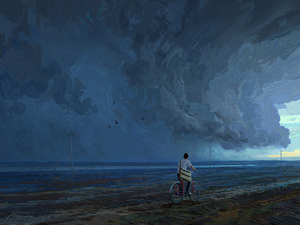
The surreal landscapes of St Petersburg-based artist Artem Chebokha, aka RHADS:  brooding digital landscapes of unlikely scale that mimic the textures of impasto oil paintings.

Prints available here.

colossal/crossconnect

Here’s How,

The current affairs podcast hosted by William Campbell (above right) meets Brenda Power, Sunday Times and Irish Daily Mail columnist and right-leaning, leftist-baiting, third-wave feminist foe.

William writes:

Are the tables of discrimination being turned against conservatives, or is it just that when you’re used to supremacy, equality can feel like discrimination? I ask Brenda Power.

Listen here

From top: James Connolly, Anna Livia Plurabelle, Phil Lynott, Patrick Kavanagh, Oscar Wilde with Constance Wilde (top inset) and the torso of a young Dionysus (inset below) and ‘Best Night Ever’ in the Botanic Gardens

Dublin statues.

Harry Warren writes:

If you are having a stroll around Dublin you are bound to pass some wonderful sculptures. Many are worth a visit and it is a good opportunity to stretch your legs and get some fresh air. If you are lucky to be abled bodied, Dublin is a lovely city to explore on foot, being relatively flat and with plenty of sculptures within walking distance to enjoy.

Most European cities have statues of their kings and queens and politicians but in Dublin along with our political figures, we also give pride of place to our cultural heroes our poets, dramatists and even some mythical creatures.

In no particular order here are some of my favourite statues and I am sure Broadsheet readers may be kind enough to share their favourites in the reply section below.

Anna Livia Plurabelle, the lady of the river, as she is portrayed in James Joyce’s Finnegans Wake as a personification of the River Liffey. Some years ago, in a bout of religious fervour many people all over Ireland genuinely believed that they witnessed statues of the Virgin Mary move and that is another story, but this statue really did move!

The sculptor Éamonn O’Doherty was commissioned by Michael Smurfit to create the statue that would celebrate Dublin’s Millennium. It was originally sited in a fast-flowing fountain in Dublin’s O’Connell Street. Unfortunately, it became a target for litter louts along with the occasional box of washing up powder being dumped in resulting in the street being covered in foam. To Dublin City councils shame they removed the statue in 2001 and hid it away for ten years in a crate in St Anne’s Park in Raheny.

Eventually, in consultation with Éamonn O’Doherty who wanted her to be located near the Liffey in water, in February 2011, Anna Livia was finally relocated to the Croppies Acre Memorial Park, Wolfe Tone Quay. Her journey to the park was very appropriately by boat. The Ringsend Boat Club proudly floated her down the River Liffey to a purpose-built pond when she reclines very elegantly today.

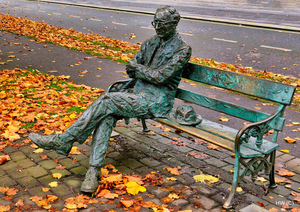
Patrick Kavanagh
, a superb poet and whose poem “Raglan Road” was immortalised in song by Luke Kelly of the Dubliners. After leaving what was then Parson’s bookshop on Baggot Street Bridge, Patrick often sat along the Grand Canal contemplating the water deep in whatever thoughts a poet may have.

The sculptor John Coll took his inspiration from the Kavanagh poem, “Lines written on a Seat on the Grand Canal”. He created a superb life-sized sculpture of Kavanagh sitting on a bench that you can view at the Baggot St end of the canal. A plaque quotes “Leafy-with-love banks and the green waters of the canal Pouring redemption for me”.

James Connolly
, Socialist and Commandant of the Dublin Brigade in the Easter Rising, his statue is on Beresford Place. Sculpted in 1996 by the Éamonn O’Doherty, it is a fine bronze life-like statue of Connolly proudly standing in front of a curved wall with a sculpted plough and the stars replete with one of his best-known quotations, “The Cause of Labour is the Cause of Ireland / The Cause of Ireland is the Cause of Labour”.

Connolly was born into poverty in Edinburgh, Scotland, to Irish parents and for his part in The Rising, was sentenced to death. If the mortally wounded Connolly first tied to a chair and then strapped to a stretcher to enable his execution, wasn’t so cowardly executed by a British firing squad, I often wonder how different modern Irelands politics would have been if a true socialist had been elected to government during the formation of the state.

Phil Lynott
, Phil was best known as the lead singer and bass player for the Rock band Thin Lizzy. He was an excellent frontman and lyricist. “When I’m in England I say I’m from Ireland, when I’m in Ireland I say I’m from Dublin, when I’m in Dublin I say I’m from Crumlin, when I’m in Crumlin I say I’m from Leighlin road, when I’m in Leighlin road I say I’m a Lynott”.

Paul Daly‘s superb bronze sculpture of Phil Lynott is outside of Bruxelles Pub on Harry St reet just off Grafton Street. You may have to wait a moment to view the statue as so many fans commandeer it to take selfies. Daly managed to capture the swaggering essence of Phil whose life ended tragically far too early in 1986.

Unfortunately, like many of the cut throat deals that permeate the rock business Paul struggled to receive any royalties for the hundreds of miniatures of his work that have been subsequently sold. Today Daly is continuing to create new art and is selling it on his website , including wonderfully detailed miniatures of Lynott, Freddie Mercury and Rory Gallagher.

Dublin’s Botanic Gardens has several statues but I love the statue of two women by local sculptor Bob Quinn, located near to the entrance in front of one of the wonderful Victorian glass houses. It is titled ‘Best Night Ever’. The two women are sculpted walking arm in arm on what I like to imagine, a girl’s nights out, looking blissfully happy in each other’s company, one carrying her hand bag, the other her shoes. There is a joyful animation to it that almost makes the sculpture appear to be moving.

Oscar Wilde’s sculpture in Merrion Square park, A three-part masterpiece by sculptor Danny Osborne, sited across the road from 1 Merrion Square, Wilde’s childhood home. Today Wilde is one of Irelands most popular and loved writers. Echoing his life, if you look at Oscar’s face notice that the left side of his face has a sardonic grin, while the right side is sad.

His sculpture is accompanied on two separate columns by his pregnant wife Constance, and on the other, a torso of a young Dionysus. The two columns are covered in quotations of Wilde’s witticisms and writings. The quotes are personal favourites by a mixture of poets, politicians and various artists, people like Christy Moore, Seamus Heaney, Michael D Higgins and Robert Ballagh. All are well worth a read.

So, as you ramble across Dublin ponder a while and enjoy the statues, they all have a tale to tell.


All pics by Harry Warren

Dublin city centre

This morning.

According to a Hastings Hotels romance survey of 16,000 people….

…Bernice Burnside writes:

Almost a third of single women in Ireland say lockdown has made them realise how much they enjoy their own company and do not need a partner.

But as level five restrictions continue to keep singletons apart, only 15% of men feel the same way.

24% of single men are using online dating more, twice the number of single women (12%) logging on for love….

With the Republic and Northern Ireland both bound by tough Covid restrictions until at least March 5, the loss of our social lives has made 32% of unattached women realise they are happily single and don’t need to meet someone, over double that of men (15%).

FIGHT!

RollingNews

The four test actions were taken by Dublin bars Aberken, trading as Sinnotts Bar; Hyper Trust Ltd, trading as ‘The Leopardstown Inn’ and ‘Inn on Hibernian Way’ Ltd trading as Lemon & Duke. The fourth action was taken by Leinster Overview Concepts Ltd the owner of Sean’s Bar, which is based in Athlone, Co Westmeath.

This morning.

The High Court has ruled that four pub owners are entitled to be compensated by insurer FBD for the disruption their businesses suffered due to the Covid-19 pandemic.

Via RTÉ

Mr Justice Denis McDonald found that a policy sold by FBD covered losses the pubs sustained by having to close due to the global health emergency.

He disagreed with FBD’s interpretation of its policy and said cover is not lost where the closure is prompted by nationwide outbreaks of disease provided that there is an outbreak within the 25 mile radius and that outbreak is one of the causes of the closure

The issue of quantifying the losses, the judge said will be dealt with at a later date.

Hic.

Court rules pubs entitled to insurance over Covid closures (RTÉ)

Ooh.

Last night.

Rathangan, County Kildare

Kildare Gardai were called to an accident on the R414.

Driver and passengers escaped injury. Driver had no licence or insurance.

That’ll learn them.

Name that jammer, anyone?

@GardaTraffic

Broadsheet.ie