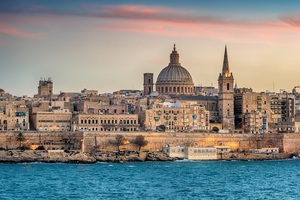
From top: Valletta, Malta at sunset; Derek Mooney
One of the downsides or having such easy access to British news, particularly the BBC, is that we assume Brussels to be as fixated on Brexit as the Brits imagine. As Brexit dominates the headlines here and the UK we suppose that everyone in Brussels and across Europe is as focussed on Brexit as us. They are not.
It is not that the other EU capitals don’t take the looming Dec 31st deadline seriously or are not straining to avoid a hard crash out. They would prefer see a no deal Brexit avoided, as much for Ireland’s sake as their own, but they have long since accepted that Brexit is happening. So, all that is left to resolve is the manner of the post Brexit relationship. Brexit will not be reversed, so there is no point in EU heads of government expending any further political capital on it.
Their attention therefore moves to more pressing matters, so where Brexit still dominates the headlines here, news broadcasts and papers in France, Germany, Spain and Italy feature stories about the deteriorating relationships between Hungary, Poland and the rest of the EU.
It is a crisis long in the making. Most EU member states are worried by the creeping anti-democratic behaviour of the Hungarian and Polish governments, that has resulted is sustained attacks on press freedom, restrictions on judicial independence and denial of minority rights. Attacks that have – up to now – prompted strongly worded statements but little hard action from Hungarian strongman Viktor Orbán’s EPP allies, including as Billy Kelleher MEP pointed out last week, Fine Gael.
While both countries have benefited economically from EU membership, their governments have been less than eager about allow their citizens fully share the EU’s human rights and rule of law benefits.
A recent attempt by EU member states to ensure that only counties upholding democratic standards could access the emergency coronavirus relief package and budget (worth about €1.8 trillion) hit the buffers at last week’s EU leaders’ summit as Hungary and Poland vetoed the package. While limiting access to the funds only requires a qualified majority vote, establishing it requires unanimity.
Not that Poland and Hungary are the EU’s only recalcitrant states. The EU’s first annual rule of law report, published at the end of September, examined rule of law issues including corruption, fair procedures and press freedom across EU member states. It found that counties such as Romania, Cyprus and Bulgaria still had some way to go in strengthening their rule of law provisions, but that they were broadly moving the right direction.
The other country whose report card was less than stellar was Malta. At first glance putting Malta in the same league as Hungary, Poland or even Bulgaria might seem a bit of a stretch for the sedate Mediterranean holiday spot.
Up to this time two years ago, the only political figure of note from the tiny Mediterranean island I had heard of was the charismatic Dom Mintoff, and he stepped down as Prime Minister and leader of the Maltese labour party back in 1984.
The EU’s negative finding on Malta is a lot less surprising however when you see the 2019 EU barometer survey finding that a staggering 89% of Maltese believe corruption in Malta is “widespread”. It is a feeling that has grown dramatically in the years following assassination of investigative journalist Daphne Caruana Galizia.
Galizia was killed by a car bomb outside Valletta city in October 2017. Her Running Commentary blog had been reporting on corruption, kickbacks and money laundering involving dodgy Russian enterprises, well-connected Maltese businessmen and senior government officials, including advisors to then Maltese Premier and Labour party leader, Joseph Muscat.
In 2018, the CBS news 60 Minutes programme ran a feature on how the “smallest nation in the European Union is earning an unsavoury reputation, with a series of scandals involving allegations of bribery, cronyism and money laundering.”
While Galizia’s murder sparked international outrage, the Maltese criminal investigation was slow and plodding. Three low-level criminals were arrested for planting the bomb, but Maltese authorities seemed less than enthusiastic about going after who ordered it.
This lethargy did not deter her sons, friends and supporters from campaigning to stop the Muscat government from brushing the scandal under the carpet.
Around this time last year mass protests began outside the Prime Minister’s office in Valletta and continued for several days. Such was the political storm inside and outside the Maltese parliament that Muscat’s chief of staff, Keith Schembri and his Energy Minister, Konrad Mizzi, eventually resigned. So too did another minister accused of taking kickbacks.
Both Mizzi and Schrembi had been implicated by Galizia in corruption accusations arising from the 2017 Panama Papers. These pointed to both men being involved with tax-dodging offshore companies, along with one of Malta’s wealthiest men, the casino and hotel tycoon Yorgen Fenech. Some days after Mizzi and Schrembi resigned, Fenech’s luxury yacht was stopped while trying to flee Maltese waters and Fenech was arrested.
On December 1st 2019 Muscat announced that he too would resign. He was replaced last January by former competitive body builder Robert Abela. Fast forward to August/September 2020 and former Prime Minister Muscat is being interviewed by Maltese police in connection with the Galizia murder on foot of Fenech’s allegations they had inappropriately discussed key details of the case while Muscat was still in office. Meanwhile Schrembri is arrested amid allegations that he unlawfully received a kickback worth €100,000 through illegal passport sales to Russians.
While the resignations and arrests are signs of some progress, as is the growing civic society movement for reform, Malta still has a long road to travel. The case is far from closed and one year on the full story has still to emerge and the only ones still convicted of the Galizia murder are the three small time thugs who planted the bomb.
A few days ago, Pantelis Varnava the husband of the whistleblower who was one of Galizia’s primary sources, was arrested (and later released) in Greece on what he says are fabricated charges by Cypriot authorities.
Varnava’s Russian wife, Maria Efimova, had helped Galizia expose a trail of dirty money from the Maltese Bank where she worked that connected the Azarbaijan President Ilham Aliyev, and Joseph Muscat’s wife, Michelle.
Last week Max Schrem’s digital privacy organisation NOYB.eu filed a complaint against the company responsible a massive Maltese voter data breach, a company that has close ties to the ruling Labour party.
Meanwhile one of the three ministers who was embroiled in a financial scandal last year over a hospital privatisation deal, is set to step down as Finance Minister this week to become the next Governor of the Maltese Central bank and an ex-officio member of the governing council of the European Central Bank. The minister, Edward Scicluna, is the same minister as appeared in the previously mentioned 2018 60 minutes programme, saying:
“It looks bad, but it’s not.”
Wrong, Prof Scicluna, it is every bit as bad as it looks and if it is getting any better it is no thanks to you or the others who have spent years looking the other way.
Derek Mooney is a communications and public affairs consultant. He previously served as a Ministerial Adviser to the Fianna Fáil-led government 2004 – 2010. His column appears here every Monday.Follow Derek on Twitter: @dsmooney
Getty