
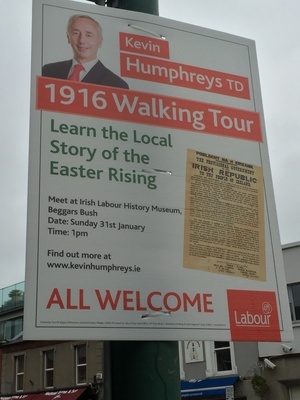
Ah here.
Bob writes:
Some bandwagon jumping/early electioneering in Sandymount [Dublin 4]



Ah here.
Bob writes:
Some bandwagon jumping/early electioneering in Sandymount [Dublin 4]

O’Neills 1916 Jersey.
Party at the front.
Proclamation on the back.
Murph writes:
O’Neills doing their bit for the year that’s in it…it’s just vile.

Sackville Street after the Easter Rising, one of the 1916 images exhibited at Photographers’ Gallery, London
“The exhibition reveals how photography (like Yeats’s poem) served as a weapon of propaganda for the nationalist cause, helping create heroes of the slain and mythologise what was a relatively minor event into one we’re commemorating 100 years on. ”
…The other problem is the rather partisan tone of the wall-texts: the sense of British wrong and Irish right pervades (the decision to paint some of the gallery walls shamrock-green hardly helping).
Hence we’re told that “Ireland’s economic fortunes had declined markedly” after the official Act of Union; that British conduct was frequently “draconian”; that Prime Minister, David Lloyd George “ignored a democratic mandate”, and so on.
…Which is a pity, as the last thing we need is any kind of blame game. If that were the case, one might stress in riposte that the rebels were bankrolled by Germany. But such an approach seems unnecessarily polemical at a time when reconciliation is the order of the day. Besides which, it denies the photographs the proper chance to speak for themselves.”
A two-star review for the Sean Sexton Easter Rising photo collection
Fight!
Easter Rising, The Photographers’ Gallery, review: ‘needs less blame’ (Telegraph)
Thanks Colm King


The State’s commemorative €2 coin to mark the centenary of the 1916 Easter Rising.
Designed by Emmet Mullins who sez:
“The coin features a depiction of the statue of Hibernia on top of the GPO where she has witnessed the events of 1916 and watched the growth of a nation since the Rising”…
Coin in its own presentation case yours for a greasy till fumbling €15.
RISE!
Commemorative coins and coin sets (Central Bank)
Commemorative €2 coin released to mark 1916 centenary (Irish Times)
Rollingnews/Central Bank


Page five of The Cork Examiner on January 5, 1916.
*Squints*
*Click to enlarge
Thanks Andrew Martin

“…my uncle bought a lawnmower off him”
The Rubber Bandits quiz the person on the street about what they know of 1916.
Part of The Rubber Bandits Guide to 1916, New Year’s Eve at 11pm on RTÉ2
Thanks Spaghetti Hoop

Jaded with the modern world? Hankering for the simple ways of your early 20th century ancestors?
Laura Gaynor writes:
So a company I work with (Macalla Teoranta) are making a programme where they get kids to live a day in the life of a 1916 kid. They’ll have to live without any modern technologies and attempt 10 challenges based on chores and daily tasks faced by the children of that time. The series is presented by Simon Delaney (Moone Boy, Alan Partridge Alpha Papa)
Interested?
Go here for details OR send a ONE MINUTE VIDEO CLIP of yourself here by December 20th explaining how YOU could have survived growing up in 1916 and why you deserve a bed in our 1916 House.

Never mind.
Try this…
Therese Caherty writes:
Poets Louis de Paor and Catherine Ann Cullen, along with veteran arts critic Ciaran Carty are the judges for the international Thomas MacDonagh poetry competition to be launched in Dublin today
Organised by Reclaim the Vision of 1916, the competition invites original entries of not more than 30 lines, not previously published, including on social media, on the theme ‘The Vision of 1916: Yesterday, Today and Tomorrow’.
The author of the winning poem will receive a €1,000 prize and a medallion (above), designed by artist Robert Ballagh, of the poet and 1916 Rising leader, Thomas MacDonagh. The second and third prize winners will receive €500 and €250 respectively.
Entrants must be aged over 16, can be living in Ireland or abroad and, in keeping with the vision of 1916, are particularly welcome from Ireland’s new communities. full details of entry requirements are at link below Entries can be in English, Irish or any language commonly used in Ireland today (with English translation).

The Dublin Port Tunnel
At Dublin City Council this evening, independent Cllr Niall Ring will propose renaming the port tunnel after 1916 hero Tom Clarke.
21st Century Citizen writes:
Persons suffering from 1916 fatigue may wearily note that Dublin port is our major trading link to our nearest neighbor and should be seen as a symbol of cooperation & friendship, rather than division and you-shot-my-grandpaism. Irish visitors rolling off the ferry in Holyhead for their abortions might not feel so welcome joining the Louis Mountbatten orbital ring-road.
It being too late to propose a counter-motion calling for immurement in same (and aptly named Dublin Port Tunnel – a tunnel serving Dublin Port) as penalty for incitement to wave flags in the faces of visitors – Broadsheet readers may wish to drop an email to their local Councillor to express any feelings on the matter. Your local Councillors are here
Fight!
(Wikipedia)

Eamon De Valera in 1916 (left) and Thomas MacDonagh
In 1916 Irish Volunteer Commandant Eamon De Valera had expressed concerns that a secret society was plotting a Rising to his senior officer Thomas MacDonagh.He complained that some of his men knew more about military activity than he did and demanded clarification.
MacDonagh told him he was correct and explained to de Valera how a rebellion was being planned by the Irish Republican Brotherhood through a secret military council working within the Irish Volunteers. MacDonagh held that this would take place at Easter.
De Valera was horrified, as a practising Catholic felt he could not be part of an oath bound society and threatened to resign his commission, but his concerns were eased by MacDonagh who held Catholicism should not be an issue and that by taking the oath to the IRB, de Valera could remain a Catholic if he chose. Swearing de Valera into the IRB, on the condition that his oath was ‘an empty political formula,’ and did not undermine his Catholicism,
MacDonagh was criticised by Eamonn Ceannt who asked him why he swore de Valera into the conspiracy. Almost prophetically MacDonagh noted ‘don’t you worry about De Valera…. He will come through as he always lands on his feet.’ MacDonagh would be shot at Kilmainham Gaol on May 3rd 1916, addressing the firing squad he lamented ‘I know this is a lousy job, but you’re doing your duty – I do not hold this against you’.
By contrast, as MacDonagh predicted, de Valera fell on his feet, spared from execution he would rise to dominate Irish politics for a generation as one of the most important and controversial figures in modern Ireland.
Good times.
Pics via O’Brien press