

Enda?
Yesterday evening.
Castlebar, Co Mayo.
Castlebar Golf Club tweetz:
Former Taoiseach and honary member Enda Kenny, alongside his son Ferdia pictured with men’s captain Tom before they tee’d off….
Previously: Hello You



Enda?
Yesterday evening.
Castlebar, Co Mayo.
Castlebar Golf Club tweetz:
Former Taoiseach and honary member Enda Kenny, alongside his son Ferdia pictured with men’s captain Tom before they tee’d off….
Previously: Hello You
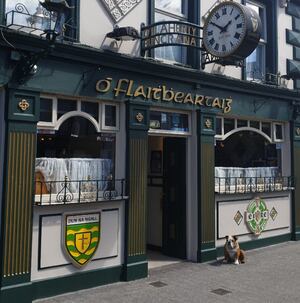
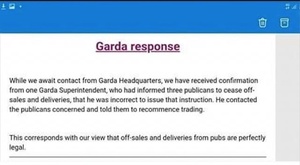
O’Flaherty’s Bar in Buncrana, Co Donegal; email VFI members allegedly received; postmaster in Buncrana receives pint of Guinness
On Saturday night.
Gardai put an end to O’Flaherty’s Bar in Buncrana, Co Donegal’s Guinness delivery service.
They wrote on their Facebook page:
Sorry folks unfortunately tonight we were forced to stop the Guinness Express. 20mins ago we were swarmed by one undercover garda two patrol cars, one sergeant and one uniformed garda.
Despite being unable to tell us after two weeks what law we were breaking they confiscated our remaining 20 pints of Guinness (currently situated at Buncrana Garda Station).
So any pre-payments that were made we will gladly refund the payment asap if you contact this page thank you. #freethe20stout
Comment the #, and when these restrictions are lifted, one lucky customer will win a free round of 20 stout.
Attached picture [above] is the email every VFI member received for guidance on trading during this pandemic.

One room shared by seven asylum-seeking men in a direct provision centre opened in March in Ennis, Co Clare
This morning.
In The Irish Times.
Sorcha Pollak reports that asylum seekers living in direct provision who lost their jobs due to the pandemic have stopped receiving their Covid-19 unemployment payments.
Ms Pollak also reports that asylum seekers living outside direct provision who lost their jobs due to the pandemic continue to receive the payment.
She adds:
“Asked to clarify why the payment had stopped for those in the accommodation system, a spokeswoman for the Department of Employment Affairs and Social Protection said people in direct provision already had their “accommodation and other basic needs met by the State, and the Covid-19 pandemic unemployment payment is not available to them”.
“Some 1,208 people living in direct provision were working at the end of 2019, according to Department of Justice figures.”
Meanwhile…
Further to the Minister for Health Simon Harris confirming yesterday evening that there have been 164 confirmed cases of Covid-19 in direct provision centres, infectious disease specialist registrar in Cork University Hospital Dr Eamonn Faller told RTÉ’s Morning Ireland earlier…
“I’m concerned about anyone living in tightly congregated settings. I suppose direct provision centres or any tightly congregated settings are an absolute catastrophe in a pandemic of a highly transmissible airborne virus.
“This virus loves having people that are in close contact, where it can spread. And we’re seeing in the settings within direct provision where people don’t have the facility to social distance, we’re seeing huge increases in the numbers of cases.
“In the last five days, we’ve seen 165% increase from the 62 figure quoted on Sunday to the 164 figure quoted by Simon Harris in the Dáil yesterday.
“That, like those numbers are in keeping with a pandemic that is unfettered, that’s the three-day doubling time that we had at the very beginning and it’s because there are these people in tightly congregated settings that have no capacity to social distance.
“And haven’t really been given the capacity to social distance.”
He added:
“When someone tests positive in a direct provision centre, they are moved out of that centre. But of course that does leave people they were tightly congregated with, that leaves their contacts, that leaves other people within the centre and just because the person who was symptomatic that was tested has been moved out of the centre, it does not mean that still aren’t people that are asymptomatic spreading the virus in this tightly congregated setting where you can’t socially distance.”
Asked if widespread testing should now take place in direct provision centres, Dr Faller said:
“Yes, it absolutely should. I think we have, so there’s nine clusters, 164 cases now. We don’t know the proportion of people who are infected with this virus who are asymptomatic and given that, given the difficulties with social distancing in these centres, I think testing of all the residents and appropriate isolation would, that would be appropriate.”
Later, he added:
“If testing and meaningfully lowering the density of these centres doesn’t happen soon, then we’re just going to see this doubling time every three days, this massive increase in cases and I mean this isn’t just, this isn’t an issue affects the people in direct provision centres.
“This affects the people in the towns and villages that these direct provision centres are in. As well as being a massive concern for the people in direct provision, it’s a huge wider public health risk. We can’t lift restrictions, if we have active community spread. And if you have any pockets of active community spread, that’s active community spread for everyone.
“In this pandemic what’s bad for any one person, is bad for everybody. This isn’t a disparate group. The virus does not discriminate between groups. So if you have pockets of active infection then that is going to spread within the community.”
Listen back in full here
Related: Problems mount at Caherciveen Direct Provision centre (Michael Clifford, The Irish Examiner)
Yesterday: 164
Previously: “I’ve Seen Some Misleading Information On Social Media” (April 1, 2020)

This evening.
In the Dáil.
Health Minister Simon Harris confirmed that 164 people living in Direct Provision have tested positive for Covid-19.
He also told the Dáil that 160 healthcare workers live in Direct Provision centres across Ireland.
At last night’s press briefing with the Chief Medical Officer of the Department of Health Dr Tony Holohan, journalists were told that, as of midnight last Saturday, there were 88 confirmed cases of Covid-19 in Direct Provision centres.
Meanwhile…
And only 15% of all Direct Provision residents (1300/7700) have been tested, because HSE will only do full testing of a centre if a cluster is suspected, it confirmed yesterday. So we still don’t know what the real numbers of #COVID19 cases are in Direct Provision.
— Dr Lucy Michael #DirectProvisionneedsSelfIsolation (@drlucymichael) May 7, 2020
Watch live here
Previously: “Please Start Moving People Now” (March 24, 2020)

An especially succinct précis of the Trump administration’s unhinged approach to the COVID-19 pandemic (published two days before today’s proclamation from Trumpton) by NYU Professor of Journalism, Jay Rosen.
The plan is to have no plan, to let daily deaths between one and three thousand become a normal thing, and then to create massive confusion about who is responsible — by telling the governors they’re in charge without doing what only the federal government can do, by fighting with the press when it shows up to be briefed, by fixing blame for the virus on China or some other foreign element, and by “flooding the zone with shit,” Steve Bannon’s phrase for overwhelming the system with disinformation, distraction, and denial, which boosts what economists call “search costs” for reliable intelligence.
Stated another way, the plan is to default on public problem solving, and then prevent the public from understanding the consequences of that default. To succeed this will require one of the biggest propaganda and freedom of information fights in U.S. history, the execution of which will, I think, consume the president’s re-election campaign.
MORE: The Plan Is To Have No Plan (Jay Rosen, Pressthink)
(Pic: via New Yorker by Andrew Caballero-Reynolds / AFP / Getty)

Exactly. Not a large excess at this stage. @seamuscoffey did some nice analysis capturing this also. https://t.co/3q6jQb0Q6v. Though reluctance of some to go to hospital could lead to non-COVID excess in the future.
— Gerard McCarthy (@ger_the_sea) May 5, 2020
Number of death notices posted on RIP.ie in April 2020; tweets from Gerard McCarthy and Pádraig MacCarron
Yesterday.
Gerard McCarthy, of Maynooth University and Pádraig MacCarron, of University of Limerick published their research after they looked at the number of death notices posted per county on RIP.ie in April 2020.
Mr MacCarron spoke to RTÉ’s Morning Ireland earlier and told how they found that there were more death notices for Dublin, Kildare, Laois, Meath, Louth, Cavan and Monaghan than any month over the past ten years in those counties.
In comparison, Kilkenny‘s death notices were about the same as April 2019.
Speaking about the accuracy of the figures, he said that the number of death notices posted on RIP.ie match up with figures from the Central Statistics Office death and mortality data.
Asked if the increase in death notices in certain counties can be “put down purely to Covid”, Mr MacCarron told Morning Ireland:
“Yeah, it seems to be. The mean number of deaths in April for the last ten years is about 2,500. And the official numbers give about 1,200 people died [of Covid] in April. So if you add those together, there’s only 60 extra deaths. And our death notices posted on RIP.ie compared to the average plus the number of deaths from Covid.
“And in fact if you add up the number of deaths from Covid to last year’s number of death notices, that would be about 100 higher than it is now. So it seems like the official numbers are quite representative and that’s the main cause of this excess.”
Listen back in full here
Meanwhile…
Is that really data analysis? Look at what the UK have. Here is an example for Wales.https://t.co/SPQ4WYAO3n
The question is why isn't postal codes or eircode data available for Ireland. I wonder if Northern Ireland are allowed to inform their population of the level of risk?
— melissa ocallaghan (@melissaocallag1) May 6, 2020
Meanwhile, on RTÉ’s Brainstorm, they write:
Nationally, the number of death notices posted on RIP.ie in April 2020 for the whole of Ireland are the highest on record, but comparable with January 2018 and 2017 when there was a bad flu season.
Typically deaths peak in Ireland in the winter are associated with respiratory diseases, including the seasonal flu. The number of death notices posted typically decreases going into April, whereas there is a spike associated with the coronavirus in 2020.
Comparing the magnitude of this spike to the seasonal peak in winter of other years, it could be argued as comparable to the numbers of death notices posted in previous years (January 2018 was the previous maximum).
There is increasingly heated debate about whether the unprecedented measures implemented to combat the spread of Covid-19 are necessary to maintain, if excess mortality is comparable to that of the seasonal flu.
However, this picture of the national situation, where Ireland could be on track to keeping mortality to that of a bad flu season, belies a more complex geography of the pandemic in Ireland.
…Looking in more detail at the map, it is the border counties of Monaghan and Cavan that are worst affected where the increase in postings in April 2020 relative to the average number of postings was 150% and 120% respectively.
What death notices tell us about the coronavirus across Ireland (RTÉ Brainstorm)

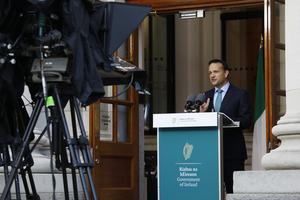

Taoiseach Leo Varadkar at government buildings tonight
Taoiseach Leo Varadkar addresses the nation with an update on Covid-19 restrictions. | Follow live updates: https://t.co/rOWrBuKXEX https://t.co/nf1bjfZ75p
— RTÉ News (@rtenews) May 1, 2020
This evening.
At Government Buildings.
Taoiseach Leo Varadkar announced that the current Covid-19 movement restrictions will remain for another two weeks.
However, from next Tuesday, May 6, 2020, the 2km limit for exercise and non-essential travel will be increased to 5km.
Also from Tuesday, he said people who are “cocooning” will be able to go for a walk or drive within 5km, as long as they “avoid all contact” with other people.
The “plan to reopen the country” is a five-stage plan, involving three-week blocks, starting on May 18 with the fifth phase starting on August 10, he said.
He mentioned that “not long from now, some summer night, we will see our friends again” and that “in later phases” other workplaces, including pubs, cinemas and gyms, will open.
He said schools and colleges will reopen in September/October.
At the outset, Mr Varadkar said the “curve has been flattened and has now plateaued” before saying “we’ve not yet won this fight”.
At the end of his address, he said he’s received about 10,000 pieces of correspondence and “everyday” he tries to set aside time to read some of them.
He recalled letters he got from Jessica, a wheelchair user “who feels an enormous cloud of loneliness around her”; a letter from healthcare worker Anne-Marie who contracted Covid-19 at work who said her patients were like family; a letter from pensioner Phil who lives alone whose mental health is starting to suffer.
He also said he got a letter from Rachel, aged 13, who is worried about her grandparents and wondering when she’ll be able to go back to school. “Someone worried about her future but who ends her letter asking me to stay safe,” he said.
UPDATE:
Here is the link to the Road Map that has been announced this evening : https://t.co/Od3AT4E3q5 @fiannafailparty @broadsheet_ie @loveclontarf_ie @nearfm
— Alan Bracken … (@A_Bracken) May 1, 2020
Previously: “The Is The Calm Before The Storm”
“There’s No Fate But What We Make For Ourselves”
Meanwhile…
With reports of people in Direct Provision and emergency accommodation being locked inside these state-funded institutions that are profiting off them during a pandemic, Ireland’s caretaker leader refuses to allow media questions after a national address on restrictions. https://t.co/5CvJKq5Wdc
— Caelainn Hogan (@CaelainnH) May 1, 2020
Previously: Locking Down Our Liberties