Tag Archives: Dail

Screen Shot 2017-05-02 at 14.07.53 Screen Shot 2017-05-02 at 14.11.29

This afternoon.

In the Dáil.

During Leaders’ Questions.

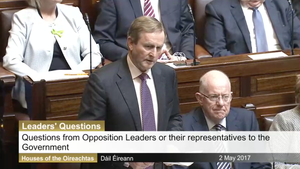
Fianna Fáil leader Micheál Martin raised the National Maternity Hospital with Taoiseach Enda Kenny.

From their exchange:

Micheál Martin: “Can you confirm that that hospital group [St Vincent’s Hospital Group] and the Sisters of Charity will not have a majority on the board? And, above all, will you ensure that the State, the taxpayer, will own this hospital and will have its investment reflected in it? As a bottom line, given the investment it is taking?”

Enda Kenny: “Yes, I can, I can confirm that there will be complete clinical independence. I can confirm that the Sisters of Charity will not have majority of the board and, in relation of ownership, this is a matter that requires some, some consideration…”

Watch live here

Previously: How Deal Leaves Doors Open For Church Control

Screen Shot 2017-03-28 at 16.23.55Screen Shot 2017-03-28 at 16.26.07

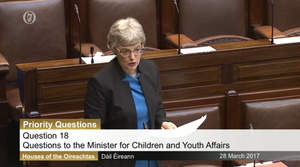
From top: Sinn Féin TD and spokesperson for Children and Youth Affairs Donnchadh Ó Laoghaire and Minister for Children and Youth Affairs Katherine Zappone


You’ll recall the second interim report from the Commission into Mother and Baby Homes which was given to the Minister for Children Katherine Zappone last September.

This interim report was to identify any matters that the commission felt warranted further investigation as part of the commission’s work.

Last week Fiach Kelly, in The Irish Times, reported that the indemnity agreement signed in 2002 between the then Minister for Education Michael Woods and 18 religious congregations – which served to cap the orders’  liability – may be extended to include children abused in mother and baby homes.

Mr Kelly reported:

Well-informed sources said the delay in its publication was due to the controversial nature of the proposed form of redress.

One source suggested that it may never be published if there had not been public outcry over the commission’s confirmation last month of the discovery of the remains of babies and infants at the site of a former mother and baby home in Tuam, Co Galway.

Further to this.

This afternoon.

In the Dáil, during Priority Questions.

Sinn Féin TD Donnchadh Ó Laoghaire raised the second interim report in the Dail this afternoon after asking what steps the State is taking in regards to protecting unmarked graves – other than the remains recently found at the Bon Secours mother and baby home in Tuam, Co. Galway – in order to prevent them from being interfered with.

Mr Ó Laoghaire also claimed that the second interim report does not recommend widening the terms of reference in the Commission into the Mother and Baby Homes.

From their exchange…

Donnchadh Ó Laoghaire: “It’s my understanding, Minister, that the second interim report was before Cabinet this morning. The 27th of July last year, you issued a press release saying that the commission was to report back in September. That report has still not been published. Now you’ve committed to publishing it by the end of the month. It’s not published today, to the best of my knowledge. I presume it will be published in the coming days so I want to hear from you, when you intend to publish it.”

“But also, minister, to outline the reason for the delay because it has been with your department and with you for some six months now. And that has caused a great deal of concern and anxiety among survivors and I think it’s important that we get a sense of, for what reason was, what I think, was an inordinate delay in publishing this report was.”

“And also to state, Minister, it’s my understanding or has been reported that the report does not recommend an expansion of the terms of reference. That being case, I believe that the Commission [into Mother and Baby Homes] is no longer fit for purpose.”

Katherine Zappone: “Thank you, deputy Ó Laoghaire, I’m interested in your comments in that regard. I’d like to bring my comments though, responses, back to the question that you actually have asked me. As I know, I will take up some of those issues later on in terms of other questions and I think again in terms of the question about making decisions to bring forward injunctions. The Government, arguing, has the responsibility, something that we should consider, I’m saying I’m not necessarily, not willing to consider that. But my understanding and in terms of the advice that I have received that in order to do that, we need to have it brought to our attention, that there are some real concerns in relation to a preventative measure, in terms of different sites that may require, that may require an injunction. On the basis of people who have an interest in that regard. And so I would be open to hearing from those and consider the issue again in that regard.”

Acting Ceann Comhairle: “Thank you, Minister…”

Anyone?

Previously: ‘What’s In It That’s So Frightening?’

17352243_1860900994169103_5988825770612281153_n

This evening.

At Leinster House.

Up to 30 asylum seekers, along with members of the groups Movement of Asylum Seekers Ireland and Anti Racism Network, and others, will make a presentation on the International Protection Act (IPA) to members of the Dáil.

As this presentation takes place, supporters will gather outside the gates of the Dáil.

Organisers of the event write:

Last month, the IPO (International Protection Office) launched the single application procedure for asylum seekers in Ireland. In early February the IPO sent a 60-page questionnaire form to over 3000 people in the asylum process to be returned within 20 days, including legal counsel.

This new procedure was supposed to increase the efficiency of Ireland’s asylum process. It has, according to those affected, been a ‘shambolic disaster’. Lack of clarity about the deadline, the paralysis of the swamped Refugee Legal Service, the difficulties of retrieving documentation, poor translations of of the form are just some of the obstacles people have had to deal with as they complete a form determining their future and the futures of their children.

The IPA has introduced sweeping changes to Ireland’s immigration law. Many of its provisions seem designed to undermine the internationally recognised right to seek asylum. While the Department of Justice insists that the single procedure will speed up the asylum process, fears that this will be achieved through accelerated deportations, unmonitored refusals, and defective, erratic assessment processes are being proven all too accurate.

Vicky Donnelly of Galway One World Centre observes: “While Trump’s ‘travel ban’ has, quite correctly, been criticised by politicians here, Ireland has been quietly deporting people at the border before they can even make a proper case for asylum. At a time of unprecedented crisis, when a focus on human rights is most needed, the IPB appears purpose-designed to facilitate and speed up deportations. History will judge us harshly unless we recognise these issues and act to correct them.”

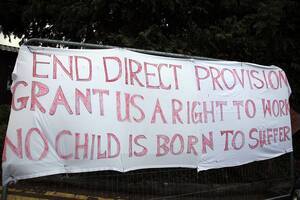
Campaigners to visit Leinster House and highlight new Direct Provision chaos 


Support MASI! Challenge the International Protection Act (Facebook)

Previously: Heard It Before

17098447_1264037323643748_4609777203332495076_n

This morning.

In the Dáil.

Before deputies made statements about the confirmation last week that human remains have been found at the site of the former mother and baby home, run by the Bon Secours order, in Tuam, Co Galway.

The Minister for Children Katherine Zappone told the Dáil that, by the end of the months, she will publish an interim report that the Commission of Investigation into Mother and Baby Homes gave her last September.

She also said a scoping exercise will be carried out to examine calls for an expansion of the commission’s terms of reference “to cover all institutions, agencies and individuals that were involved with Ireland’s unmarried mothers and their children.”


From Ms Zappone’s speech:

Experience tells us it can take time to shine a light on dark periods of our history. The truth is hidden. Sometimes hidden in plain sight.

It takes the brave testimony of survivors, long studies by historians and the dogged determination of investigative journalists to bring a spotlight to events which were previously only whispered about – in this case for generations.

It is now almost a week since the Commission of Investigation into Mother and Baby Homes confirmed what we had all feared.

Today I wish to place on the record of this House the Commission’s update that significant number of human remains are buried in the site of the old Mother and Baby Home in Tuam.

For survivors, loved ones and campaigners such as the tireless Catherine Corless it was a moment of vindication. After decades and years of hard work, determination and unwavering commitment the truth has been laid bare for us all to see.

This House, and our entire state, owes a debt of gratitude to Catherine Corless for her work.

Many men and women alive today spent time in that institution, either as children or as young women. Today I offer them my personal solidarity and, as a citizen, my personal apology for the wrongs that were done to them.

Deputies will know that the Commission of Investigation into Mother and Baby Homes continues its work.

You will also know that cases have been made that the terms of reference of this Commission should be reviewed.

I want to acknowledge the calls made since Friday for an expansion of the Terms of Reference to cover all institutions, agencies and individuals that were involved with Ireland’s unmarried mothers and their children.

I can commit to Deputies that a scoping exercise will be carried out to examine this. As Minister I will be announcing the detail of this exercise in the coming weeks. As Minister I will also be publishing the second interim report of the Commission by the end of this month.

I am also mindful that by design the Commission is largely concerned with questions of legality; of legal liability, of compliance with the laws of the day and so on.
These are important questions.

They are however not the only issues which we should consider.

What happened in Tuam is part of a larger picture.

Part of a tapestry of oppression, abuse, and systematic human rights violations that took place all over this country for decades.

As a modern open society we must not treat these as isolated incidents but rather confront what was a dark period in an honest, mature and reflective way. We must acknowledge that what was happening in these institutions was not unknown. We must acknowledge that what was happening in these institutions was not without the support of many pillars in society.

We must acknowledge that this very House debated legislation that allowed for those residing in institutions such as County Homes to work for little or nothing in return for the so-called charity that was shown to them.

Lest we contend that people did not know what was happening, let us remember that some members of this House spoke out against it.

In the Finance Committee debates on the Health Bill 1952, which took place in July 1953, Deputy Kyne condemned putting unmarried mothers in county homes to effectively involuntary labour as “having revenge on her”.

While Deputy Captain Cowan described as “absolute brutality” the fact, as he described it, that “They are not let out even”.

Earlier than that — before our Constitution had been finalised — members of the Oireachtas also raised questions about the ill-treatment of so-called illegitimate children.

Thus, as I said, this history may be dark, but it was not entirely unknown. We must acknowledge that sometimes it was fathers and mothers, brothers and uncles, who condemned their daughters, sisters, nieces and cousins and their children to these institutions.

And that sometimes it was not.

We must accept that between 1940 and 1965 a recorded 474 so-called “unclaimed infant remains” were transferred from Mother and Baby Homes to medical schools in Irish universities.

We must listen to, record, and honour the truth of people’s experiences. We must commit to the best of our ability to recognising, recording and making reparations for the truth.

Making these commitments and honouring them will not be easy. But we must – for those who suffered and also for future generations.

Establishing the truth is important for many reasons – but not least to ensure that the darkness of the past will not return in the future.

Irish women and Irish children must never have to endure such suffering again. As a feminist, as an Independent Minister and as an Irish woman I feel a moral and ethical compulsion to reach beyond the legal questions of what happened in Tuam and elsewhere.

That compulsion is driven to try to arrive at this truth. For it is only from acceptance of the truth that we can move past it; not by drawing a line under it, but by highlighting it.

By recognising it as part of our history and part of our national story.

By commemorating and memorialising it.

By honouring its victims.

By recognising the part that individuals, communities and institutions played in it.

By making sure that, while we still have time, we look to those who are still alive and accept their accounts of what was done to them, and of the wrongness of that. In the coming days, as Minister, I will start a conversation with advocates, with historians and scholars specialising in transitional justice.

The United Nations defines transitional justice as the set of approaches a society uses ‘to try to come to terms with a range of large scale past abuses’. Transitional justice puts survivors and victims at the heart of the process. It commits to pursuing justice through truth.

It aims to achieve not only individual justice, but a wider societal transition from more repressive times, to move from one era to another.

Taking a transitional justice approach means that we will find out and record the truth, ensure accountability, make reparation, undertake institutional reform, and achieve reconciliation.

In doing this I want to acknowledge the many people who have contacted me personally in recent days to tell me directly of their experiences. It is important to also ensure that we learn from international best practice in transitional justice, such as the Museums of Memory in Argentina and Chile, for example.

There may also be lessons to be learned from processes used to establish the truth in other contexts and other countries.

Writing about the Mother and Baby Home in Tuam, as well as other matters, in the London Review of Books last year, our Laureate for Irish Fiction, Anne Enright, said: “The living can be disbelieved, dismissed, but the dead do not lie. We turn in death from witness to evidence, and this evidence is indelible, because it is mute”.

Let us not disbelieve; let us not dismiss.

Let us commit to do justice not solely through law, but through speaking and listening, and through believing what our eyes, our ears what our compatriots tell us.

Transcript via Katherine Zappone

Yesterday: What’s In It That’s So Frightening?

quicker to load than those huge png images

From top: Taoiseach Enda Kenny; Independent TD Catherine Connolly of Galway West

This afternoon.

During Leaders’ Questions.

Independent TD Catherine Connolly raised the Bon Secours Mother and Baby Home in Tuam, Co Galway.

Specifically, she raised concerns about Taoiseach Enda Kenny using “carefully crafted words” to tell the Dáil, “no nuns broke into our homes to kidnap our children”.

And she recalled an interim report the Commission of Investigation into Mother and Baby Homes gave the Minister for Children Katherine Zappone last September.

This interim report was to identify any matters that the commission felt warranted further investigation as part of the commission’s work and, recently, the Adoption Rights Alliance and Justice for Magdalenes Research groups have called on Ms Zappone to publish it.

Ms Connolly and Mr Kenny had the following exchange…

Catherine Connolly: “A shocking discovery, according to everyone, and particularly to yourself Taoiseach. But this is something that Galway has been aware of for a long time, highlighted by Catherine Corless back in 2014, in her painstaking and self-funded research.”

“By the witnesses, the many, many women who went before the commission of inquiry into child abuse which culminated in the Ryan Report, as far back as 2009. They told their stories about their experience in Mother and Baby Homes. It was brought to the attention of Martin McAleese when he concluded his report on the Magdalene laundries. So none of this is shocking to the survivors.

“What is shocking to the survivors, and to me, is the carefully crafted words that you’ve come into the chamber with. And, in particular, that you say ‘no nuns broke into our homes to kidnap our children’, ‘we gave them up to what we convinced ourselves was the nuns’ care’ and so on. I don’t doubt your bona fides, a thaoisigh, but I certainly doubt your judgement in reading that out, a carefully crafted speech with a sentence like that in these circumstances. My question: please answer. Where is the interim report that has sat with the minister since September last year? Please confirm that the site will be sealed off as any crime scene is sealed off.”

“Please confirm that records will be made available to those that are seeking them and somebody like Peter Mulryan doesn’t have to go to the High Court to seek the records of his sister. Please stop the hypocrisy…”

Enda Kenny: “That was the reason that a Commission of Investigation was set up and that has its independence with wide-ranging, wide-ranging terms of reference and it hasn’t actually reported its official findings yet. Nor indeed has the coroner declared what he considers the next step to be. The gardai have independent responsibility. What you’re asking me to do now, is to direct an independent commission to do certain things. The questions that you ask are valid questions and they do need to be answers and I expect that they will be answered. And you can refer to carefully crafted sentences if you like. The fact of the matter is: the nuns did not take the children out of the houses of Ireland. They were sent to these Mother and Baby Homes, in the vast majority of cases, by the families themselves. The disgrace that was wreaked upon parish after parish, simply because a young woman became pregnant, to give birth to a child…”

Connolly: “I’m not sure if you’re completely and utterly out of your depth or that you just stick to prepared scripts. I really don’t know what the issue is. I haven’t asked you anything about the coroner, nor the guards. I specifically asked you, in relation to publishing an interim report that your minister has since September last year. There’s the reply. She is going to publish it. I’m asking you now to confirm, why it hasn’t been published? Eight months later? What’s in it that’s so frightening? What’s in it that prevents it being published? In relation to your commission and our shameful past, who made it shameful to have what was natural, a pregnancy and a baby? Who made that shameful? Who instituted that those babies were taken? Not directly by the nuns in the middle of the night but as a result of a visit from a priest or someone else doing their job.”

“Please don’t insult the women of Ireland on International Women’s Day and just, and answer the question: when is the interim report going to be published? Please confirm that the site in Tuam will be sealed appropriately. Please stop talking about a memorial at this point which is utterly premature and deal with the facts and the issues that the representative organisations are asking you. At some stage the Government has to learn.”

Kenny: “Far from insulting the women of Ireland, I want to stand by finding out answers to these particular problems and these particular questions. And it is beneath you to take that line, deputy Connolly. Beneath you to take that line.”

“Now, the gardai themselves have a duty here. Certainly contact them if that site is not sealed off already. I haven’t read the interim report that Minister Zappone has. I’m quite sure she’s in consultation with people about this. I see no reason why the report cannot be published, the same as any other report. It may have to be in some redacted form, I don’t know. I haven’t seen it, I haven’t read it. I’m quite sure the minister will answer for that.”

“But I want you to understand this Deputy Connolly, I am as committed as anybody else to seeing that we deal with this for once and for all. I come from the west of Ireland, as you well know, and I can’t put a figure on the number of young women in my time, since the 1950s, who were sent away to foster homes or to other countries to have their children. Simply because they became pregnant out of wedlock. If you think that I insult the women of Ireland, by trying to do what I want to do here, in respect of our Government and our people, then you’re very much mistaken.”

Screen Shot 2017-02-17 at 12.56.39

https://www.youtube.com/watch?v=TyfOslJvomo&feature=youtu.be

A video compilation of clips from Independents 4 Change TD Mick Wallace.

Outlining the number of times he raised concerns about the gardaí and Garda whistleblowers in the Dáil – starting from September 2, 2013.

Previously: How Did He Get Here?

Mick’s Tape II

Thanks Chris

Screen Shot 2017-02-14 at 14.44.57Screen Shot 2017-02-14 at 15.02.02Screen Shot 2017-02-14 at 14.46.19

https://www.youtube.com/watch?v=6a_x9D91CJY&feature=youtu.be

Earlier this afternoon.

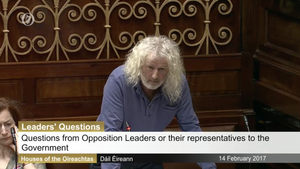
During Leaders’ Questions, Independents 4 Change TD Mick Wallace named other Garda whistleblowers.

He also claimed that, in early 2014, a journalist contacted Supt Dave Taylor, to tell him that he had been in contact with the family of the girl at the centre of the false abuse allegation against Sgt McCabe.

Mr Wallace said the journalist told Supt Taylor “he had a great story and that it was going to be really damaging for McCabe”. Mr Wallace also said, following this conversation, Supt Taylor contacted both Martin Callinan and Noirin O’Sullivan.

From Mr Wallace’s speech in the Dáil…

“Taoiseach, I think the public inquiry should have a disciplinary, a criminal investigation running in parallel, run by people, policed from outside the country. A lot of bad things have happened.

“You said there Taoiseach that everybody has the presumption of innocence. You’ve a short memory. For several years, according to the Fine Gael government, Maurice McCabe was guilty until proven innocent.”

“Noirin O’Sullivan talked yesterday of a campaign of false accusations against her. Is she saying that Maurice McCabe was lying? David Taylor? Keith Harrison? Nick Keogh? Sinead Killian? Eve Doherty? Dermot O’Connell? And others? Are they all liars?”

“If she genuinely didn’t know how whistleblowers were treated. If she genuinely didn’t, she’s not fit for the job anyway, if she didn’t know what was going on in the force.

“With the O’Higgins inquiry, she instructed her legal team to give false evidence to the inquiry until Maurice McCabe’s tape turned it upside down. If she was innocent, why didn’t she sanction or discipline the two guards involved? Why? It’s a long time ago?

“How can you explain how Nick Keogh – when he reports Garda involvement in the heroin trade in Athlone, how come he faced five internal investigations in that same year and none before that? Why?”

“And the superintendent that Nick Keogh accused of bullying and harassing him, why was he put on the promotion list? Why”

“In 2014, the Garda Commissioner appointed an Assistant Commissioner to look at Keith Harrison’s complaint and the Assistant Commissioner leaked information back to the Superintendent that the subject of the complaint.

“And then, on foot of a different complaint, involving the very same superintendent, the same Assistant Commissioner was asked to carry out an investigation.

“And, if all that wasn’t bad enough, when GSOC, following its investigation into the second matter, asked for disciplinary proceedings to be taken against  An Garda Siochana, who does Noirin appoint over it? You’d never guess: the same Assistant Commissioner.”

“A journalist contacted David Taylor in early 2014. He was press officer. The journalist told him that he’d been to the family of the girl at the centre of the sexual allegations of Maurice McCabe. He told her that he had a great story and that it was going to be really damaging for McCabe. Taylor texted [Martin] Callinan, texted [Noirin] O’Sullivan and told them the good news.”

“Callinan texted him, to welcome it. Noirin decided to ring him and have a good chat about it. A good chat about it. Now minister, Taoiseach, this is the woman who said, a couple of weeks ago, on the Sean O’Rourke programme, ‘I’ve absolutely no knowledge, nor was I privy to any campaign to undermine any individual in An Garda Siochana’.”

“The press officer, David Taylor, who was given back his job yesterday, said, this is a quote, ‘everybody in headquarters knew about the campaign against Maurice McCabe’. Everybody, seemingly Taoiseach, except Noirin. What do you think?”

Earlier: Back To Work

Yesterday: Cleared

Screen Shot 2017-02-02 at 19.57.13

You may recall a post from last week concerning Garda whistleblower Keith Harrison.

It included excerpts from a letter sent by Mr Harrison’s solicitors to Garda Commissioner Nóirín O’Sullivan on May 20, 2016, outlining how he had been subjected to harassment and continued attempts to smear his reputation and undermine his credibility.

It was one of 14 such letters sent to Ms O’Sullivan by Garda Harrison’s solicitors.

Last October, during a meeting of the committee on justice and equality, Independents 4 Change TD Clare Daly repeatedly asked Ms O’Sullivan if she was privy to any information about allegations of mistreatment of Garda whistleblowers and Ms O’Sullivan repeatedly replied:

“I’m not privy to, nor did I approve, nor would I condone any campaign of harassment…”

Further to this…

Last night, Ms Daly returned to the matter of Garda whistleblowers and what Ms O’Sullivan knew, and when, in the Dáil. She told how she’s been in contact with 10 Garda whistleblowers – all of whom, bar one, are currently out sick.

Ms Daly was speaking during a debate on a report on Garda oversight and accountability compiled by the Joint Oireachtas Committee on Justice and Equality.

She said:

“This report is not just aspirational, containing ideas we have circulated for the craic; these are serious observations, made in part on the basis of the engagement we had with the oversight bodies and the Commissioner and her team and in part from our experience over recent times. In that context, I welcome the fact that the Minister will take on board some of the committee’s recommendations.

“That is a very welcome development. Without in any way being churlish, I believe it is an awful pity some of the recommendations were not taken on board previously.

“It is a matter of record that many of the recommendations contained in the report and the Minister’s Bill were made by us a number of years ago during the debate on the first GSOC and Policing Authority Bills. I am not saying this to score points, but people have suffered as a result of some of these provisions not being available during the two years since the most recent GSOC Bill was implemented…

“…We must be realistic about why the concept of oversight has gained popular currency and is being talked about by the dogs on the street. There is just one reason, that being, the heroic stance of a number of Garda whistleblowers who shed a light on an insular blue wall of silence, an organisation in which, contrary to what the Commissioner says, dissent was deemed to be disloyalty and punished accordingly. The order of the day was rats, death threats and serious intimidation of people who tried to do the right thing.

“The public perception of what a whistleblower is has been stood on its head. Now, being a whistleblower is identified as a position to be lauded, and one that makes a valuable contribution to improving the situation for all gardaí and members of society. There are many good gardaí and, for some time, they have believed that the situation will change. They stepped forward accordingly to join the ranks of the whistleblowers and improve matters.

“We have engaged with ten serving members of An Garda Síochána who have made protected disclosures of one sort or another. Under a change in the previous legislation, GSOC is now the confidential recipient and the vehicle through which gardaí make complaints. That service needs to be beefed up radically because GSOC does not have the time or resources to provide it adequately. It does not have the legislative power to compel Garda co-operation that it needs.

“Many cases have stalled because of delays in the Garda handing over material that GSOC needs to conduct its investigations. This non-co-operation continues today. It can be covered up as administrative delays and so on, but it impacts on the work being done.

“A number of the whistleblower cases in question are in the public domain, but others whose cases are with GSOC – in the instance of Keith Harrison, for more than two years – have had relatively limited meaningful engagement with GSOC because of delays with documentation and so on. In Nicky Keogh’s case, the GSOC investigation has practically concluded and disciplinary recommendations have been made, but the Garda has not agreed to GSOC’s involvement.

“These serious matters are ongoing. One must ask, if the situation is improving, why all these gardaí bar one are out sick. All have made allegations about bullying and harassment since coming forward, which is in direct contrast with the public statements of the Commissioner that she does not know of any harassment.

“We know that she has been directly informed of that harassment, as has the Minister. Most recently, serious allegations were made, and were widely covered in the provincial media, during an assault case after Christmas. In open court, evidence was produced of doctored witness statements. The people involved in the assault were also involved in a case in which a garda had been accused of involvement in the drug trade and so on. Criminal prosecutions are being impacted.

“The situation cannot be right if so many people are out sick. The case of the only garda who made a protected disclosure but who is not out sick is appalling. It involves a family law case. He received information to the effect that the judge, who was a family friend of his former wife, had held a meeting before the court case and then granted a protection order against him. He then made a complaint to the Garda. Not only was his complaint not investigated, but the senior garda involved initiated criminal proceedings against him for interfering with the judicial process when the circumstances clearly did not meet the criteria.

“That person, albeit a member of the Garda, was a victim, only to be revictimised by what the senior garda did. To add insult to injury for him and a number of other Garda whistleblowers, the very man who did that was brought by the Commissioner to attend our committee’s hearings into oversight as a witness for An Garda Síochána. Confidence among serving members is not developed if this type of behaviour is happening.

“The Minister will see from the committee’s recommendations that we want the Policing Authority to have more control over the Commissioner. This is not a new idea.”

Transcript: Oireachtas.ie

Screen Shot 2017-02-03 at 10.08.58

https://www.youtube.com/watch?v=Mjkv1-9cVEw&feature=youtu.be

In case you missed Independents 4 Change TD Mick Wallace speaking in the Dáil on Wednesday about Nama.

A new video synopsising Mr Wallace’s points.

It follows a similar video compilation, published in January 2016, about Mr Wallace’s efforts in previous months to highlight his concerns related to Nama.

Previously: ‘Nama Sold A Site Worth €120m For €42.5m’

Mick’s Tape

Screen Shot 2017-01-31 at 16.19.26

Just now.

Taoiseach Enda Kenny in the Dáil.

In response to questions put to him about his forthcoming St Patrick’s Day trip to Washington to meet US president Donald Trump.

Previously: Trump Marred

‘I Will Work Very Closely With The US President-Elect’