
Tag Archives: Dail

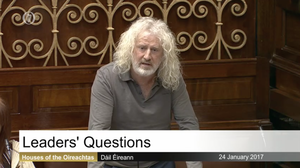
Screen Shot 2017-01-24 at 14.23.24Screen Shot 2017-01-24 at 14.25.13

This afternoon.

During Leaders’ Questions.

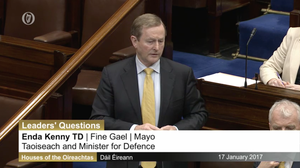
Independents 4 Change TD Mick Wallace raised the Garda whistleblower controversy again with Taoiseach Enda Kenny.

It follows a report in The Irish Times this morning which says the Government will launch a Commission of Investigation into claims made by former head of the Garda Press Office Supt Dave Taylor following a review of his claims by retired high court judge Iarlaith O’Neill.

Supt Taylor has claimed there was an alleged campaign within the gardai to ruin the reputation of Sgt Maurice McCabe.

Readers will recall how, last October, Trevor Collins, the solicitor of fellow Garda whistleblower Keith Harrison, raised concerns about Mr Justice O’Neill’s remit.

He said the exclusion of claims made by other Garda whistleblowers – including those of Garda Keith Harrison and  Garda Nicky Keogh – from Mr O’Neill’s review made it a “flawed inquiry from the very outset”.

Further to this…

Mr Wallace raised the cases of Garda Harrison and Garda Keogh and the conflicts of interest that have emerged in relation to the investigations of their claims…

And he told how, just last week, the Minister for Justice Frances Fitzgerald received a letter from a  whistleblower about a witness statement being doctored by gardai in an assault case. Mr Wallace said the background to the case involved the planting of drugs by a garda.

From Leaders’ Questions…

Mick Wallace: “We read today that you’re about to commence a Commission of Investigation into certain Garda matters, following the O’Neill report. Yesterday, the Garda Commissioner [Noirin O’Sullivan] was on the airways, telling us how wonderful everything is and how wonderful she is herself – bombing us with doublespeak.”

“Meanwhile, Taoiseach, the harassment of whistleblowers continues. The Tánaiste last December said to me, in reply to a question, the Garda Commissioner is entitled to her good name, as indeed are people making allegations entitled to theirs, unless facts properly established prove otherwise.”

“Well, Taoiseach, David Taylor, who was interviewed for 21 hours, a file sent to the DPP in September 2015, 2015 – and there’s no decision yet. Nothing has been proven against him. Is the Garda Commissioner allowed to ride rough shod over fair procedure in this area? The commissioner said yesterday: ‘I have absolutely no knowledge nor was I privy to any campaign to undermine any individual in An Garda Siochana’.”

“Taoiseach, 14 times, Keith Harrison wrote to her, detailing his harassment and bullying. He’s out sick since May 2010. He’s on €188 a week and there’s three kids at home. Nick Keogh has got nothing but grief since he reported malpractice.

“The commissioner yesterday was boasting yesterday  about taking part in the fight against heroin. But she’s protecting the Chief Superintendent who’s been involved in the heroin case in Athlone. And last year, she placed a superintendent on the promotion list who has been accused on numerous occasions of harassing a whistleblower. ”

“In June 2015, the Garda Commissioner appointed an assistant commissioner to carry out an investigation into the allegation surrounding the chief superintendent and the garda for the drugs squad in Athlone. But it was the same assistant commissioner accused of earlier leaking information back to the super who was the subject of the complaint.

“In October 2015, the commissioner stated that she had commenced an investigation into this alleged conflict of interest. October 2015. Not a word of it since. I wonder where is it, Taoiseach?”

“Following the investigation into the matter, GSOC have asked for disciplinary procedures to be taken against them. Who does Noirin appoint to look after it? Yes, the very same assistant commissioner. Who also happens to be retiring in April so he probably won’t even get to the end of it and delay it all even further.”

“This month, GSOC asked to oversee the disciplinary procedure. GSOC’s request was refused. Taoiseach, when are you going to publish the report? Are you going to include the protective disclosures of all whistleblowers in the investigation, because if you don’t, it’s only a case of kicking the can down the road because we’ll eventually have to do it. And Taoiseach, do you intend to leave the commissioner in place while the investigation goes on because it will make a mockery of it if you do.”

Later

Enda Kenny: “Mr Justice O’Neill was asked to review the allegations of wrongdoing. He was also asked to include any recommendations which he considered appropriate. The report, I understand, sets out in detail the allegations contained in the protected disclosures. I’m sure that the House will appreciate that in the view of the nature of the allegations, and the fact that third parties are mentioned, the Tánaiste referred this to the Attorney General for advice on how to proceed, including the question of what material might properly be put into the public domain, having regard for the rights of all concerned.”

“I understand that the Attorney General has given some response to that but has some further matters to conclude on. And I also understand that the specific proposals will come to Government shortly, including putting the conclusions and recommendations of Mr Justice O’Neill to the public domain, Deputy Wallace.”

Later

Wallace: “Taoiseach, you haven’t answered any of my questions. Now while the Government sat on the O’Neill report, which you still haven’t told me when you’re going to publish, GSOC had to go to the High Court to force the Commissioner to hand over the transcripts of the O’Higgins Report – almost eight months since the Tánaiste requested GSOC to investigate the same.”

“Only last week Taoiseach, the minister got a letter from a whistleblower regarding a witness statement being doctored by garda, the gardaí, in an assault case. The background to the assault case related to the planting of drugs by a garda.”

“Taoiseach, I’ll ask you again: when are you going to publish the report? Do you intend to lead the commissioner in place? Because it will be laughable if you do. And, Taoiseach, if all is so well as the commissioner likes to tell us. Can you explain to me, or can the commissioner explain to me: why are so many whistleblowers out sick? Why aren’t they at work?”

“Why doesn’t Noirin O’Sullivan ring the whistleblowers? How come she’s never even rang… she’s rang none of them. Taoiseach, would you consider asking the commissioner to ring the whistleblowers that she says she cares so much about? Because, Taoiseach, it’s a bit scary. What she says in public is one thing. The reality, on the ground, couldn’t be much different.”

Kenny: “The [protected disclosures] act protects gardai, if they make a report – either to GSOC or the commissioner – for having their identity revealed, protection from dismissal and protection from being penalised in their employment as a result of having made a protected disclosure. That’s the law of the land. That’s what the act says protects whistleblowers for. You mentioned, of course, that the minister did receive the report from judge O’Neill. There are third parties mentioned in this report and it’s only right and proper that we return to the Attorney General for advice as to in what form and what element it should be published. And, in the ministers engaging with the Attorney General on that matter, my understanding Deputy Wallace is that this will come back to Government very shortly including proposals to implement the findings that Justice O’Neill has, has recommended, following his report being sent to the minister.”

Previously: The Wrong Side Of The Thin Blue Line

Screen Shot 2017-01-18 at 13.50.55

This afternoon.

During Leaders’ Questions.

Independent TD Catherine Connolly raised concerns about Galway University Hospital with Taoiseach Enda Kenny.

To begin with (before the clip above), Ms Connolly said:

“Taoiseach, it’s Galway University Hospital is at crisis point. This is a hospital that serves a core population of 800,000 people and six core counties. In addition, it serves a number of other counties, given it really a population of a million that it serves.”

“Taoiseach, it’s operating in code black alert – the highest emergency code, together with a full capacity on an ongoing and prolonged basis. As a direct result, quite clearly, the obvious things happen, elective surgeries have been cancelled, large numbers of people have been left on trolleys, reaching a peak of 50 at Christmas time.

“And, in addition, and directly arising from that, we have an ongoing review of an operation performed in a ward; we’re awaiting a review of a death of somebody on a trolley in their 80s; we’re awaiting the conclusions of a report in relation to spinal surgery, inappropriately carried out in some places and causing premature deaths in two cases.

“We’re still awaiting confirmation that all of the recommendations of the Savita case have been implemented. In addition, we have very ill patients walking out of casualty on a daily basis and we have people with mental health problems being shoved through casualty.

“Indeed the capacity of the hospital, which is not a local issue nor a parochial issue, which I’ve said serves a million people, the capacity or rather the lack of capacity has placed it at number one on the risk register.”

….In addition, we have a report, independently commissioned by the Saolta Group and in relation to the accident and emergency, the physical environment is shocking and disturbing and unfit for purpose. We have a submission from Saolta itself and the clinical director of the hospital, telling us that ‘The current ageing facilities of the hospital are not fit for purpose, do not provide an appropriate environment to safely manage the current and future care needs of the population of that region.”

Thanks Mick Caul

Screen Shot 2017-01-17 at 14.20.58

Taoiseach Enda Kenny in the Dáil yesterday

Yesterday.

In the Dáil.

Sinn Féin TD Eoin Ó Broin asked the Taoiseach Enda Kenny about the regulation of properties on Airbnb in Dublin.

They had the following exchange…

Eoin Ó Broin: “As the Taoiseach knows the November homeless figures showed, yet again, a further rise in the number of people living in emergency accommodation, with 6,985 people in such accommodation, including 2,549 children. ”

“In addition to the lack of supply of social housing, the lack of adequate private rental accommodation is feeding this crisis.”

“Today in Dublin there are only 1,564 properties available for rent but there are 6,225 units listed on Airbnb. The Minister for Housing, Planning and Local Government, Deputy [Simon] Coveney, gave a commitment in October to introduce secondary legislation to properly regulate this sector to ensure that only properties adequate for the purposes of Airbnb would be considered and the rest would require planning permission. When will this secondary legislation be published and will the Opposition be consulted on its contents?”

Enda Kenny: “We have been through this at some considerable length over the past period of time. The action plan allows for the building of 1,500 rapid-build units and 1,600 vacant units have been sourced by the Housing Agency.”

“The expanded HAP scheme for homeless tenancies reached 550 in 2016 and will reach 1,200 in 2017. The plan also includes a 40% increase in homeless funding from €70million to €98 million in 2017. This year there will be a spend of €1.2 billion on social housing.”

“I will ask the Minister to give Deputy Ó Broin more accurate details and a date on which he expects the legislation to be published. I would point out that 200 extra beds have been provided at Ellis Quay, Little Britain Street, Carman’s Hall and Wolf Tone Quay.”

Meanwhile…

Further to this…

Yesterday evening, Mr Ó Broin released a statement, in which he said:

“In Dublin there are currently 6,225 Airbnb listings. According to data available on Inside Airbnb 2,847 or 45.4% of these listings are for entire homes and apartments. Furthermore 44.5% of the hosts have multiple listings which can indicate that it’s more likely they are running a business.

“Today, according to Daft.ie there are only 1,564 properties available to rent in the capital. With the homeless figures for November showing that 6,985 people were accessing emergency accommodation, including 2549 children, we need to ensure we are looking at every option possible to make more housing stock available.

“Back in October 2016, when An Bord Pleanála upheld a ruling that a property owner in Temple Bar required planning permission to continue renting the property out for short-term lets, Minister Coveney backed this ruling. In December, when the issue was raised in the Seanad, the Minister stated that efforts were underway to clamp down on this activity and that a change in the planning treatment was a good way to deal with it.

“Today I asked the Taoiseach to detail when the secondary legislation promised to deal with this issue will be published. Unfortunately he couldn’t give me an answer but I will be writing to Minister Coveney asking him to provide the information requested and to ask if the opposition parties will have an opportunity to have some input on the development of the regulations.

“Sinn Féin is not against the principle of Airbnb as it was originally designed however it is my view that renting out a room in your home is entirely different to renting out your entire property. If the latter is the case then you need planning permission to change the property from residential use to commercial use. While we will assess the Minister’s regulations when they are published, we believe that a maximum of six weeks rental per year is reasonable. If you are providing a commercial accommodation service then standard B&B permissions should apply.”

Transcript via Oireachtas.ie

90431080czvnxjmwqaasipe

From top: Sinn Féin TD Eoin O’Broin; From the Planning and Development (Housing) and Residential Tenancies Bill 2016

Last night.

In the Dáil.

TDs discussed the Planning and Development (Housing) and Residential Tenancies Bill 2016.

You may recall how Minister for Housing Simon Coveney launched his Strategy for the Rental Sector earlier this week, as part of the bill.

The strategy includes designating Dublin and Cork as ‘rent pressure zones’ and capping annual rent increases in these areas at 4 per cent per annum for three years until 2019.

However during the debate in the Dáil last night, Sinn Féin TD Eoin Ó Broin told the Dáil he believed the Government had drafted legislation that would result in an 8 per cent increase for renters in in their first year, as opposed to 4 per cent.

After explaining his concerns, Mr Ó Broin said:

“If it is, we have a serious problem because the Minister is asking us to vote on something here today which will actually lead to double the rate of increase than what the Minister has said. Perhaps it is by design. It is important that the Minister clarifies that point.”

Minister for Housing Simon Coveney requested an amendment to his amendment on the bill after Mr Ó Broin pointed out the error.

The debate on the Bill will continue this morning from 11.30am.

From last night’s debate…

Eoin Ó Broin: “This group of amendments relates to the Government’s strategy for the rental sector launched this week. As we have no other formal opportunity to discuss the strategy, I want to open my comments on these amendments by making some observations on it.”

“Given the fact we were led to believe this was going to be a comprehensive strategy for the fundamental reform of the private rental sector over the next several decades, it is deeply disappointing. There are 26 measures listed in the document, ten of which were previously announced by the Minister. For some of them, it was the fifth time they were announced. Of the other 16 measures announced, the majority of them will not come into effect until the last quarter of next year or they were so ambiguous in the document that it is not clear whether they will have a positive or beneficial effect on the reform of the private rental sector. This is not a long-term strategy.”

“It does little in dealing with real security of tenure or the urgent need to reduce evictions. As far as I can see from the limited amount of detailed information in it, it does little to address the dysfunctional underpinnings of the rental sector. In fact, it seems to be based on the same failed policies of the previous review and strategy for the rental sector going back to before the creation of the Private Residential Tenancies Board and the introduction of the Residential Tenancies Act.”

“While we all have been trying to facilitate the Minister in bringing forward measures to tackle the housing and homelessness crisis and taking him at his word, there is part of me that wonders if it was not a mistake to launch the strategy, as important as it is, in the last week of this Dáil term and to table such substantive amendments when we would not have detailed committee scrutiny but only a few hours in the Chamber. When the Minister spoke on Committee Stage when he gave us first sight of some of the amendments, he said the strategy was being broadly welcomed. When the Minister read the following morning’s newspapers, I am sure he took a different view.”

“Donal McManus, the head of the Irish Council for Social Housing, not somebody known for vocal criticism of the Government’s policy given the membership he represents, wrote in The Irish Times the most devastating critique of the measures contained in these amendments and the overall strategy.”

“His key point was that this strategy and the measures we are debating today were a missed opportunity, in some senses will make matters worse, and will not deal with the kind of issues many of us who went to the stakeholder consultation meeting that the Minister organised hoped it would.”

“Donal McManus is not the only one. The Minister indicated the non-governmental organisations, NGOs, thought the strategy was good. Most of the NGOs said that while it may be a step in the right direction, it has fundamental flaws. Some of the homeless charities have expressed deep concern at the gaps and absences, especially in the rent so-called predictability measure and its potential impact to lead to greater levels of homelessness.

“On the rent predictability issue itself, the only one thing predictable about this measure is that people will face consecutive years of rent increases, both in the rent pressure zones and outside. We had a debate in this Chamber over recent days about whether Fine Gael believes in intervening in the housing market.”

“Of course it does. Like Fianna Fáil, Fine Gael has a long history of direct intervention in the housing market, whether through the use of tax incentives, incentivising private home ownership, incentivising investment in various types of property activity or even, for example, in rent supplements such as RAS and HAP.”

“There is no ideological objection or obstacle to Fianna Fáil and Fine Gael intervening in this market. The issue is who does it intervene for, in whose interests and for what outcome? That is really the nub of the difficulty many of us have with this measure. The Minister also repeated on a number of occasions at the press launch, which I attended, that this measure is a major intervention in the market but, in fact, it is not. Rent supplement is a much more substantial intervention in terms of a price setting mechanism in the private rental sector and is far more significant than this measure.”

“In his comments today and previously, the Minister keeps talking about balance, saying that whatever this Government does, it has to balance the interest of investors and the need to maintain and increase the stock of private rental properties with the needs and interest of tenants. The difficulty is the market, as it currently stands, is so skewed against the tenant that when the Minister talks about balance, what he is really doing is continuing to tip the scales against those who most need this Government’s help at this point in time.”

“I will talk about the details of the proposals, particularly in Government amendments Nos. 55 and 68. I put this question to the Minister the other day. A number of other commentators, some of whom think this is a good measure and others who do not, have asked this same question. I would like to get an answer at some point this evening.”

“When the Minister, Deputy Coveney, was asked at the press launch what was the basis for the figure of 4%, he said repeatedly that it was about the yield or return on the investment of the investor he is hoping to attract to provide greater levels of private rental accommodation.”

“When the particular question of where the 4% came from, he talked about the benchmark investment yield of 4% that the strategic investment fund operates. The difficulty is that this is not what is in this amendment. What is in the amendment is an annual rent increase of 4%, which over three years would probably add another one percentage point yield to the 6% or 7% yields that investors can currently get at market prices and market rents. I do not understand.”

“Perhaps I do not read these things properly or perhaps I am not smart enough but at some point the Minister should explain to us the interaction between the investment yield and the rental increases in a specific way, not in the very ambiguous and contradictory way he did on an RTE radio over the past day or two.”

“The Minister is right that the 12.5% would be the impact over three years for those worst affected by these measures. Nobody in our party has claimed everybody in the private rental sector will be hit by 12.5%. Even if it is only 10% of the 300,000 tenancies, it is bad for those people and therefore it is wrong. It is wrong even if it is 20%.”

“Perhaps the Minister has figures in terms of how many rental tenancies are up for review next year, the year after and the year after that. If he has that information, he should share it with us so at least we know how many people would be affected. For those worst affected by these measures, it will be 12.5% in the affected areas.”

“A number of people made a point which I will repeat. The families we are talking about do not have the money the Minister is now giving landlords free rein to charge them. The total cost for an average family in Dublin over the three years, if they are hit with the full 12.5%, is €4,500. That is the total cost of increased rent over three years. Where will they get it? There will not be wage inflation of that amount. There will not be reductions in the cost of living of that amount. There will not be tax cuts for low or middle income workers to that amount. Where will they get the €4,500? For people in Cork, the figure is about €3,200. That is based on current average rents in the affected areas according to the RTB.”

“One of the points that has not been debated enough today is with regard to the other areas. The Minister said he wants a rational and evidence-based way of determining whether other areas outside the four local authority areas in Dublin and Cork city are included. The national rental average is one of his benchmarks. There is nothing rational about that. The national rent averages are simply too high. We have had three or four years of dramatic rent inflation. If the starting point for including other areas is the national average of the rental index, that is simply too high.”

“I agree with previous Deputies who said one of the consequences of setting that bar so high is that many areas where people are struggling with rent increases will not be included after they are assessed by the RTA and therefore will not benefit from this. That includes many of the areas that Fianna Fáil has made such a huff and puff about over the past number of days. Equally, 7% rent inflation in four of the last six quarters sets the bar so high that areas that fall slightly short of that but which should be included in any rent relief measure will not get any benefit.”

“I listened to the Minister very carefully and perhaps I misunderstood his comment at the end of his initial intervention. He seemed to suggest that the reason these other areas could not be included now is that we do not have quarter four data from the RTB rent index and therefore we have to wait for that data to process it and assess it over the last six quarters.

Simon Coveney: “We are also moving to local electoral areas…”

Acting Chairman Eugene Murphy: “Okay. That is…”

Ó Broin: “No, I am interested to hear the Minister.”

Coveney: “…which is the key change.”

Murphy: “Deputy Ó Broin without interruption.”

Ó Broin: “I am quite happy to have the additional information.”

Coveney: “I will come back to it.”

Ó Broin: “Anybody who uses the quarterly RTB index knows it has sub local authority areas. That information is already available up to quarter three. There is no reason that those areas could not be included now on the basis of those sub local authority areas. I also suspect, and the Minister can correct me later if I am wrong, that the RTB has the raw data and all it would require is a sufficient number of staff over a short period of time to provide it. I would be very surprised but I will stand corrected if that is not the case. Even with the sub local authority data that they have published, it would have been a better basis than the one that has been provided. There is no guarantee, and I say this with the greatest of respect to the Deputies from Fianna Fáil, that any of the other areas outside the four Dublin local authorities and Cork city are guaranteed access to this, in my view, poorly designed measure depending on those assessments.”

“I want to raise a technical question, and I do so in all sincerity. I am not a mathematician and I always find mathematical equations difficult to understand.”

“The end of the equation the Government has included in amendment No. 55 refers to “t/12”, where “t” is the number of months between when the rent was originally set and when the new rent is set under these measures. In the first year of these three years, “t” would be 24 because it would be two years from the period the last rent was set to the end of the two-year review. If my calculations are right, and again I could be wrong, what that actually means is that in the first year when this equation is used as the basis of the rent review, it would be an 8% increase, not a 4% increase. That could be a drafting error.

“If it is, we have a serious problem because the Minister is asking us to vote on something here today which will actually lead to double the rate of increase than what the Minister has said. Perhaps it is by design. It is important that the Minister clarifies that point.”

“In terms of Sinn Féin’s two amendments, amendment No. 1 to amendment No. 55 and amendment No. 11 to amendment No. 68, I will not rehearse the argument we have had here repeatedly. The first is to link rent reviews to the consumer price index [CPI]. Deputy Jan O’Sullivan has a very helpful amendment to my amendment to amendment No. 55. While I do not expect that Fianna Fáil and Fine Gael will support it, I am ever the optimist, so I am more than happy to accept Deputy O’Sullivan’s amendment to mine. I have tried to provide a better proposition in terms of including areas, not just other major urban areas, but also local electoral areas, to ensure they benefit.”

Transcript via Oireachtas.ie

Pic: Gavan Reilly

Previously: An Alternative Strategy For Affordable Homes

capture

The Planning and Development (Housing) And Residential Tenancies Bill due for debate has been pulled from today’s proceedings.

A Government comms person writes:

We are not in a position to take the Planning and Development (Housing and Residential Tenancies) Bill 2016 today, and now propose to take the Road Traffic Bill 2016 (AT 10AM THIS MORNING) which did not conclude last night

Panic Fight!

Watch here.


Update:

friday

It’s back on.

screen-shot-2016-12-06-at-14-58-24 screen-shot-2016-12-06-at-15-04-34

Further to yesterday’s vote by the board of Independent News and Media to give shareholders a dividend while closing off the company’s pension scheme – and the protest by former and current employers over the same…

This afternoon.

During Order of Business in the Dáil.

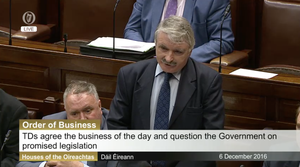
Fianna Fáil TD Willie O’Dea asked Taoiseach Enda Kenny if he found it acceptable that “a solvent, profitable company in this country, can change and close down a defined benefit pension scheme, on a whim – to the detriment of their pensioners and deferred pensioners”?

Readers will note that Mr O’Dea didn’t specifically name Independent News and Media (INM) and neither did Mr Kenny in his reply to Mr O’Dea….

Willie O’Dea: “There’s an implied recognition in the Programme for Government that the pension problem in this country needs to be dealt with. Now, can I ask you: do you find it acceptable that a solvent, profitable company in this country, can change and close down a defined benefit pension scheme, on a whim – to the detriment of their pensioners and deferred pensioners and there is no provision in Irish law to deal with it. Can you tell me when such a provision will be put in place?”

Enda Kenny: “There is no law, no legislation governing this, in respect of Ireland. As you know, there are two defined benefit pensions in respect of the case that you’re probably referring to. In Britain, they have a defined benefit which is based upon levies and only becomes of, only becomes, is only used when the company involved becomes insolvent. The measure, company, we refer to now, is not insolvent. This is a matter in respect of defined benefit contributions that has caused quite a difficultly, a number of difficulties, over the period. Obviously, the last actual certificates filled by defined benefit schemes with the Pensions Authority show that over 60 per cent meet the standard and the remaining schemes had recovery plans. And there is concern that the certificates due in the coming months will, however, show significant deterioration.”

“The operation of a pension scheme is, in the first instance, a matter for the trustees of the particular scheme. The minister met recently with the chairperson of the Pensions Authority. He’s asked the authority to report back to him with an assessment of the current overall position in relation to defined benefit schemes. So he will report to the House when that comes back.”

Meanwhile…

screen-shot-2016-12-06-at-15-07-47

Later.

Social Democrats TD Catherine Murphy also raised the matter but did specifically mention INM.

Catherine Murphy: “…Taoiseach, do you now accept that there is a gap in the law that is leaving a group of people, we’re seeing with one company, INM, the Independent newspapers, we’re seeing them – whom have the benefit, mind you, of €130m-plus being written off by AIB and the Bank of Ireland – leaving people who’ve worked in that industry, they’ve deferred their pensions in a lot of cases, leaving them very exposed because of this  gap in the law.”

“There’s an urgency about this and other companies doing exactly the same thing. Taoiseach, do you not see that there is a need for urgent legislation in respect of this gap in the law?”

Kenny: “Well, the point is that, in the UK, there is a pension protection fund which is paid for by levies, but it only comes into use when the company is insolvent and the company you mentioned is not insolvent. Clearly, the…

Murphy: [Inaudible]

Ceann Comhairle: “The Taoiseach, without interruption.”

Kenny: “The minister has met with the chairman of the Pensions Authority. He’s asked him to report back on the issue of defined benefit pensions. The situation that will arise over the coming months and coming years, obviously, we’ll deliberate on that when he, when he has that report back…”

Earlier: ‘You Can’t Take It With You’

wyghbtf9screen-shot-2016-11-30-at-10-25-18

From top: Irish Times Health Correspondent Paul Cullen; Independents 4 Change TD Clare Daly and health correspondent at The Irish Times Paul Cullen

You may recall the publication last week of Judge Maureen Harding Clark’s report on the symphysiotomy redress scheme.

And some of the subsequent criticism of both and the report and the media coverage of the report.

Senior lecturer at Birmingham Law School, Mairéad Enright wrote:

[Judge Clark’s report] is not the independent report survivors of symphysiotomy are entitled to under human rights law. The media have read it as diminishing SOS’s claim that the non-emergency substitution of symphysiotomy for Caesarean section without consent, as practiced in Ireland, violated many women’s human rights. However, this coverage has been insufficiently critical of this report.

“…It is a mistake to think of the story of symphysiotomy as one about ‘bad doctors’. It is a story about bad systems of knowledge, and bad cultures, which corner women, induce compliance, deny their autonomy and thereby wound them. Those cases are extraordinarily difficult to litigate because the assumptions which drive the old system persist in judicial reasoning and are exacerbated by an adversarial framing.”

“Outside the courtroom, we can find the same problems. What is striking about this report is that it uses constructs from those systems and cultures – valorising reproduction however painful, stoking a suspicion of women who claim their human rights, privileging medical literature over first person testimony – to silence protest. It deserves closer, and more critical reading and discussion.”

Further to this.

Yesterday, Independent 4 Change TD Clare Daly and Anti Austerity Alliance TD Ruth Coppinger raised Judge Harding Clark’s report and the media coverage – with Ms Coppinger naming Irish Times journalist Paul Cullen.

Clare Daly: The Harding Clark report into the symphysiotomy redress scheme has been described as deeply skewed, profoundly unfair, subjective and selective, intellectually dishonest, morally bankrupt, replete with false allegations, omissions, distortions, misrepresentations and contradictions, and biased throughout. Those who said that are being soft on Judge Harding Clark whose report cannot go unchallenged or uncorrected. She goes way beyond the terms of reference of her assessor report to the Minister for Health when all she was asked to do was deal with the activities and expenditure of the scheme. Instead, she deviated into personal and unsubstantiated commentary, which is highly inappropriate in the context of outstanding litigation. Her report is riddled with false allegations, such as alleging that leading campaigners against symphysiotomy had alleged they had the procedure when they had not. That is completely and utterly untrue.”

“The only interpretation one can draw from this report is that it is a defence of the uniquely Irish practice of non-emergency symphysiotomy. It serves to diminish survivors’ claims and is a further violation of those women’s human rights. Symphysiotomy as practised in Ireland is a human rights abuse and that is the case regardless of this report. There can be no denying that the State has been culpable in this but rather than address these matters honestly, the report has served to diminish the suffering caused and undermined the experiences of the women. There is a continued suggestion that the women were lying. Nobody who met these women could ever believe that.”

“Of course, Judge Harding Clark met hardly any of them. It was a paper review with no right to appeal any of her decisions. It was her opinion and her opinion only. It is hugely traumatic for the women involved that this horrific report has been published. I believe the Minister needs to intervene to have it withdrawn. It is hostile in its tone and it smears and discredits survivors rather than dealing with a bad and deliberate policy and a poorly-administered scheme. It needs to be withdrawn and we need clarification on this matter.”

Ruth Coppinger: “I, too, have been absolutely appalled by the media coverage and the commentary of certain people in the media in the last week in response to this report. I agree that the methods of assessment were defective. I agree with Deputy Daly on the policy of Judge Harding Clark of taking oral evidence and meeting only a handful of the women involved. If she had met more, she would have seen for herself some of the injuries and limping, etc., that these women endure. Using contemporaneous radiology in one particular case, the judge stated that a 2004 X-ray did not show injuries to the women and that therefore the injury had happened afterwards. The judge went way beyond her brief, showed her own bias and showed contempt for these women. I believe it is absolutely vital that this Dáil and the Government agrees to set aside time to have a proper analysis of this report.”

“There are a couple of myths that the report tries to knock down. The first is that symphysiotomy was a normal procedure practised in many countries, as argued by Paul Cullen, for example, in The Irish Times. In 1944, there were four of these operations in the national maternity hospital. In 1948, there were 43. That was because of the arrival of Dr. Alex Spain, an arch-Catholic, as head of the hospital, who refused caesarean sections and said that their result would be contraception, the mutilating operating of sterilisation and marital difficulty. It is utterly wrong to say that. They also argue that symphysiotomy was not dangerous. Clearly, it was. It was not a benign procedure. It was not used in other countries as a first resort; it was used as a last resort. This is the third whitewash report there has been. It is a disgraceful indictment of the system that it does this to women who were brutalised in Catholic Ireland of the past.”

Later

Daly: “I have to say that there has been a certain rewriting of history again. We know that the majority of survivors never accepted this redress scheme to begin with. The Minister of State is dodging the key elephant in the room, which is that this report goes one step even further from that. It is riddled with factual inaccuracies, unverifiable anecdotes and is severely damaging. It is well known that people experience trauma and upset as victims of abuse if their stories are not believed. The report is done in a manner which disbelieves the testimony of the women involved. It makes outrageous claims. We know that not one woman anywhere submitted that she had consented to or was aware of that procedure, yet the judge said that she found it very difficult to believe that is the case. There is no evidence to support her view in that situation. This is the same judge who, when awarding payments previously, told the women they were getting the money to redress their “unhappy experience”. This was deliberate butchery that was carried out on people for ideological reasons.”

“What the report shows is a deliberate undermining of the human rights campaigners and groups whose work actually led to the setting up of this scheme to begin with, bad and all as it is. I remind the Minister of State that it took a former Minister to go to court to get the Guerin report withdrawn. We know the McAleese report into the Magdalen laundries was hugely criticised and controversial. The point that is being made here is that this document cannot stand. In and of itself, it abuses the women involved. It has to be withdrawn and considered further by this House.”

Coppinger: “There has been an attempt by the Catholic right to seize on this highly flawed report to argue against the whole question of Catholic control of maternity hospitals. There is no question that this was done and motivated by a Catholic medical theology. It is also argued very patronisingly that these women did not know the difference between a caesarean section, a symphysiotomy or anything else that was happening to them.I know women were kept in ignorance but I think most women would know if they had their pelvic bones broken.”

“The scheme relied on written and radiological evidence which was extremely unfair because proving a symphysiotomy happened over 50 years ago is incredibly difficult if medical records do not exist. In that sense, the scheme militated against the older women and some younger women were able to pursue their claims successfully. The fact there were 185 unsuccessful applications does not mean that 185 symphysiotomies were not carried out. As I said, it was difficult to prove. People were also only given 20 days to apply to the scheme which is highly restrictive in the context of gathering up information.”

“There is no way that this Dáil could or should stand over this report. A debate must take place in this Chamber to question the rationale of Judge Harding Clark.”

Transcript: Oireachtas.ie

Notes on Judge Harding-Clark’s report on the symphysiotomy payment scheme (Mairead Enright, Human Rights in Ireland)

Pic: Paul Cullen

82829932_036-1

Shane O’Farrell

You’ll recall the case of Shane O’Farrell.

The 23-year-old, from Carrickmacross, Co Monaghan, was killed in a hit-and-run by Zigimantus Gridziuska, on August 2, 2011.

Gridziuska was on bail for several offences at the time and was on suspended sentences in the Republic and the North which should have been activated prior to the incident.

He pleaded guilty to failing to stop, report or remain at the scene of the crash and he received an eight-month suspended sentence in on February 28, 2013, on condition that he leave the country within 21 days.

Judge Pat McCartan, at the Circuit Criminal Court in Dublin, gave Gridziuska the choice of serving the with months or leaving the country and he chose the latter.

During the sentencing of Gridzisuka, Shane’s mother Lucia O’Farrell claims Judge McCartan asked if there was anything coming up in the pipeline for Gridziuska and that the State solicitor failed to notify the judge that – over the five months before Gridziuska’s trial – a file had been prepared in relation to insurance fraud charges against Gridziuska.

Ms O’Farrell repeatedly requested for this file to be compiled and completed so that it could be included in the proceedings of the case of dangerous driving causing death. However, it wasn’t.

On March 6, 2013 – just days after he was ordered to leave the State within 21 days – Gridziuska appeared in Carrickmacross District Court for insurance fraud and he was jailed for five months by Judge Sean MacBride in relation to three policies of insurance fraud, one of which covered the day on which Shane was killed. Judge MacBride also banned him from driving for ten years.

Further to this…

GSOC has been carrying out an investigation into Shane’s case for the past two and a half years.

On September 28, 2016, in the Dáil, Fianna Fáil TD Jim O’Callaghan raised Shane’s case and said:

“If the GSOC report comes back, I will be holding her to what I believe should be an agreement that the family deserves an inquiry if the GSOC report indicates there are further matters that merit investigation.”

Further to this, Sinn Fein’s leader Gerry Adams raised Shane’s case during Leaders’ Questions in the Dail today while Shane’s Mrs O’Farrell was in the gallery watching on.

He explained the details of Shane’s case and mentioned that he had given Taoiseach Enda Kenny a file about the case – before the summer recess.

Mr Adams had the following exchange with Taoiseach Enda Kenny.

Gerry Adams: “You might tell me that the Justice Minister has Shane’s case with GSOC but it’s been there four and a half years and no result yet. The case, Ceann Comhairle, is multi-dimensional, shocking and sickening at every turn, it merits a proper statutory investigation, Taoiseach. Will you commit to this please?”

Enda Kenny: “I recall when this accident happened, Deputy Adams. Nothing that I can say or do will bring back Shane O’Farrell and I’m happy to see his mother [Lucia O’Farrell] in the gallery today. I’ve read the file that you gave me. I’ve read the other extensive files that exist in this case. I am aware that there is a civic action against the State and that GSOC have been carrying out an investigation on this. I feel that, that I would like to meet Mrs O’Farrell and hear her story myself. And I will do so from a humanitarian point of view. There are processes that are always followed; nothing will bring back Shane O’Farrell whom I understand was a brilliant young student. So, I know the MInister for Justice answered questions on this recently, I think to Deputy [Jim] O’Callaghan and she indicated, as she had met the family herself, as indeed many have, that she would like to be in a position to have the response of GSOC and that that work was well advanced. Though, as you point out, it’s been going on for quite a while. My understanding from that is that GSOC wish to interview a number of other gardai and that the Minister would be prepared to follow through with whatever the recommendations of GSOC were. This is a very sensitive and sad situation for the O’Farrell family and I’d like to think, that the very least we can do is have every possibility examined so that Mrs O’Farrell, Shane’s mother and his sister, can be an at least, know that the situation was examined in the way that it should be. Thank you for giving me the file which I read and for your question, I’ll make arrangements to meet with Mrs O’Farrell when I have an opportunity.”

Adams: “I thank you, Taoiseach, for your response and I thank you particularly for agreeing to meet with Mrs O’Farrell. This was a young lad, as you say, he was 23, he was a brilliant student at Trinity, he was about to start work at the European Parliament and he was a fluent Irish speaker. He was a gentle, young man with a bright, bright future. And Lucia, and Jim [Shane’s father] have been robbed of their pride and joy. He was their only son. But this case goes beyond his tragic death. It reveals, in my opinion, a series of grievous flaws in the management and response by the justice agencies. There are 59 complaints with GSOC in relation to Shane’s case but nothing to show. Four and a half years later, and this delay is causing ongoing trauma to his family. And I’m sure that you agree that all citizens must have confidence in our justice systems and, of course, all systems have their failings. But we all have a duty to ensure that they are of the very highest standards. As you say, Shane O’Farrell can’t be brought back, but his family can get justice. So I thank you for your reply, I thank you for your agreement, as I’ve said, to meet with Shane’s mother. But Taoiseach, they have asked for a statutory inquiry, will you agree to that? Or, failing that, today will you agree will you make your position known on this issue after you’ve met with Mrs O’Farrell and can you do that as quickly as your busy schedule will allow?”

Kenny: “Yes, I will make my views known and I will arrange to meet Mrs O’Farrell as soon as I have an opportunity. I would say that this is one of over 200 cases where people feel very grievously hurt on a range, a very broad range of issues across many years. And a review panel was set up to look at all these cases including the tragic death of Shane and that consisted of two senior and five junior counsel who are very experienced and the recommendation that they made was to take no further action. Now, I’m not a senior counsel but my job in politics engages me with so many people. I read this file and I will meet Mrs O’Farrell and I will make my views known. I’d like to think that the GSOC inquiry is, you know, practically complete. That’s my understanding. But that’s not of any value to people who say ‘I’ve been waiting for so long without any clarity as to when I’m going to have, I’m going to have a completed document’. The Minister for Justice did say, I’d like to get that, and I’d like to, you know, decide what the best option is arising from that report. I have no input obviously into the civic action as for a person’s right to take a case against the State. But I will meet Mrs O’Farrell because I want to meet her on a humanitarian basis. This is one of a number of very tragic cases and, as I say, nothing will bring back Shane O’Farrell.”

Previously: ‘Delay, Deny, Lie, Then Cover-Up’

O’Callaghan transcript: Kildarestreet.com

screen-shot-2016-10-05-at-12-27-57

screen-shot-2016-10-05-at-12-19-15

Further to Independents 4 Change TD Clare Daly’s interview on Morning Ireland this morning in relation to the treatment of Garda whistleblowers and, during which, she called for the resignation of Garda Commissioner Noirin O’Sullivan.

The matter was raised with Taoiseach Enda Kenny during Leaders’ Questions in the Dáil today.

Mr Kenny had the following exchanges with Sinn Fein TD Mary Lou McDonald and MS Daly.

Mary Lou McDonald: “You say the minister [for justice Frances Fitzgerald] will reflect on these matters and decide what to do. I understand that the minister has in fact been in possession of correspondence for some months. I understand that the minister actually failed to respond to a number of Garda whistleblowers. Can I ask you Taoiseach, who’s in charge here? Is the minister in charge? Is the commissioner in charge? Who is accountable for these practices? Who is accountable for the smearing and targeting of Garda whistleblowers. Do you have confidence Taoiseach in the commissioner? Do you have confidence that she is discharging her duties fully and faithfully. Do you have confidence in her capacity to protect whistleblowers? And I would ask you the same question of your minister, Minister Frances Fitzgerald.”

….

Enda Kenny: “I haven’t seen the correspondence that the minister received, nor should I because it was sent to her [France Fitzgerald] under that [the Protected Disclosures] act.I assume that the information, contained therein, needs to be examined and needs to be reflected upon very carefully becaue it is very serious.”

“Otherwise, it wouldn’t be received under that section of the act. Somebody’s got to do that Deputy [Mary Lou] McDonald and I would expect that that would be, or certainly that that could be a member of the judiciary who will examine the contents of the document received and see whether they stand up or whether they don’t.”

“Obviously, out of that, out of that comes a decision about what action might or might not be taken. I’ve already said I’ve absolute confidence in the Minister for Justice and the Garda Commissioner, I don’t have any reason not to.”

….

Clare Daly: “Taoiseach, you might have got away with that response to deputy McDonald, if you could call it a response, if this was an isolated incident of mistreatment of whistleblowers and I note that you’re confidence in this minister and the commissioner are a bit like the time you gave 100% confidence to the last two before it went to zero overnight.”

“Now, exactly two years ago this week, I put it to you that a Garda whistleblower in the Midlands region had come forward with serious information regarding Garda involvement in the drugs trade. Information which was indisputable.”

“Now that individual Nick Keogh has subsequently been vindicated by an internal Garda inquiry which supported his allegations in that regard. And yet, two and half years on, this whistleblower has been out sick for almost a year, he’s surviving on just over €200 a week. He’s had five internal investigations drummed up against him. Medical certificates admitted saying he was out with work-related stress were changed to absence from flu, while the Superintendent who stood over all of that is on the promotions list.”

“Now you were twice approached by a Garda in that division and warned about a senior officer who failed to deal with complaints in that area and twice, since you were approached, that senior officer has been promoted. Including, being handpicked by the Commissioner for a high-profile job in the Phoenix Park, despite three complaints against Garda whistleblowers against him.”

“Four times, one of the Garda whistleblowers wrote directly to your Minster for Justice and told her of the treatment he was experiencing. He made the point that, as his colleague in a different region was getting exactly the same treatment that it couldn’t be a coincidence and it was inconceivable that senior management and the Garda Commissioner would not be aware of it.”

“Nineteen times myself and Deputy Wallace have raised what has been happening to whistleblowers Nick Keogh and Keith Harrison, who’s out two years surviving on a pittance with a young family. He’s post has been opened. Garda patrol cars cruising down a lane where he lived 25 kilometres from the nearest Garda station. The HSE called to his kids – all on Commissioner O’Sullivan’s watch.”

“So, really, how many examples do you need to be presented to you in terms of the gulf between the public statements of the Commissioner and her private actions in relation to dealing with whistleblowers before you’re going to act. Your minister has had [inaudible] from the O’Higgins commission. She’s had the Section 41 complaint from the civilian head of An Garda Siochana and, most shockingly, she has had a protected disclosure of two senior gardai outlining systematic, organised, orchestrated campaign to not just discredit a whistleblower but to annihilate him with the full involvement of the present and former commissioner. So I want to ask you, Taoiseach, is very simple. What in God’s name do you need another investigation for? Is it not patently obvious that it’s beyond time for the commissioner to go?”

Kenny: “Well, the question here is in respect of the, of the information received under the Protected Disclosure Act and that has been received by the Minister for Justice. She has to assess that and appoint a person of competence to deal with it. As I say, whatever is in that documentation, either stands up or it doesn’t. And in that regard it is a very serious matter. The powers of GSOC are there for all to see, the justice has requested that those powers be extended and the minister is considering that. The Independent Police Authority itself has been asked for its views on, on the treatment of whistleblowers and those in the gardai who made disclosures known about wrongdoing or alleged wrongdoing. From that point of view, as I said, whistleblowers should not be in the position that you outline here for two members of the gardai and, obviously, if these investigations have been taking place, whether by GSOC or internally, this matter has to be concluded. Whistleblowers have always provided a valuable service in the public interest and I respect that completely and will defend it. In the case of the most recent documents received by the Minister for Justice , we’ve got to deal with that by appointing a person of ability to go through that documentation and assess whether or not the contents of it stand up or whether they don’t. And I expect that the minister will make an announcement about that very soon, Deputy Daly.”

Daly: “You tell us that whistleblowers shouldn’t be treated poorly and you’ll respect and defend that but you must have a different interpretation of her respect and defence than I have. Because you have been presented with evidence, and your minister has, over a period of two and a half years, that that has not been the case.”

“You tell us that GSOC has the powers that the powers are there for all to see. The powers are not there for all to see, even GSOC have said they don’t have the powers to deal with this situation. Does it not seem odd to you, minister, or Taoiseach, when you listen to the commissioner this morning, when she says that the gardai is an area where she wants to encourage whistleblowers to come forward despite all of the evidence that these people have been mistreated.”

“So, could you maybe tell me this? If the commissioner herself is not directly involved in that harassment, do you not have a problem that her authority is so discredited that instructions she has allegedly given – for whistleblowers to be protected – are being wholesale ignored across the ranks of An Garda Siochana, because that is the evidence that is being presented to your minister over a whole period of time.”

“So if you mean what you say, and you really do really respect and defend whistleblowers, you’d be answering very differently because you’d actually be doing something rather than just talking about it.”

Watch Dáil proceedings live here

Earlier: “Word Came Down From The Top That He Be Crushed”

Previously: When The Whistle Blows

‘They Tried To Blame Maurice For Everything. It Was Bullshit’

Clarifying Matters

The Thin Blue Timeline Updated

screen-shot-2016-09-27-at-13-24-00 ctwxjmywgaasccf screen-shot-2016-09-27-at-13-31-46 screen-shot-2016-09-27-at-13-31-36 screen-shot-2016-09-27-at-13-30-56screen-shot-2016-09-27-at-13-31-09

This afternoon.

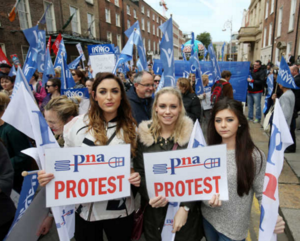
Outside Leinster House on the first day of the Dáil term after the summer break.

Gardaí at the gates of the Dáil.

And members of the Irish Nurses and Midwives Organisation, SIPTU and the Psychiatric Nurses Association calling for “the restoration of incremental credit for nurses and midwives who graduated between 2011 and 2015”.

Those protesting included nurses Maria Phelan, Christine Gibbons and Eimear Byrne from Kilkenny Mental Health Services (above).

Pics: Sam Boal/Rollingnews and Mick Caul (second from top)